
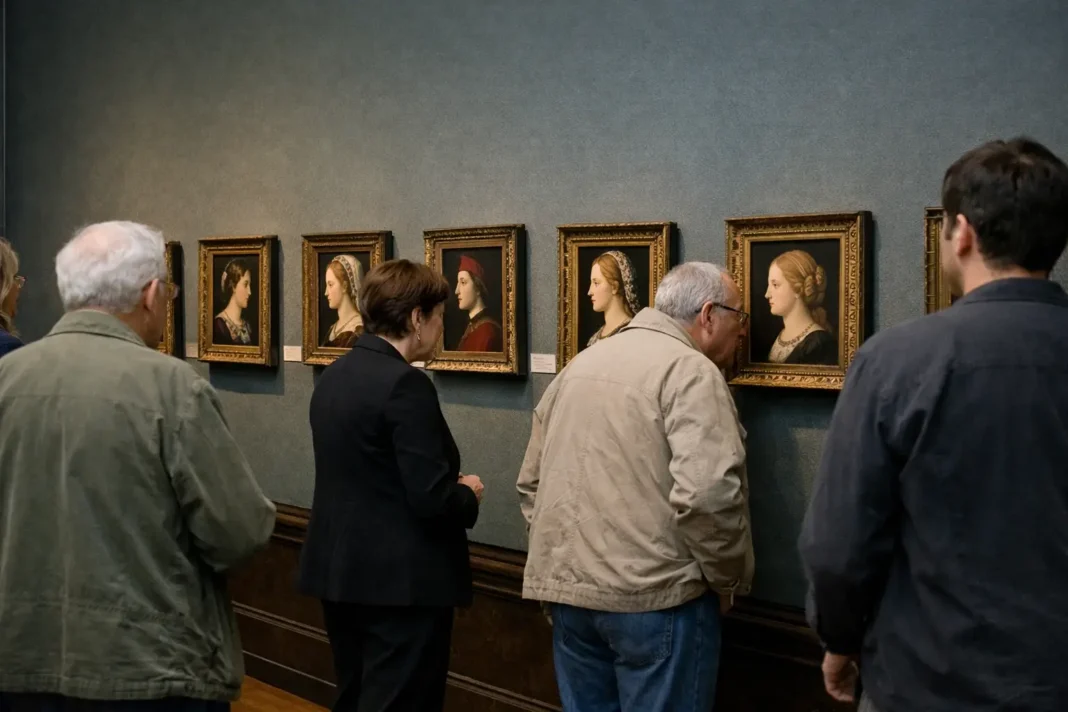

Jan van Eyck’s faces still appear startlingly alive, but the current exhibition at the National Gallery in London shows that their realism is only the beginning. The display gathers 10 surviving portraits by the 15th-century Flemish master, placing rare emphasis on works that are often discussed through their technical brilliance but are equally rich in visual traps, inscriptions and calculated ambiguity.
The paintings are mostly small, close to A4 in scale, and present their sitters with a striking consistency: the viewer sees slightly more of the left side of the face than the right. That repeated format gives the exhibition an unusual intensity. Seen together, the portraits invite comparison not only between different patrons, but between the artist’s methods of persuasion. Van Eyck renders skin, fabric, hair and light with such precision that the eye accepts the image as immediate presence, even as details begin to suggest that the surface is not as transparent as it first appears.
Among the works, the Arnolfini Portrait remains the major exception. Larger, stranger and more complex than the other portraits, it has long occupied a singular place in the history of Flemish art. In this context, however, its difference becomes part of a broader argument: Van Eyck’s portraits were not passive records of appearance. They were objects designed to be scrutinised, owned and interpreted. Their inscriptions, painted frames and material effects create an exchange between painter, sitter and viewer that goes beyond likeness.
The exhibition also gains force from its contrast with another London display: the Barbican Art Gallery presentation of white paintings by the American artist Robert Ryman. Ryman’s square canvases insist on paint as paint, refusing the idea of the picture as a window onto another world. Van Eyck, by contrast, uses the illusion of a window so convincingly that it becomes a form of misdirection. The more natural the image appears, the more actively it asks to be decoded.
For contemporary audiences, the value of the National Gallery’s focus is not simply historical. It clarifies how portraiture helped shape ideas of identity, status and memory long before the modern age of images. In Van Eyck’s hands, the face becomes both evidence and enigma: a carefully made encounter in which realism, devotion, vanity and wit remain inseparable.






