

There has always been a tension in landscape representation between observation and idea, what is seen and what is imagined, and the physical terrain and the cultural desire projected onto it.
In the case of the Land of Israel, this tension becomes particularly charged: the landscape is never simply “there.” It is read, remembered, interpreted, and often already imbued with historical, biblical, ideological, or emotional meaning before a brush even touches the canvas.
Within this long tradition of projection and reinterpretation, Yehuda Armoni’s work emerges as a contemporary return to observation, rooted, disciplined, and resistant to excess symbolism, yet fully aware of the historical weight the landscapes he depicts carry.
The 17th-century Dutch painter Samuel van Hoogstraten, in his 1678 treatise Introduction to the Academy of Painting, recounts a story told to him by his teacher, Rembrandt.
In 1630, the Guild of Saint Luke in Leiden hosted a two-day competition between three landscape painters, each embodying a different approach: “Usus” (practice), “fortuna” (luck), and “idea” (concept).
The third painter, Jan Porcellis, utilized only a fraction of the allotted time yet triumphed over his colleagues. The conclusion was decisive: the “idea” holds more weight than laborious craft or mere chance.
However, a more elusive and critical point remains: none of the three artists looked at nature during the competition.
One is left to wonder: Where is the direct, seemingly innocent observation that would later become the hallmark of 19th-century French painting?
And to the larger question: What exactly is an “Israeli landscape?”
Is it the Tower of David in Jerusalem, a kibbutz water tower, a roof crowded with solar heaters, or the Roaring Lion monument in Tel Hai?
Since I am a fundamentally wicked person and far less romantic, I would suggest that an “Israeli landscape” is also a street in Mea She’arim with a sign that reads: “Women are requested to cross to the opposite sidewalk.”
There has always been a tension between depicting a concrete landscape and an idyllic or imagined one, between reality and idea.
It is therefore possible that the Israeli landscape is primarily a cultural construct rather than a physical description of place.
Rembrandt and Eugène Delacroix, both of whom painted Jesus on the Sea of Galilee, never actually saw the scene they depicted. Yet their imagined storm became part of the place’s visual memory.
A landscape can be beautiful, functional, symbolic, or ideological. Prof. Boris Schatz, the founder of the Bezalel Academy of Art and Design in 1906, trained his students to produce decorative representations of holy sites – the Western Wall, Rachel’s Tomb, the Tower of David, and even carpets woven with such motifs.
In his view, the role of the artist was to construct a unified national image, to “publicize the soul of the nation.”
Early influences
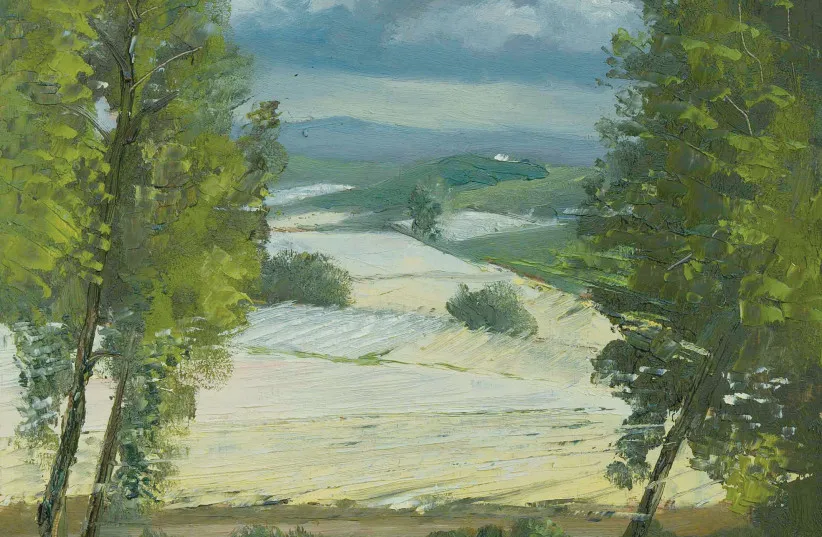
Early influences on the first generation of painters included Paul Cézanne and the School of Paris. Some, like Reuven Rubin, also absorbed Henri Rousseau’s naive painting, producing dreamlike landscapes of Jerusalem and the region, suspended between observation and invention.
Rubin’s Jerusalem is usually bathed in a conceptual, radiant light that few of us experience in reality.
The painters of the 1920s sought to depict a fertile, blooming land, yet their gaze was often filtered through ideology and expectation.
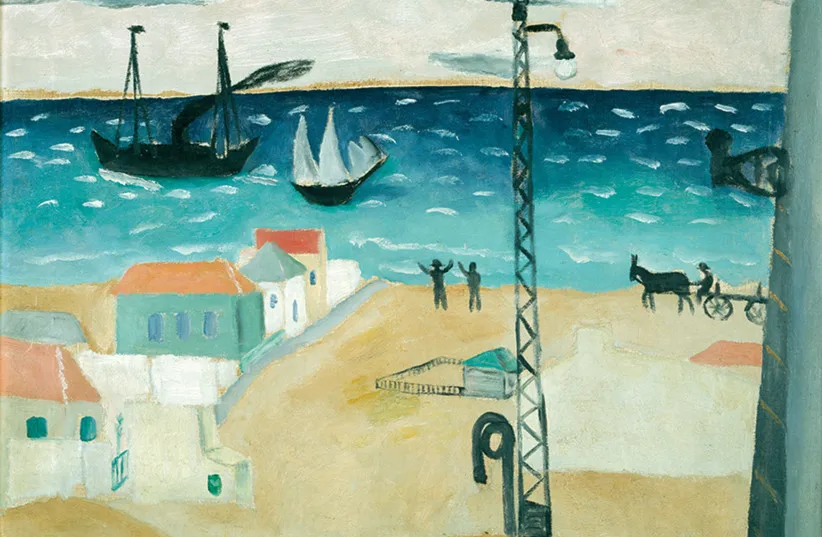
Perspective became secondary to narrative. Reality itself was frequently staged through the artist’s eye. From Shimshon Holzman’s camels in the Yarkon to Nahum Gutman’s Jaffa scenes, Israeli landscape paintings absorbed the social and the local into the visual field.
Even marginal urban details became compositional elements. In describing the Jaffa coast, Gutman placed a brothel in the middle of the picture, showing that reality was not free of the artist’s intervention or humor.
Progress entered the frame as well: zeppelins over Tel Aviv, and the visual tension between pastoral ideal and technological intrusion.
Siona Tagger depicted the technological leap in Palestine (the Land of Israel) through the smoke-billowing train racing between Jaffa and Jerusalem in 1928.
Ludwig Blum turned to monumental, luminous views of Jerusalem and the Dead Sea, the place where Moses was last seen. At the same time, Yohanan Simon embedded ideological life into kibbutz landscapes, such as Sabbath in the Kibbutz.
Joseph Zaritsky gradually moved from observation to abstraction, dissolving landscape into color fields as one of the founders of the New Horizons movement.
While his 1928 Jerusalem shows clear houses and donkeys, his 1951 Yehiam celebrates total abstraction with vibrating patches of color.
Zaritsky achieved this “liberation” from reality by painting large oils in the studio based on small field watercolors.
In 1973, the Climate (Aklim) group was founded, featuring painters like Eliahu Gat and Ori Reisman. They blurred the boundary between body and landscape, viewing literal realism as anachronistic.
Gat painted “fleshy,” impasto-heavy landscapes of the Galilee influenced by Chaïm Soutine, where it was not always clear if the subject was a woman’s body or the rolling hills.
Reisman, influenced by the School of Paris, focused on flat patches of color and minimalist country landscapes using primary yellows.
Liliane Klapisch, a French-born painter in Jerusalem, prefers to describe intimate, banal corners, trash cans, power poles, and construction sites, isolating the spiritual from the ordinary as an allegory for the act of creation.
Return to realism
Later generations oscillated between abstraction and a return to realism. Artists such as Eli Shamir, Israel Hershberg, David Nipo, and Uri Blayer reintroduced direct observation.
Shamir, despite being told at the academy that figurative painting was “dead,” beautifully depicted the haze of the Jezreel Valley and his agricultural parents at work in the fields.
His paintings are layered with biblical past, evoking the battles of Deborah and Yael near Tel Hazor, and his own family history. Nipo continued to paint in the Gaza border communities even as missiles passed overhead, capturing the pastoral beauty of fuel tank farms that simultaneously hint at ecological threats.
Blayer, carrying heavy canvases like a modern-day Samson, focused on the play of light on rocks in the Negev and Judean Deserts, and even rare subjects like the Roman camps at Masada.
Ilan Baruch often paints landscapes with prickly pear cacti, touching on sensitive issues of identity and the Sabra ideal.
The “problematic” choice of the sabra as our symbol stems from the fact that it was introduced by the Arabs, who, in turn, brought it from Mexico.
Gal Weinstein created The Jezreel Valley Carpet and Nahalal out of felt, representing the mythic landscapes of Zionism as floor installations.
Sigal Tsabari captured the poetics of the urban landscape in Rishon Lezion, finding surreal beauty in backyards and rooftops, such as a violin maker drying his instruments on a laundry line while doing a handstand.
Across these approaches, landscape remains unstable: sometimes ideological, sometimes intimate, sometimes abstract, sometimes insistently literal.
So perhaps landscape is not what is there, but what is chosen to be seen. A new exhibition of Armoni’s work, The Pattern of His Homeland’s Landscape, is about to open at Rothschild Fine Art in Tel Aviv.
Bound to his homeland
“Man is nothing but the pattern of his homeland’s landscape,” wrote the poet Shaul Tchernichovsky about the deep connection between a person’s character and the landscapes of their childhood and early experiences.
What a pity that when writing these beautiful words, the Russian poet envisioned the steppes of the Crimean Peninsula, and not the Land of Israel.
Regarding his first impressions of the Holy Land, where he spent his last 12 years, he wrote with disappointment: “Oh my country, my homeland! A bald rocky mountain.”
Despite this, Armoni’s paintings of the Israeli landscape might have offered even Tchernichovsky a different kind of belonging. One thinks, in particular, of the monastery at Latrun, the Church of Our Lady of the Seven Sorrows, known locally as the Monastery of the Silent.
And indeed, in the spirit of Tchernichovsky’s line, Armoni is deeply bound to his homeland, not only through his long military service of roughly 25 years, but also through his painting and his family roots.
He is a descendant of the Castel family (Castel in Hebrew is “armon” – hence Armoni), who arrived in the Land of Israel after the expulsion from Spain over 500 years ago.
Let us return to the paintings. Armoni specializes in landscape. Some may argue that there are more spectacular landscapes in the world, such as the groves of Tuscany and Umbria, the Grand Canyon, Niagara Falls, the fjords of Norway, the glaciers of Antarctica, or the caves of Belgium.
Yet for many, there is no substitute for the landscapes of this small country: the Sea of Galilee, the Dead Sea, Masada, the Ramon crater in the Negev, Solomon’s Pillars, and more.
Armoni is drawn not only to monumental biblical sites, but also to what might be called “trivial landscapes” (a term coined by Dr. Smadar Sheffi): Ben Shemen Forest, Latrun, Canada Park, the Ayalon Valley, and the Lachish region.
And just as we do not know why Johannes Vermeer spent months painting a maid pouring milk, it is equally difficult to explain Armoni’s repeated return to the same motifs, such as grapevines wrapped in plastic. The muses, perhaps, know.
In its early days, landscape painting was considered inferior to the other genres. In the Italian Renaissance, the landscape does not serve as a subject, but appears only as a background for paintings such as Madonna and Child.
In contrast, already during that period, Flemish painters like Bruegel dedicated entire paintings to landscapes. But even these panoramic paintings still contained human figures and were not painted purely as landscapes.
Painting outdoors
There are many troubles involved in painting in nature: sudden rain, winds (that blow the canvas away), heat waves, and so on.
A particularly extreme example belongs to Vincent van Gogh: in 2017, the restorer of the Nelson-Atkins Museum, where an oil painting of his depicting an olive grove (1889) was displayed, discovered a grasshopper in the heart of the painting, which apparently found its way to its burial place while the paint was still wet, and could not escape.
And indeed, already in 1855, Van Gogh described in a letter to his brother Theo his frustration with his attempts to paint landscapes in the bosom of nature.
“When I sit outside and try to paint, a hundred flies suddenly come, not to mention the sand and the dust,” he wrote.
Armoni is indeed happy to join Van Gogh’s club, but he says that he is mainly attacked by swarms of gnats while painting outdoors. Landscape painting, it turns out, is not merely standing in front of the expanse, but also a stubborn confrontation with what lives and moves within it.
The researcher Dr. Mimi Haskins compared Armoni’s paintings to poetry by the likes of Wislawa Szymborska, Leah Goldberg, Tal Nitzán, Natan Zach, and Natan Alterman.
To me, the paintings are no less close to familiar songs, those we are able to hum without knowing when we learned them. Perhaps because of this, facing the vegetation and blossoming in his paintings, it is not a text that sneaks into memory, but a melody.
When I observe the paintings, three songs play within me: “The Green Mountain Always” (Yoram Taharlev and Moni Amarilio), “Green Fields” (performed by The Brothers Four), and the wondrous song by Georges Brassens: “Oh, in the Wood of my Heart,” better known to us in Ehud Manor’s translation and Corinne Allal’s voice: “Somewhere in the heart, a flower is blooming.”
One of the two largest paintings in this exhibition is called Capriccio. This is a term that reminds us, and not by chance, of the word “caprice” (“whim” in Hebrew).
In painting, the term refers to the depiction of a place that is completely Srealistic and sometimes even familiar to the viewers, but at the same time is devoid of any concrete hold on reality.
Meaning: the place in the painting simply does not exist, and the creative assembly of elements from reality creates it; a connection of what is not truly connected, but could have been.
There is no doubt that great audacity, and some would even say pretension, is required to try to improve the works of the Creator. However, this phenomenon certainly exists and is documented in the history of art.
In 17th-century Holland, the painters Hercules Seghers and Jan van Goyen were particularly prominent in this genre. Seghers, in his “fantastic landscapes,” used to divert rivers from their course with his brush or add church spires where none had been, all for the sake of creating a more interesting picture.
Three 18th-century Italian painters, Canaletto, Francesco Guardi, and Giovanni Paolo Pannini, also contributed to this genre.
The first two worked in Venice, while Pannini worked mainly in Rome. Pannini’s favorite landscapes included ruins and buildings from antiquity, and he created paintings in which one could see, in a single place, the Colosseum, the Arch of Constantine, Trajan’s Column, and the Pyramid, which is actually located at the other end of Rome.
Young travelers, especially among the English nobility, loved this capricious genre. They were frequently sent on an educational cultural journey, the “Grand Tour,” to the sources of classical culture.
And so, instead of buying a picture as a souvenir from every site that impressed them, Pannini assembled for them in one beautiful picture, with meticulous attention to the laws of perspective and details, everything they wanted to bring back with them to England.
Let us return to Armoni. Until now, he endeavored to depict with great faithfulness and out of internal integrity exactly what his eyes saw in the nature before him.
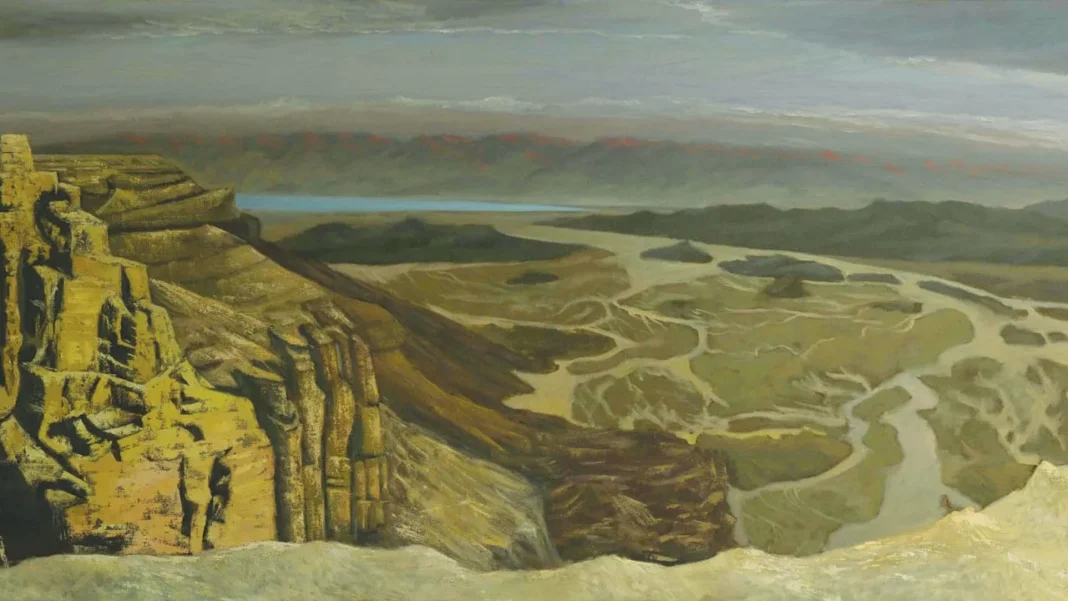
However, in his panoramic and impressive Capriccio, he deviates from this habit. Seemingly, a view of the northern Arava, the mountains of Edom and Moab, the Dead Sea, and some primordial cliff, perhaps somewhat reminiscent of Masada, is revealed to our eyes.
But, in truth, Armoni borrows elements from different places (mainly Timna Park and Ramon Crater) and constructs a new landscape from them, which cannot be found in reality, a sort of act of creation.
On process, technique, and image
Much has already been written (especially by Dr. David Graves) about Armoni’s use of the sfumato technique, and also noted regarding the importance of the small paintings done in the field in the bosom of nature.
For comparison, the painting Quarry in Lachish, exhibited for the first time in this exhibition, was created in a three-stage process: a quick painting in a small format (20 X 20 cm.) in nature, then a medium-sized painting (40 X 40 cm.), and finally, a studio version measuring 100 X 100 cm.
The unique aspect of Armoni’s painting is that the quarried area, painted in bright white, looks exactly like a painful wound in the landscape.
In another painting in the exhibition, Monster Rock, Armoni went through an interesting process. He says that initially, he did not notice that the rock he was painting could or might resemble the head of a monster. Could it have been a hungry lion dozing by the roadside, waiting in ambush for innocent pedestrians?
From this late realization, a surreal dimension was added to the realistic picture, alongside an invitation for the viewer to engage in interpretations and associations.
Well, let me take you on an associative journey, one of many possibilities inherent in the picture. As we all remember, during the biblical period, lions roamed the land.
It is told, for example, about Samson that he tore apart and killed one of them. However, in our days, the Land of Israel is not abundant with lions unless they are made of stone or concrete.
Let’s examine some of those stone monsters together. First stop: the Lions’ Gate in the wall of the Old City of Jerusalem. There we find four beautiful reliefs of lions, dating from the 13th to the 16th centuries.
Second stop: an anonymous alleyway in Tel Aviv. There, a concrete lioness statue has stood for about 100 years.
Third stop: Tel Hai, with Avraham Melnikov’s famous 1934 sculpture, The Roaring Lion, designed in an Assyrian style.
Fourth stop: a year later (1935), another lion suddenly appeared, this time winged (the symbol of the city of Venice), atop the Italian insurance company building – Generali – in Jerusalem.
And in recent years, it seems the trend has been revived. In the Gaza border communities, for instance, two more lion statues appeared: a roaring lion (between Kibbutz Nir Oz and Magen) and a silent lion (Kerem Shalom).
But Armoni’s lion is the most monstrous of all, because it hides by the roadside, silently ambushing pedestrians, as if it were a gang of robbers.
A large work in the exhibition depicts the Montfort fortress (Montfort, as in “mountain fortress”), an archaeological site from the Middle Ages with the ruins of a Crusader stronghold belonging to the “Kingdom of Jerusalem.”
The fortress sits on a steep spur on the southern bank of Nahal Kziv in the Upper Galilee, near Kibbutz Eilon, about 13 km. northeast of Nahariya.
Built as a refuge for the knights of the Teutonic Order, it was intended not against the Muslim enemy, but against rival Christian military orders in Acre. Over time, the site gained importance, and its inhabitants reinforced and monumentalized its structures.
I am also reminded of a story about a school group that recently visited the fortress. The teacher asked why the Crusaders had chosen such a high location, and one child immediately replied: “Because there is good Wi-Fi reception here.”
In Armoni’s painting, the bright ruins are rendered with clarity and precision. The fortress stands proudly yet in splendid isolation on the cliff, while at the same time it seems to sink and almost dissolve into the surrounding green forest.
No human figure appears in the work. One might have expected a dramatic historical scene, such as a battle between Muslims and Crusaders in the 12th century.
When I asked him about this, he replied: “There’s nothing philosophical hiding behind it. As a tribute to the French painter [Jean-Baptiste-Camille] Corot, eventually, I too will start adding figures to my landscapes.”
We will wait and see.
Dr. Doron J. Lurie is an art historian and was a senior curator at the Tel Aviv Museum of Art. A renowned expert on Rembrandt and art forgery, he is a prolific author, lecturer, and curator.
Source:
www.jpost.com




