
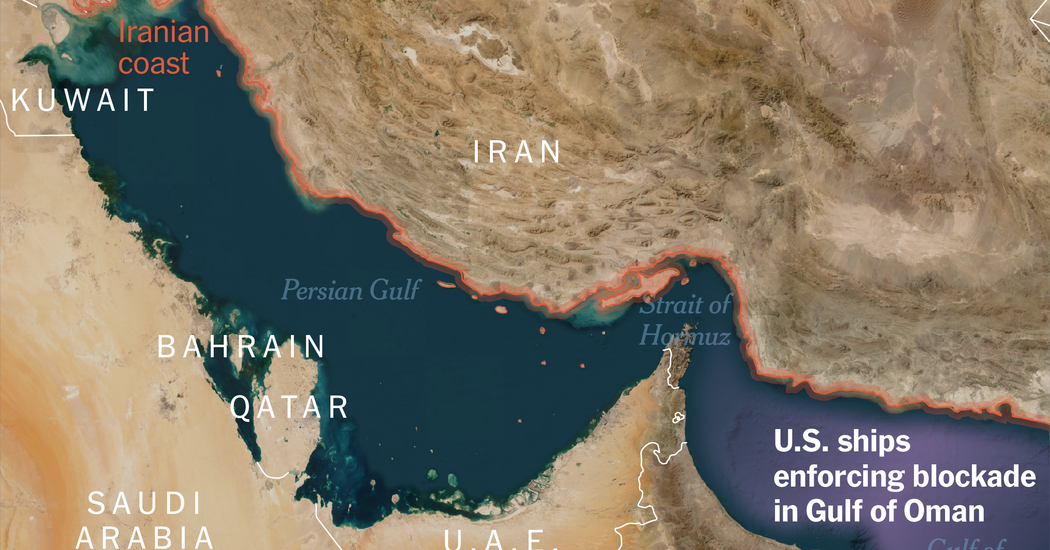

There is huge irony in the fact that a top U.S. priority in its war with Iran is reopening the Strait of Hormuz, which, of course, was open before the war. It’s a measure of the leverage — which has long been theoretical but is now proven — represented by Iran’s geographical control of the strait.
I’ve written about the deterrent power of the strait before. Today, my colleagues in Washington write about what that means for Iran, the United States and the future balance of power in the region.
Iran’s powerful deterrent
By Mark Mazzetti, Adam Entous and Julian E. Barnes
Iran’s foes have long argued that if the country managed to obtain a nuclear weapon, it would have the ultimate deterrent against future attacks. It turns out Iran already has a powerful deterrent: its own geography.
The U.S.-Israeli war has shown that Iran has the ability to shut down the Strait of Hormuz, the strategic choke point through which 20 percent of the world’s oil supply flows.
The shallow strait forces ships to pass within miles of Iran’s mountainous shore, a landscape that favors weapons like missiles and drones that are hard to eliminate completely.
Iran could emerge from the conflict with a blueprint for its hard-line theocratic government to use to keep its adversaries at bay, regardless of any restrictions on the country’s nuclear program.
“Everyone now knows that if there is a conflict in the future, closing the strait will be the first thing in the Iranian textbook,” said Danny Citrinowicz, a former head of the Iran branch of Israel’s military intelligence agency and a current fellow at the Atlantic Council. “You cannot beat geography.”
Iran tried to block the Strait of Hormuz once before in the 1980s, mining both it and the Persian Gulf during its conflict with Iraq. But mine warfare is dangerous — it can take out friendly vessels as well as enemy ones. Drones and missiles are easier to target precisely.
American military and intelligence officials estimate that, after weeks of war, Iran still has about 40 percent of its arsenal of attack drones and upward of 60 percent of its missile launchers — more than enough to hold shipping in the Strait of Hormuz hostage in the future.
Iran’s control over the strait has forced President Trump to announce a naval blockade of his own.
On Friday, Iran declared the waterway open, sending stock markets surging. Then, on Saturday, the country said the strait remained under its “strict control” unless the U.S. ended its own blockade of Iranian ports.
On Sunday, a U.S. Navy destroyer fired on an Iranian cargo ship and ultimately seized it. Iran’s armed forces called it piracy, warning that they would soon retaliate.
“The Strait of Hormuz isn’t social media. If someone blocks you, you can’t just block them back,” one Iranian diplomatic outpost wrote on X last week.
The U.S. is in a precarious position. The strait, which was open before the war, is no longer a fully accessible waterway. Its adversaries have taken notice.
“It’s not clear how the truce between Washington and Tehran will play out. But one thing is certain — Iran has tested its nuclear weapons. It’s called the Strait of Hormuz. Its potential is inexhaustible,” Dmitri Medvedev, a former president of Russia and deputy chairman of Russia’s security council, wrote on social media last week.
Read the full story here.
Iran and the U.S. plan talks in Pakistan
Despite trading threats and issuing mixed messages in recent days, the U.S. and Iran indicated yesterday that they planned to take part in another round of peace talks in Pakistan this week.
Vice President JD Vance is expected to leave Washington for Islamabad today, U.S. officials said. Iranian officials said that Mohammad Bagher Ghalibaf, the speaker of the Iranian Parliament, who attended the last round of negotiations, would take part again.
Iranian officials have publicly expressed skepticism about the prospects for a diplomatic breakthrough as a two-week cease-fire is set to expire tomorrow.
Follow our live updates.
Saudi Arabia dials back its grand ambitions
Over the past 10 years, Saudi Arabia has had some success diversifying its economy. But its dependence on oil has been difficult to overcome.
Crown Prince Mohammed bin Salman’s ambitions to end the country’s “addiction” to oil have grown more rapidly than the government’s finances. And now the war with Iran is increasing the pressure to scale back those plans.
Officials last week announced a new strategy for the roughly $1 trillion sovereign wealth fund, which may include withdrawing financial support from LIV Golf. The fund’s governor said executives would review initiatives to identify “what’s must-have” and to set aside or delay “what’s good to have.”
Over the next five days, take a close look at a great poem: W.H. Auden’s “The More Loving One.” We’ll help you learn it by heart. You can amuse yourself, impress your friends and maybe discover that your way of thinking about the world has shifted a bit.
MORNING READ
Oleksiy Klochkovsky, who delivers parcels for a private postal service in Ukraine, used to keep his eyes on the road. Now, he’s constantly scanning the sky.
Klochkovsky works near the front line. Russian strikes have destroyed three of his trucks, and he has had numerous close calls from shells, land mines and drones. “You look up, you look to the sides, you look for a drone, you look for a missile,” he said. Read about how he stays safe.
Why fashion suddenly loves older women
The most recent round of fashion shows took a giant step forward when it came to one aspect of inclusivity: age.
The Chanel show opened with 50-year-old Stephanie Cavalli, one of 15 models over 40, while 52-year-old Kate Moss appeared on the runway for Gucci.
It’s a striking shift in an industry that has long fetishized youth. Vanessa Friedman, our chief fashion critic, wrote about what’s going on.
These vegan ground meat kebabs are inspired by Turkish street food. They can be served on their own with garlic-dill mayonnaise or tucked into Turkish bread or pita with sumac onions and tomatoes.
WHERE IS THIS?
That’s it for today. See you tomorrow! — Katrin
Mark Mazzetti, Adam Entous and Julian E. Barnes were our guest writers today.
We welcome your feedback. Send us your suggestions at theworld@nytimes.com.
Source:
www.nytimes.com




