
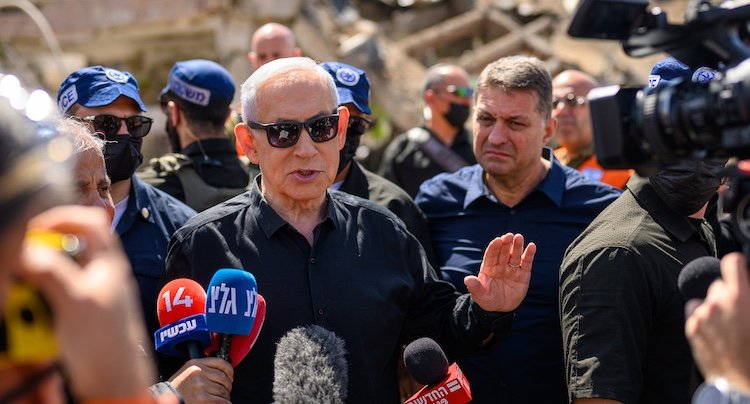

Following Mideast news requires a certain tolerance for the pain of whiplash. Fresh off of Western news cycles built around the narrative that Bibi Netanyahu is somehow puppeteering the Trump administration’s foreign policy, in Israel the prime minister is under fire for being a puppet of the American president.
“A pattern is developing where a cease-fire is being forced upon us — in Gaza, in Iran, and now in Lebanon,” said Gadi Eisenkot, the former IDF chief of staff who has turned to politics. Left-wing opposition figure Yair Golan complained that “instead of leading, Israel is again being dragged.”
The statements echo what former prime minister Yair Lapid said after the Iran cease-fire was announced: “Israel wasn’t even at the table when decisions were made concerning the core of our national security.”
Of course, a year ago, Lapid was making similar comments but casting them as proof of daylight between the U.S. and Israel in a pointed message to Netanyahu: “You lost Trump. Relations with the U.S. have never been at such a low point. The Americans made a deal with the Houthis behind your back without your knowledge. The President met with Syria’s president without your knowledge. He renewed ties with Erdogan without your knowledge.”
A different, and perfectly legitimate criticism of the cease-fire comes from the communities of Israel’s north, who have been left to wonder if the government truly meant what it said about guaranteeing their safety from Hezbollah rocket attacks and occasional incursions. Moshe Davidovich, a representative of front-line communities, put out a blistering statement: “A ceasefire that does not include lethal enforcement against Hezbollah for every violation and a buffer zone free of terror up to the Litani River is not a political achievement; it is a sentence to wait for the next massacre. The residents of the north are not statistics in an international public relations show.”
With election season not far off, then, the political argument against Bibi goes something like this: The prime minister spent a ton of political capital on this latest war, and what did it buy us? Not a permanent solution to any of the threats it was intended to address.
And yet, given the pace of change these days, betting on that message resonating months from now seems risky. One reason for that is the Israel-Lebanon cease-fire itself.
The cease-fire went into effect this evening and will have an initial time period of 10 days. According to the State Department, “This initial period may be extended by mutual agreement between Lebanon and Israel if progress is demonstrated in the negotiations and as Lebanon effectively demonstrates its ability to assert its sovereignty.”
In other words, Lebanon has to make tangible progress in disarming Hezbollah in order to earn the renewal of the cease-fire after 10 days. Then there’s this: “Israel shall preserve its right to take all necessary measures in self-defense, at any time, against planned, imminent, or ongoing attacks. This shall not be impeded by the cessation of hostilities.”
Israel has a fair amount of freedom of action, then, during the 10-day period. While that is something of a concession from Beirut, in truth it mostly means that Israel will be available to help Lebanon move the needle against Hezbollah, which would then enable the extension of the cease-fire, which is what Lebanon wants anyway.
Finally, the statement says this: “Israel and Lebanon request that the United States facilitate further direct negotiations between the two countries with the objective of resolving all remaining issues, including demarcation of the international land boundary.”
That’s another way of saying Israel’s interests in South Lebanon are legitimate and—in contrast to Hezbollah—the IDF should not be considered a hostile occupier but rather an ally engaged in constructive efforts to restore Lebanese sovereignty.
For Israel, these terms offset much of the risk of pausing attacks on Hezbollah for 10 days. For the Lebanese, the text is an announcement that the existing government is capable of getting Israel to halt its attacks through the diplomatic process, undercutting Hezbollah’s claim that it must stay armed to protect Lebanon from Israel. For Netanyahu specifically, it virtually guarantees that, by election time, Israel will be in a stronger position against Hezbollah than it is now.
Source:
www.commentary.org




