
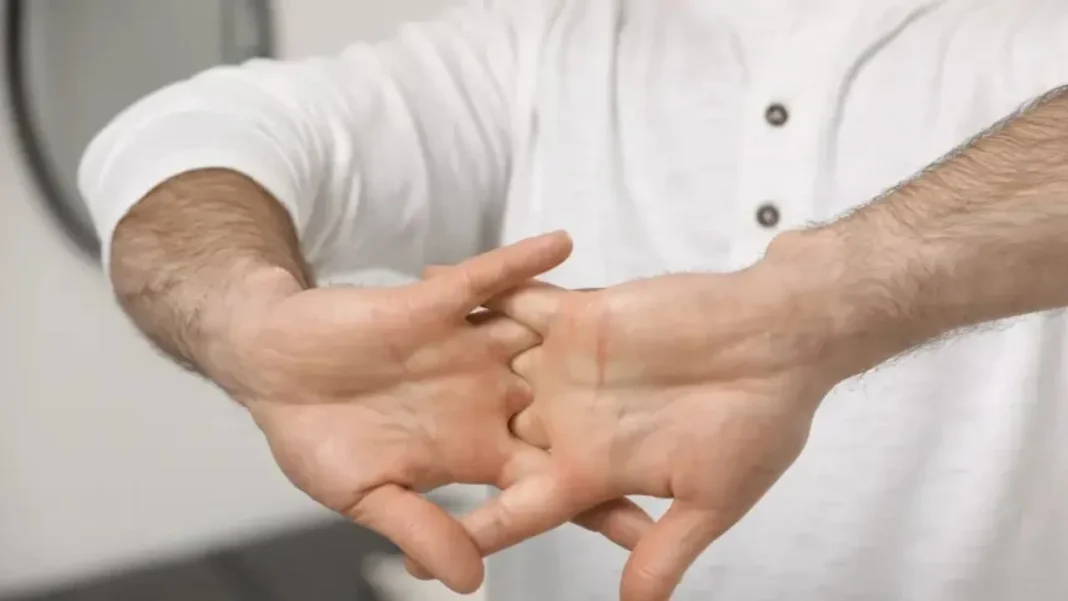

The sound that annoys the room: Knuckle cracking is a habit that divides families into two camps. On one side are those who feel relief, and on the other those who feel terror. The myth says that knuckle cracking causes arthritis, and some even add a warning – that it will cause hand tremors. It sounds plausible, because there is noise, sometimes also a feeling of “release,” and someone once said it wears down the joint.
The biological truth begins with an explanation of the sound. Joints contain synovial fluid, and when the joint is quickly stretched, a drop in pressure is created that is related to the formation of gas bubbles and the behavior of the fluid. The sound is not a “bone breaking,” but a physical phenomenon in the joint fluid.
Osteoarthritis is a common age-related condition, so it is easy to find older adults with arthritis who also crack their joints, and to assume a connection. But a causal relationship requires a proper comparison. The existing research evidence indicates that studies comparing knuckle crackers with those who do not crack their joints have not found a significant increase in the prevalence of hand osteoarthritis just because of cracking. In simple terms, the noise probably does not destroy cartilage in a way that can be shown in population studies.
However, science also does not say that the habit is completely “free of consequences.” Some studies have found certain differences in long-term heavy crackers, such as more swelling in the hand or slightly reduced grip strength, although the findings are not always consistent and are not clearly translated into proven degenerative disease.
Hand tremor is a symptom with many causes, ranging from physiological tremor, through anxiety, caffeine and medications, to essential tremor or neurological diseases. There is no known mechanism in which knuckle cracking causes tremor, and there is no good evidence linking the two. It is possible that people who crack their joints do so out of tension or a nervous habit, and then a mild tremor due to caffeine or anxiety gets “blamed” on the cracking, but that is not the same as a medical cause.
So what should be said to a person who cracks their joints? If it is not painful, does not cause significant swelling, and is not accompanied by a feeling of instability, the likelihood that it will lead to arthritis seems low. If there is pain, recurring swelling, prolonged stiffness, or functional difficulty, that is already a medical conversation about the joint itself, not about the sound.
Knuckle cracking is mainly a social and nervous matter, not a rheumatological diagnosis. You can love it or hate it, but blaming it as a certain cause of arthritis or tremor – is not supported by the evidence.
Source:
www.jpost.com




