

Sarah Vacchiano on Experiencing a “Soft Launch” to Adulthood—and Writing About It
It began with a starter marriage at 21. At the time, I didn’t know anyone else who had so neatly checked all the proverbial boxes: I’d graduated from college, got married, bought a house, and sized myself up for potential motherhood. I had seen what I thought a successful adult life looked like, I bought it, and I cut the tags.
Article continues after advertisement
But by the time I turned 30, most of those boxes were unchecked. I had finalized my divorce, packed up my law school apartment in the North Carolina suburbs, and moved to Manhattan to chase my dreams of becoming an entertainment lawyer. Long past what would traditionally be considered my “coming of age” years, I was desperately in need of a new roadmap.
All the familiar refrains that you hear after hitting rock bottom—optimistic invocations of “second chances,” “starting over,” and “finding yourself”—felt acutely cliché. I’d followed the trajectory of a provincial 19-year-old who discovered Sex and the City in a suburban college town, got married and divorced in my 20s, then moved to New York City during the peak of Lena Dunham’s reign in the early 2010s.
Amid the confusion, loneliness and, dare I say, existential freefall I felt on the subway, or when I came home to an empty apartment, or when I walked the quiet streets before sunrise to make a 6 AM workout class, I kept trying to convince myself that my story wasn’t such an outlier. But the reality was there wasn’t a single person in my social circle who was already divorced.
If “chick lit “defined the early-2000s heroine, the coming-of-adulthood story embraces her millennial successor.
I had always been an avid reader, but a foray into “self-help” and “personal growth” books was unfulfilling. I craved a literary roadmap filled with women who had some experience of life under their belt, but still didn’t have all the answers; women who were coming back from weighty mistakes and forging ahead to create the lives they wanted. There had to be something in between “coming of age” and “fully formed.” Increasingly, I found myself turning to the female-driven women’s fiction of the early aughts.
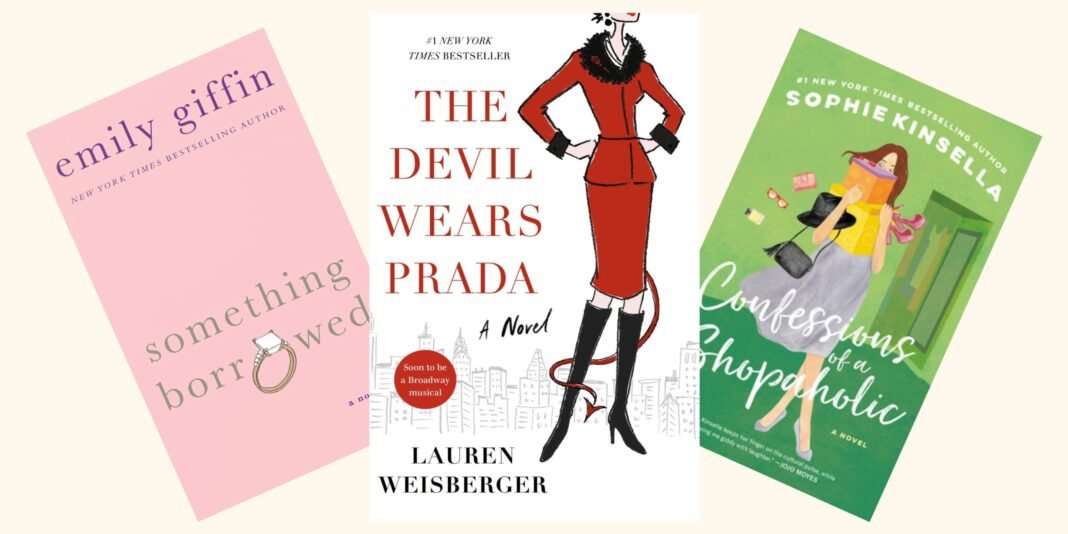
A decade after publication, books like The Devil Wears Prada and Something Borrowed already felt nostalgic, and I craved relatably flawed protagonists like Andie Sachs and Rachel White. As a literary genre, “women’s fiction” and “chick lit” had fallen out of favor by the 2010s. But the elements that made it a once-beloved genre are archetypally timeless. There was an emotional honesty that embraced the idea that growth isn’t always linear (see Andie from The Devil Wears Prada, fumbling a relationship with a good guy because her career came first). It allowed life’s messiness to orient rather than derail (thank you, almost every Sophia Kinsella character). It gifted us with characters that made us feel slightly less alone when it seemed everyone else had life figured out (Rachel from Something Borrowed, who despite being a successful lawyer with a cute New York apartment, commits the cardinal female sin of sleeping with her best friend’s fiancé). We recognized ourselves in these women, and at the same time were inspired to evolve and find ways to level up so we could someday become the older and wiser versions of ourselves.
In an almost prescient way, the classic “chick lit” heroine paved the way for millennial adulthood, where milestones arrive later and rarely in the expected order. They gave us permission to delay parenthood, reinvent ourselves more than once, and changed the way we looked at relationships. If “chick lit “defined the early-2000s heroine, the coming-of-adulthood story embraces her millennial successor. Think of it as if The Devil Wears Prada went to therapy.
“Coming of adulthood” is a genre that picks up where “coming of age” stories leave us, for anyone who’s ever felt like life came with just a few more rewrites than expected.
One night soon after I moved to the city, I turned on the movie adaptation of Something Borrowed. I had read the book years earlier, but watching someone who was great on paper make giant mistakes before she could figure it out resonated deeply. As the end credits rolled, I opened my laptop and started to write a rough synopsis about a woman who gets married and divorced before 30, then moves to New York to chase her dreams of becoming an entertainment lawyer. I didn’t know it at the time, but I was writing the book I wanted to find as I was getting my life back on track. An older, though not necessarily wiser, bildungsroman; more layered and complex, and certainly less readily definable than “coming of age,” but evocative to the right audience: a “coming of adulthood” story, inspired by the women’s fiction of a decade earlier that I loved so much.
I didn’t know it when I was writing it, but my debut novel, Soft Launch: A Coming of Adulthood Novel, is a love letter to the books that helped me get through a young divorce, then guided me through the reinvention of my 30s. I finished the first draft when I was 36 and found a publisher four years later, right after I turned 40. In between, I lived the milestones I wasn’t ready for in my 20s or early 30s: I remarried, had a baby, moved to Los Angeles and found career success. At 41, I became a debut author. And all along the way, I made plenty of (relatable, messy) mistakes.
I don’t know if the life I ultimately created would have been possible without those early aughts novels that acknowledged the journey of becoming—not finding ourselves, but creating ourselves, as George Bernard Shaw would say—is a lifelong process that sometimes doesn’t even begin in earnest until our 30s (or later). “Coming of adulthood” is a genre that picks up where “coming of age” stories leave us, for anyone who’s ever felt like life came with just a few more rewrites than expected.
__________________________________

Soft Launch: A Coming-Of-Adulthood Novel by Sarah Vacchiano is available from Little A.
Source:
lithub.com




