

In 1999, a young Jack White had the forethought to record a performance at his local bowling alley in Detroit. During the show, he and a collection of local musician friends, calling themselves Jack White and the Bricks (White, Brendan Benson, Ben Blackwell and Kevin Peyok), stood on the riser over a few lanes at the iconic Garden Bowl and played Bob Dylan and ? & the Mysterians covers — along with a collection of just-released and yet-to-be-released White Stripes songs.
The band played on lanes 11 to 14, recalls David Zainea, whose family has owned the Garden Bowl for 80 years, “and it was packed.”
In 2013, White turned the raucous recording into a limited-edition vinyl for his label Third Man Records’ exclusive vault series titled Jack White and The Bricks: Live On the Garden Bowl. In between early renditions of tracks that wouldn’t be heard until later White Stripes albums, listeners can hear the crack of bowling balls connecting with pins at the back of the lane.
White may be one of the most successful artists to play the Garden Bowl, but he was far from the only one. Originally opened in 1913 and purchased by Albert Zainea in 1946, The Garden Bowl is the oldest continuously running bowling alley in the U.S. As the mid-century bowling craze, which saw 35 bowling alleys open within two miles of midtown Detroit in the 1960s, died down, the Zainea family introduced “Rock-N-Bowl” — allowing bands to play directly over the lanes.
“A lot of bands don’t like playing it,” David, the grandson of Albert Zainea, jokes. “They can see the bowling balls coming at them. But some of them love it.” The Rock-N-Bowl shows can hold an audience of just over 100 people, and the sound, David adds, is surprisingly good thanks to the low ceilings and acoustic tiles.
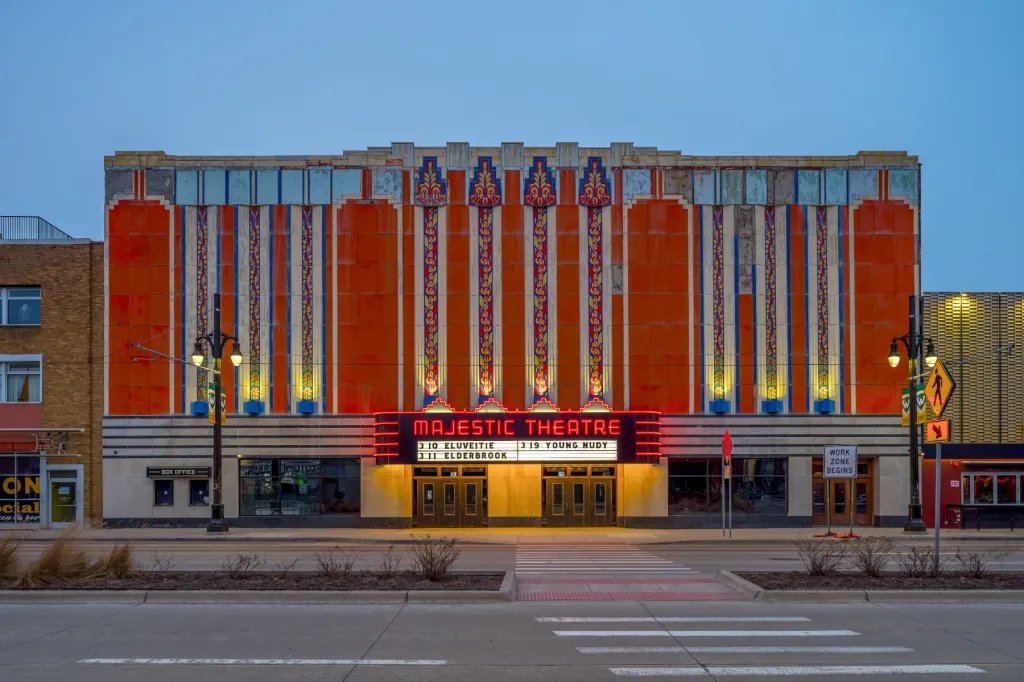
The Garden Bowl is one of four spaces that make up the independently owned Majestic Theatre Center today. After immigrating from the Middle East to the United States in 1907, Albert Zainea moved to Grand Rapids, Mich., and started a candy store at the age of 15, according to the as-told-to history collection “Words and Wisdom from Papa Joe” by Albert’s son and David’s father, Joseph “Papa Joe” Zainea. Albert went on to open a grocery store, a dairy farm and creamery, and a slaughterhouse before buying the Garden Bowl. In 1984, Albert purchased the Majestic Theatre next door to the bowling alley.
The Majestic, which first opened in 1915, was the first theater designed by legendary architect C. Howard Crane (Detroit Opera House, Fillmore Detroit, Fox Theatres in Michigan and Missouri), who designed it in an Italian style. Almost 20 years later, the city decided to expand Woodward Avenue and the theater lost 35 feet from the front of the building along with its balcony seating. At that time, its terracotta facade was recreated to its current Art Deco style.
The Majestic went bankrupt in the 1950s and became a church, then a photography studio, David tells Billboard. The photography studio “really hacked it up,” he says. “It was in neglect. We put a lot of money into that building. The roof was gone. It was leaking. The ornate plaster — what we could afford, we fixed up.”
The bowling alley and the theater were separate buildings “and we punched a hole in there to make it cool. It’s four rooms of fun,” he adds.
Since the Zainea family renovated it, the Majestic has hosted shows by artists including The Black Keys, Sheryl Crow, Laufey, Drake, The Yeah Yeah Yeahs, Post Malone, Patti Smith, St. Vincent, Sharon Jones & The Dap Kings, Zach Bryan and Wilco.
But the family wasn’t done opening up venues. In the early 1990s, there was a void in the Detroit concert space; there was the Garden Bowl and theaters over 1,000-capacity, but not much in between, David says. So a few years after relaunching the 1,100-capacity Majestic, the Zaineas decided they needed to make better use of the complex they created and turned the second floor of bowling lanes into a 750-capacity club. “It started as a pool club because it was called the Magic Stick,” David says.
“I start booking bands there. I’m like, ‘Wow, this is another avenue of income,’” David continues. “We needed a smaller venue because local bands didn’t want to play in the theater because it was too large.”
Bands like The Shins, Queens of the Stone Age, The Hives and The Black Keys took over the stage, as well as shows from Wilco, Buddy Guy, Los Lobos, Foster the People, Rüfüs du Sol, Car Seat Headrest, George Clinton and, of course, The White Stripes.
The Magic Stick eventually became a staple of the neighborhood. Locals would stumble in on any given night to see whoever was playing, and the venue successfully tapped into the garage rock scene that exploded from the mid-1990s to the 2010s. “Things go through a cycle, but we hit it with the garage rock and I’ve got to give it to my staff,” David says. “They saw the opportunity for that genre of music to play.”
In 2017, Third Man Records released another Vault package with a recording of The White Stripes’ Aug. 18, 2000, performance at what the label called “Detroit’s venerable Magic Stick.” David says he still has a copy of the check that he used to pay the band hanging in his office and remembers at least one other acoustic set White played at the Garden Bowl.
“When Jack got really successful, he wanted a bowling alley in his house in Nashville,” says David. “I had some old foul-lights [these indicate when a bowler has crossed the line onto the lane] and bowling equipment and I just gave it to him. He sent me a plaque of the album cover.”
David will be the first to admit that running the bowling alley was a lot different than running a concert venue.
“When I first got into the [concert] business, I didn’t know what I was doing. I booked Warren Zevon. I was the promoter, the loader, the backstage provider and I pulled it off but the tour manager wasn’t very happy with me,” David says, adding that Zevon “was sober and I didn’t have enough coffee and he was pissed. I made an urn of coffee and brought it back there because we owned a restaurant at that time.”
When the tour manager told David they needed to settle the show and David said he didn’t know how, the tour manager pulled him aside and taught the new theater owner how to close one out. “He gave me a lesson I’ll never forget,” says David. “Then I told him, ‘We’re losing money on it!’” (AEG is now the exclusive booker for the Majestic Theatre.)
After 80 years and three generations (David’s brother, Joe Zainea runs the building’s restaurant, Sgt. Pepperonis Pizzeria and Deli), the family has considered selling the music venues, which carry a lot more risk than the financially stable bowling alley. But they’ve never felt they were given a fair offer. “I’m not going to give it away. And I still like doing what I do,” David says. “We’re an anchor on that little block and we feed these other smaller businesses and it makes me happy to do that. From the bartenders to the stagehands to the sound guys, everybody gets a little piece of it. And I hope that never changes.”
At the very least, the building’s facade will never change. In 2008, after years of lobbying by the elder “Papa Joe” Zainea (who passed away earlier this year at 93), the iconic art deco facade of the Majestic Theatre was added to the National Register of Historic Places. However, the family is still able to make changes to other parts of the building and unveiled $1 million in renovations, including a new marquee, in 2019.
“We’ve been there for 80 years. We adapt to what the community needs and then we persevere,” says David. “You don’t get rich in small venues, but I don’t care. I’m happy with where I sit at the table.”

Source:
www.billboard.com




