
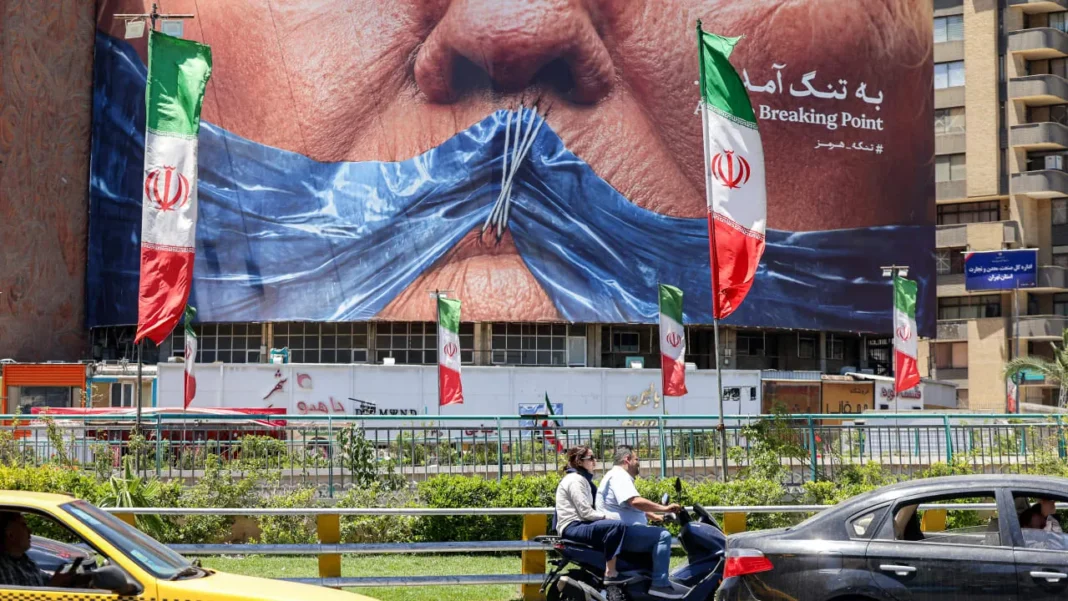

The regime in Tehran fears its own people more than it fears American bombs. That single fact has been the key to Iranian strategy since this war began, and it should be the key to American strategy for ending it.
So far, Washington has focused heavily on strikes against military targets and infrastructure and on economic pressure. Both matter, but neither is likely to topple the regime on its own.
Destroyed power plants and refineries can eventually produce popular anger, but that is a slow, indirect route to victory. The current approach gives the regime time to adapt, to blame outsiders, and to keep its grip on the streets.
Targeting the regime where it is most vulnerable
If America wants a faster, more decisive path to victory, without a single American boot on the ground, there are five things it should do instead.
First, demand public proof of life of Mojtaba Khamenei. Since February 28, every statement attributed to the man now treated as Iran’s supreme leader has been a written text, never a video or even an audio recording.
This is a sharp break from his father’s practice of frequently appearing on camera, including from hiding. This is not a security precaution; it’s a pattern that points to one conclusion: he is likely dead or incapacitated. Every round of negotiation with Iran rests on the claim that “the supreme leader” must approve any deal.
Washington should say plainly, and publicly, that it will not continue talks through any mediator until it receives verifiable proof that the man supposedly making these decisions is alive and functioning.
The regime cannot produce that proof. And the resulting crisis of legitimacy, made visible to the Iranian public, would do more damage to the regime’s standing than another round of strikes on civilian infrastructure.
Second, give Israel a free hand to finish Hezbollah in Lebanon.
Hezbollah is not a Lebanese militia that happens to receive Iranian support; it is Iran’s foreign legion, the ground force of a regime whose army was never built for conventional deployment.
Washington should say so explicitly, recognize the Lebanon front as part of the war against Iran, and let Israel dismantle Hezbollah both for Israel’s security and for Lebanon’s own future as a state at peace with its neighbors.
Third, call the Iranian people back into the streets, and protect them.
Trump should publicly urge Iranians to resume the protests that have repeatedly shaken this regime, paired with an announcement that Israel will provide drone cover over Iranian cities to shield demonstrators from the Basij and the Islamic Revolutionary Guard Corps (IRGC).
Make clear that regime officials will be held personally responsible and personally targeted for any protesters killed.
Targeting the regime’s true source of power
Fourth, stop bombing infrastructure and start hunting the enforcers.
In the weeks before the ceasefire, Israel had already shifted tactics, striking Basij checkpoints and IRGC positions used to suppress demonstrations, rather than national infrastructure.
That is the model to expand, not abandon. The regime will not fall because a power grid goes dark; it might, eventually, if people take to the streets over the resulting hardship, but that is the slow and uncertain route.
Targeting the IRGC and Basij directly where they are, the men manning the checkpoints and running the crackdowns, is faster and more direct.
It intimidates the enforcers into desertion and gives ordinary Iranians the space to protest without immediately facing the boot of the regime’s own security services.
Fifth, shut down Pakistan’s overland lifeline to Iran.
Since the American blockade began, Pakistan has opened six overland trade routes into Iran, undercutting the sanctions regime that Washington claims to be enforcing.
The US has known about these routes for months and said nothing. If it is serious about economic pressure, it should say publicly and forcefully that Islamabad must close them and call out Pakistan’s role in helping the regime survive.
None of this requires American troops on Iranian soil.
It requires a shift in focus: away from the assumption that enough physical destruction will eventually break the regime and toward the more precise and more honest recognition of what the regime actually fears, namely, its own people seeing it exposed as weak, illegitimate, and unable to protect its own enforcers.
Proof of life of the supreme leader, a free hand for Israel against Hezbollah, protection for protesters, pressure on the IRGC instead of the power grid, and an end to Pakistan’s sanctions-busting trade routes – these are the fastest routes to the outcome everyone says they want: an Iran without this regime.
Source:
www.jpost.com





