
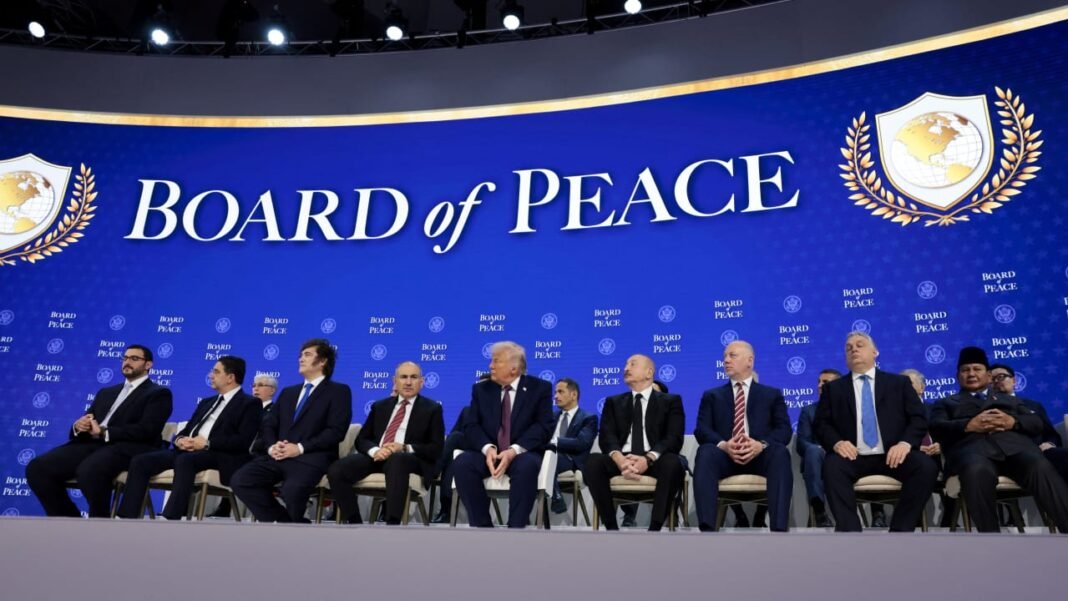

US President Donald Trump’s 20-point plan for the Gaza Strip, announced on September 29, 2025, linked a one-off hostage/prisoner exchange to a transition period in which Gaza would be demilitarized and placed under tightly managed international oversight.
The new governance features a technocratic National Committee for the Administration of Gaza (NCAG) – a Palestinian body running services and reconstruction. It would operate under the strategic control of a Trump-chaired “Board of Peace” and an international security presence.
Hamas is to be removed from governing authority and stripped of its military capacity. In its place, vetted local forces and international troops would enforce a terror-free, demilitarized Gaza.
Meanwhile, massive, externally directed reconstruction and investment programs would get underway.
In due course the Palestinian Authority would inherit Gaza from this interim committee, but only if the PA completes a prescribed reform program on security, corruption, and governance. At that point a unified Palestinian administration over Gaza and the West Bank, backed by elections, is envisaged.
Beyond that, the plan holds out the prospect of US-backed negotiations toward a Palestinian state, but only once the demilitarization process is in progress, and the reformed PA proves it can govern Gaza within this heavily circumscribed framework.
The plan was formally adopted by the UN Security Council on November 17, 2025, in Resolution 2803.
Eight Arab and Islamic states had already issued a joint statement welcoming Trump’s effort and confirming that they were ready to work with the US on implementing it: Egypt, Indonesia, Jordan, Pakistan, Qatar, Saudi Arabia, Turkey, and the UAE.
Even Hamas had agreed to some parts of the proposal, including hostage release and transferring authority, while maintaining that other elements – such as its own disarmament – required further negotiation.
The first phase of the plan – ceasefire plus hostage and prisoner exchange – was achieved and ended large-scale Israel-Hamas hostilities.
For phase two, the UN resolution authorized a temporary International Stabilization Force (ISF) to help demilitarize Gaza and train Palestinian police, with US coordination and contributions from Arab and other states.
As of mid-2026, Indonesia, Morocco, Kazakhstan, Kosovo, and Albania had pledged troops, while Egypt and Jordan have agreed to train Palestinian police.
However, no ISF units have actually deployed inside Gaza, while the $100 million earmarked by the UAE for police training remains frozen.
Meanwhile, the military geography on the ground has been changing. Since the ceasefire, the IDF has steadily reduced the area controlled by Hamas from 47% of the Strip to 40% or even less. In May 2026 Prime Minister Benjamin Netanyahu said that he intended to expand Israel’s control to 70% of Gazan territory.
However, territory and population are not in balance. No more than 15% of Gaza’s population remains in Israeli-controlled areas; at least 85%, and perhaps more, are living in wretched conditions in the coastal zones and urban enclaves held by Hamas. Reports speak of overcrowding, problems with sanitation and access to services, and a severe lack of water.
Gaza’s traditional water sources have been badly degraded by the war, leaving much of the population reliant on minimal supplies, some trucked in daily. Trump’s 20-point plan and its Board of Peace envisage substantial investment in repairing Gaza’s water infrastructure, but in reality these water-sector reconstruction measures remain largely at the planning and pledge stage.
More generally, despite Trump’s announcement that billions have been pledged through the Board of Peace, the Financial Times reported on May 27 that no donor money has actually reached the World Bank, and that informed sources said “not one US dollar” had yet been spent on Gaza reconstruction through the Board’s funding mechanisms.
Turkish and Egyptian construction giants, US and European firms, and Gulf-based companies are preparing bids to benefit from the envisaged multibillion-dollar rebuild. Most projects are at planning or competition stage, except for one large-scale build actually under way.
A Gaza-based contractor, Masoud & Ali Contracting Co. (MAC), is constructing an Emirati-funded housing compound for tens of thousands of displaced Palestinians in an Israeli-controlled part of southern Gaza.
In addition, a few businesses and contractors have started limited reconstruction – principally Palestinian, Egyptian, Turkish, Gulf, and some Western firms. This activity is patchy, often outside Trump’s Board of Peace framework, and hampered by unresolved security conditions and frozen financing.
In mid-2026, Trump’s 20-point Gaza peace plan can best be described as wilting. While still formally in play, phase two is largely stuck. The ceasefire is repeatedly violated, Hamas demilitarization and therefore Israeli withdrawal have not occurred, and reconstruction in accordance with the plan remains minimal.
Bringing the Gaza plan back to life
This is not precisely the picture presented on March 24 by Nickolay Mladenov, the UN high representative for Gaza and director-general of the US-backed Board of Peace, in his first appearance before the UN Security Council. He was present to brief members on progress in implementing the Gaza peace plan endorsed the previous year in Security Council Resolution 2803.
Mladenov informed the council that a plan, developed with and guaranteed by the US, Egypt, Turkey, and Qatar, “is now in place for the decommissioning and reintegration of armed groups in Gaza.” He described the principle at the heart of the framework as: “one authority, one law, one weapon.”
This formula, he stressed, applies without exception to all armed active militias in the Strip, explicitly including Hamas. The objective is the complete decommissioning of weapons in Gaza and their transfer to the control of the technocratic Palestinian authority.
Mladenov said that the first priority, after consolidating a total ceasefire and emergency humanitarian measures, would be to identify and remove heavy weapons systems and military-grade infrastructure, including tunnels. Subsequent stages would expand disarmament in parallel with staged Israeli withdrawals. The process would be supervised by Palestinian security forces answerable to the National Committee.
Crucially, Mladenov linked compliance with disarmament to the start of large-scale reconstruction, arguing that collecting the most dangerous weapons is a precondition for economic recovery.
Meanwhile, starting on June 30, the Board of Peace held a two-day “reset” meeting at a Cyprus resort, bringing together board officials, the NCAG, and allied advisers to review stalled plans for postwar governance, reconstruction, and a transition away from Hamas rule. Participants later called the talks “highly productive.”
So the Gaza peace plan is not dead; it is languishing. It could surely be nursed back to health.
The writer, a former senior civil servant, is the Middle East correspondent for Eurasia Review. Follow him at: www.a-mid-east-journal.blogspot.com
Source:
www.jpost.com



