
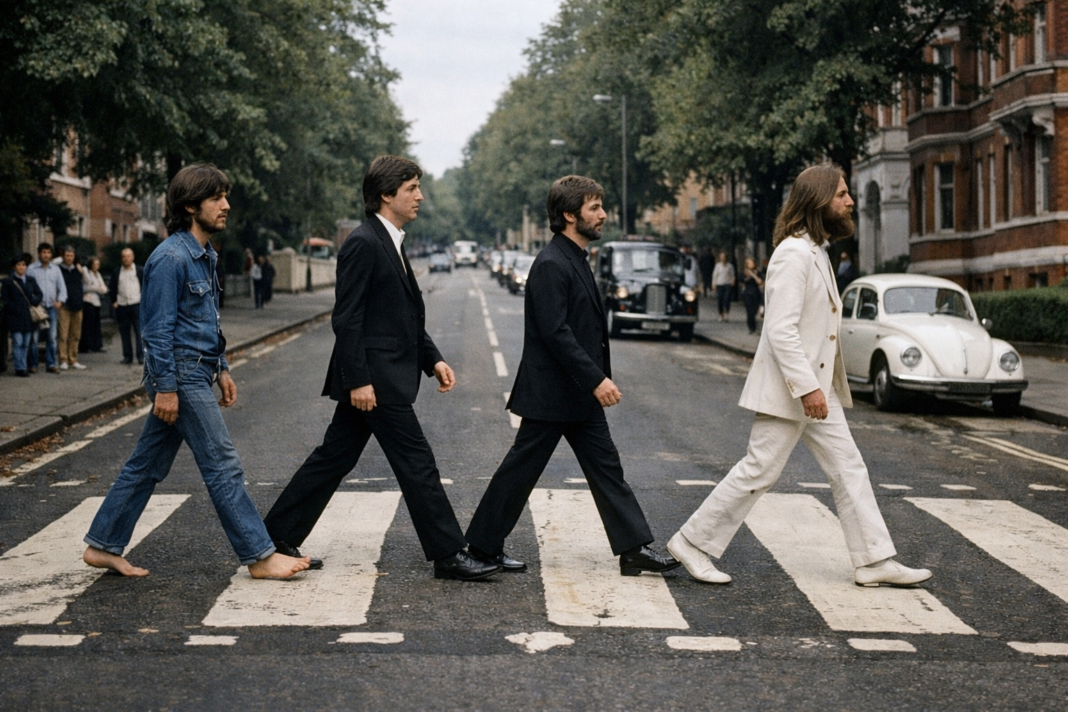

Four figures on a zebra crossing have come to stand for a moment in popular culture that far exceeds the simplicity of the scene. The photograph, taken on 8 August 1969, shows The Beatles walking across a striped pedestrian crossing on Abbey Road in north London. The image’s compositional clarity — a central vanishing point, crisp white road markings and a bright, cloudless sky framed by summer foliage — gives the photograph a suspended, almost painterly quality.
The picture was made by Iain Macmillan, who worked quickly to capture the band during a brief interruption of traffic. The ordinary task of crossing a street is transformed by the fame of its subjects; the presence of the four musicians turns a mundane urban fragment into an emblem. Observers have long noted visual echoes of contemporary British art in the scene: the flat expanses of colour and sharp perspective invite comparisons to the work of painters who sought clarity and modernity in similar everyday vistas.
Beyond its formal qualities, the image has accrued a life of its own. It is widely reproduced, parodied and referenced across media, making the zebra crossing one of the most recognisable album-cover images in modern music history. Fans visit the actual site in St John’s Wood, and the crossing has become a fixed point in narratives about the band’s later years. The photograph’s repeated reuse in advertising, photography and popular reference demonstrates how a single picture can function as a cultural shorthand for an artist, a moment and an era.
The enduring appeal of the Abbey Road cover rests on that balance between the banal and the iconic. It documents a specific time and place while remaining open to reinterpretation: a clear day, a simple street and four people walking can be read as an intimate snapshot or as a symbol of a larger cultural shift. Decades after the shutter clicked, the image continues to prompt discussion about celebrity, visual memory and the ways ordinary urban scenes are transformed when they intersect with public imagination.



