
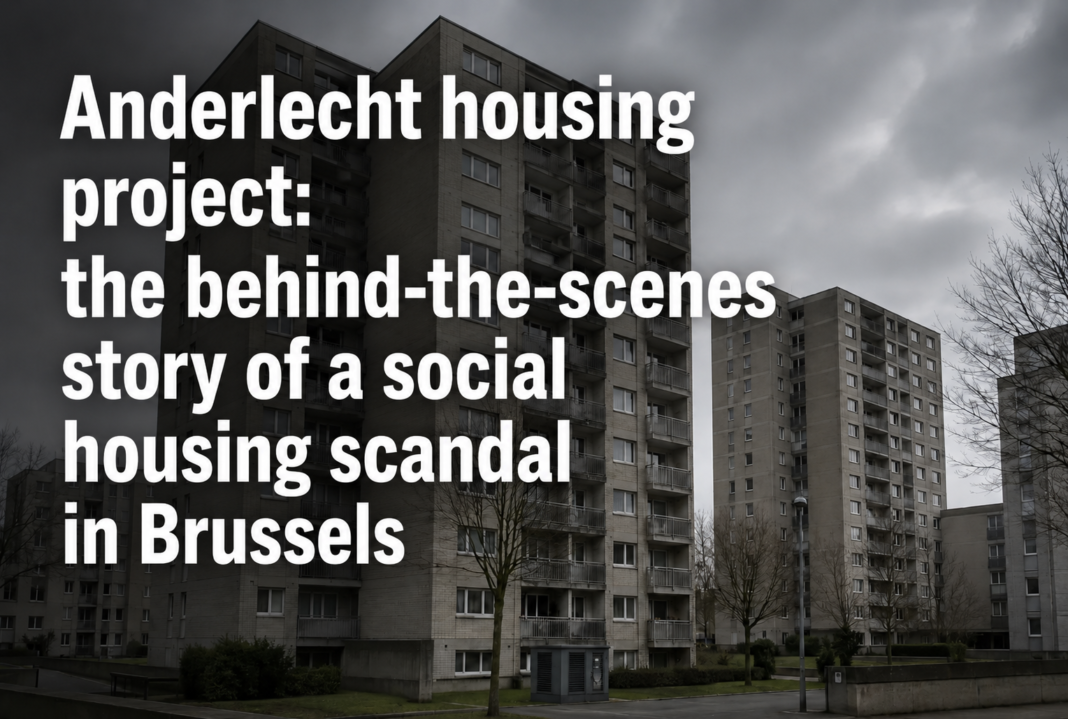

To understand the scale of this case, we have to go back several months. The Foyer anderlechtois, one of the main public service real estate companies in the Brussels-Capital Region, is responsible for managing several thousand social housing units within the territory of Anderlecht. Like all social housing companies, its mission consists of allocating these housing units according to criteria strictly defined by regional regulations, taking into account, in particular, income, family composition, and seniority on the waiting lists.
But over time, several questions began to emerge regarding the internal functioning of the organization. Reports mentioned exemptions granted to certain candidates, while questions arose concerning a committee responsible for reviewing these exemptions. The way in which certain decisions were made raised questions, as did the oversight mechanisms supposed to guarantee the fairness of the procedures.
The case truly took on another dimension when the matter was referred to the justice system following reports of possible irregularities. Shortly after, a journalistic investigation by the VRT further heightened interest in the case. The fruit of long months of investigation, this report brought to light several testimonies and documents raising suspicions of favoritism, political clientelism, and interventions in certain social housing allocation procedures. The accusations immediately sent a shockwave through the Brussels political landscape.
In the days that followed, the prosecutor’s office ordered several searches, notably at the headquarters of the Foyer anderlechtois as well as at various locations linked to the investigation. The judicial investigations aim to determine whether criminal offenses were committed. At this stage, however, it should be recalled that no conviction has been pronounced and that the investigations are still ongoing.
Faced with the scale of the revelations, the Brussels Parliament decided to take an exceptional step by creating a parliamentary commission of inquiry. This is only the second commission of this type since the creation of the institution, proving the sensitive nature of the case. Unlike a judicial investigation, this commission’s mission is not to condemn anyone. Its role consists of analyzing the functioning of public institutions, identifying potential administrative or political dysfunctions, and formulating recommendations to prevent such situations from happening again.
For several weeks, MPs heard from numerous witnesses, including former officials of the Foyer anderlechtois, representatives of the regional administration, executives of the Brussels-Capital Region Housing Company (SLRB), as well as several political figures. Hundreds of documents were also analyzed in order to reconstruct the sequence of events and to understand how certain decisions could have been made.
However, the work of the commission did not escape controversy. Several members of the opposition denounced a schedule deemed far too tight to examine such a complex file. These tensions reached their peak when a rapporteur decided to withdraw from the commission, believing that the working conditions did not allow the investigations to be conducted with all the necessary serenity. Despite these criticisms, the majority of the work has now been completed.
The final report is expected to draw up a comprehensive assessment of the functioning of the Foyer anderlechtois, analyze the social housing allocation procedures, examine the role played by the various oversight authorities, and propose a series of recommendations aimed at strengthening transparency and governance in the sector. This document will not constitute a judicial judgment, but it could serve as a basis for potential reforms of social housing in Brussels.
Before producing its effects, however, this report must be presented and debated in a plenary session of the Brussels Parliament before the parliamentary recess. MPs will be called upon to discuss its conclusions, vote on the recommendations formulated, and, if necessary, consider new measures to reinforce citizen trust in the social housing system.
Beyond the political dimension, this case above all recalls the importance of guaranteeing perfect equality of treatment in the allocation of social housing. In a Brussels Region where tens of thousands of households sometimes wait for long years before obtaining housing, the slightest suspicion of irregularity can deeply undermine trust in public institutions. While the judicial phase now follows its own schedule, the parliamentary debate expected in the coming days will constitute an important step toward drawing lessons from this case and, perhaps, opening a new chapter in the management of social housing in Brussels.





