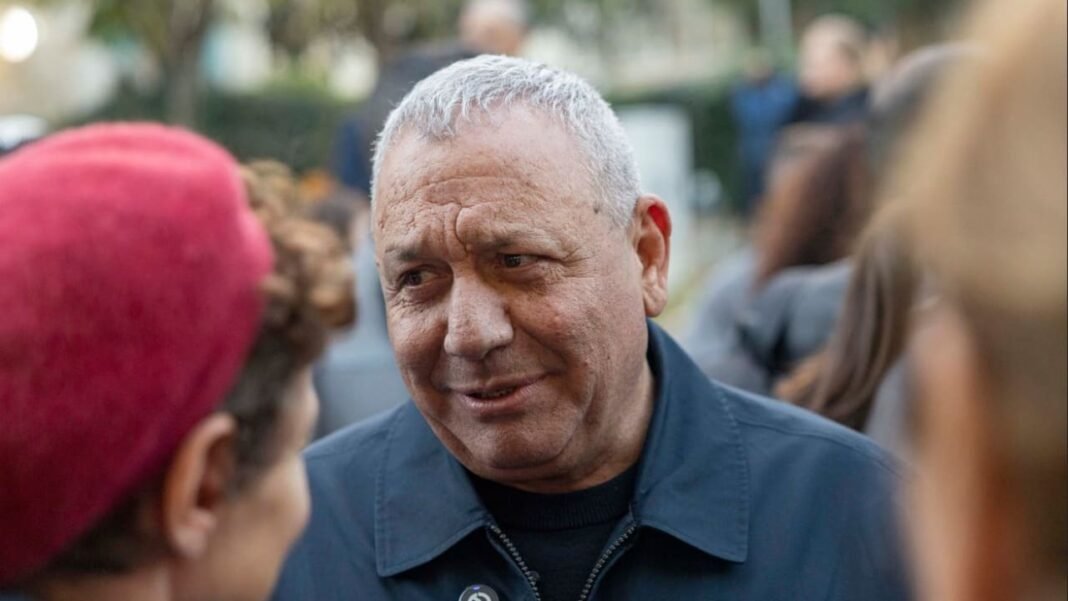

If Knesset elections were held today, Gadi Eisenkot’s Yashar! party would be the largest party in Israel, closely followed by Prime Minister Benjamin Netanyahu’s Likud, according to an N12 poll on Monday.
The poll found that Yashar! would win 23 seats, one less than last week, and that Likud would also hold one less seat than last week’s poll suggested, at 22 mandates.
Together, led by Naftali Bennett, also lost one seat compared to the previous poll, sitting at 14 mandates. In addition, Yair Golan’s Democrats lost one mandate, bringing the party’s total to 10 seats.
Yisrael Beytenu, led by Avigdor Lieberman, maintained nine seats, N12 reported. The Shas, United Torah Judaism, and Otzma Yehudit parties all maintained eight seats, the same as in last week’s poll.
The Arab parties, Hadash-Ta’al and Ra’am, received five seats each, while Bezalel Smotrich’s Religious Zionist Party received four.
Tropper, Hendel’s party passes electoral threshold
Blue and White, led by Benny Gantz, and Balad, led by Sami Abu Shehadeh, both failed to reach the electoral threshold, polling at 1.6% and 1.3% respectively.
In contrast, the new poll found that if elections were held today, Chili Tropper and Yoaz Hendel’s Bayit Tzioni – HaMiluimnikim (roughly translated to the Reservists’ Zionist Home) would pass the electoral threshold and gain four seats.
The electoral threshold is 3.25%, meaning parties must earn at least 3.25% of the vote to win seats in the Knesset.
N12 reported that due to Bayit Tzioni – HaMiluimnikim passing the threshold, the opposition parties reached 70 seats, compared to the current coalition parties, who received 50 of the 120 Knesset seats.
This week’s poll also marks the first time that the non-Arab opposition parties reached 60 seats.
N12 also found that if the Arab parties Hadash-Ta’al and Balad united, Likud would lose an additional seat, bringing them down to 21.
Best Candidate for Prime Minister
Although Eisenkot had previously polled ahead of Netanyahu as the best candidate for Prime Minister, the latest poll found the two were tied at 38% support.
Netanyahu continues to poll ahead of Bennett in suitability for leadership, with 40% choosing to vote for him over the former Prime Minister, compared to 34% who would support Bennett.
Netanyahu is also considered more suitable than Lieberman at 39% compared to 25%.
Issues affecting voters
A significant majority of the public was confident about their vote, with only 10% saying they were ‘still hesitant,’ the poll found.
Within the undecided voters, 1.3% support the Netanyahu bloc, 4% support the change bloc, and 1.3% are unsure.
Almost 30% of respondents who said they planned to vote for a different party than in the previous election said that October 7 had affected their position.
Additionally, 32% of people said that the most influential issue for their vote was security and the management of the war, placing it as the biggest issue affecting voters.
Approximately one-fifth of respondents said that the division between the blocs and social polarization had the biggest influence on their vote, 12% said that it was personal security and crime prevention, and 12% said that it was who is at the head of the bloc.
Source:
www.jpost.com