
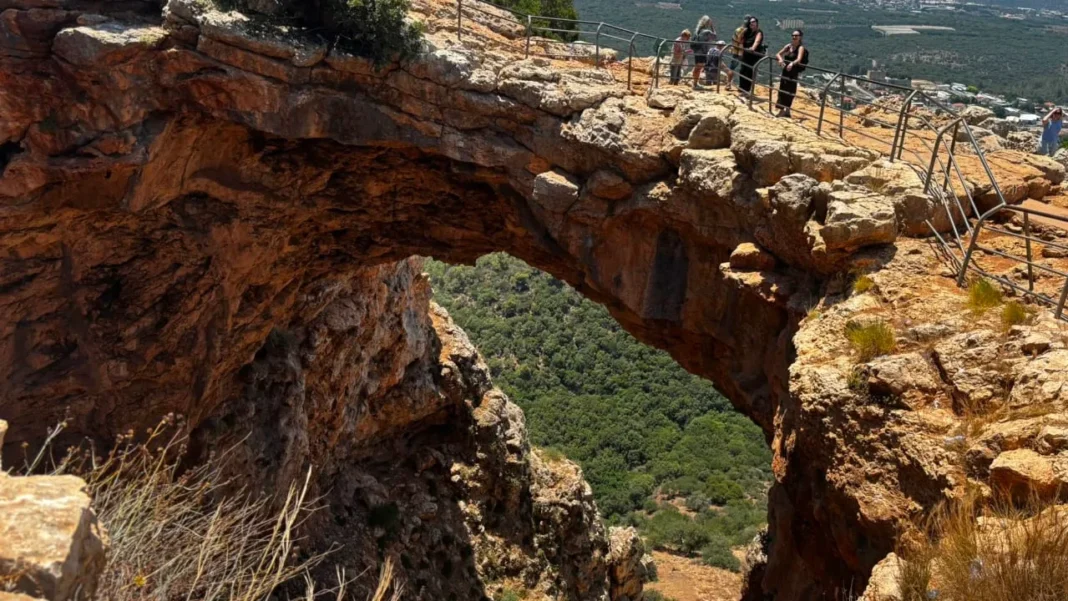

The Keshet cave in northern Israel is one of the most striking sites in the region.
Situated in the western Galilee near the Lebanese border, the cave overlooks Nahal Betzet, and from the top of the cave, the whole of northern Israel along the Mediterranean can be seen.
The cave consists of a large arch, such that when one is above it, they appear to be peering down hundreds of meters into the green foliage below. It’s a unique view, unparalleled in the region.
On Saturday, the path to the cave was full of visitors. Several tour groups had arrived. At least two of the groups were Russian speakers; a large motorcycle club, with their Harley-Davidsons and leather jackets, was also here. In addition, a group of Arab women had come for lunch.
There were other visitors among the groups, speaking a variety of languages, including Hebrew.
The arrival of the visitors illustrates how northern Israel, near the Lebanese border, is reviving amidst the ceasefire in Lebanon. Not all was quiet in Lebanon today. Reports from there indicated there had been airstrikes near the coast, a few miles north of Keshet cave.
What is going on in the North during Hezbollah ceasefire?
But on the border, it seemed quiet. The walk down to the cave takes about 10 to 15 minutes. It’s a stroll. On a hot day though it’s worth having a little water or a hat. The parking is near the Adamit community.
During the 1,000 days of war with Hezbollah, this area was sometimes closed off to traffic. In the first days of the war, after Hezbollah attacked on October 8, 2023, the roads here were blocked, and people were evacuated from places like Adamit and nearby communities such as Zarit and Shtula.
The one community that remained was Arab al-Aramshe, a Bedouin community here. Route 8993 connects these communities. To get here, you need to drive up from Shlomi and Route 899 below. During the war, this area was occupied by soldiers, and tanks and artillery were deployed near the border. However, a lot has changed now.
From the border area, the concrete fence separating Israel and Lebanon is visible. If not for the fence snaking along the border, the landscape would be pretty green, with small trees and bushes, and almost untouched by people. The border wall is a reminder of the threat.
Rosh HaNikra. (credit: Seth J. Frantzman)
Down by the Keshet cave, one of the visitors flew a drone on Saturday. The buzzing is a reminder that today the drone threat seems less on people’s minds. But it should be on their minds because not long ago the FPV drones flown by Hezbollah were threatening soldiers not far from here, in places like Rosh HaNikra.
From Keshet, I drove along the border, then over to Shomera, and past the old church at Iqrit. Then back to Shlomi and Rosh HaNikra. Although the site here is closed, people can still see the beautiful view of the Mediterranean. Here, the whole Zevulon plain below.
This is an interesting area because one can see down to Acre, and also Nahariya and all the way to Haifa. There is a lot to do here. The Old City of Acre is one option, as is the pretty coastal area of Achziv. The Crusader castle of Montfort is also worth a visit.
There is good food in the Druze town of Hurfeish, or, a little farther away, there is the Yehiam Fortress and an interesting old ruined estate house near Ga’aton. Yarka, the Druze town, also offers many shopping options, including the largest children’s store in Israel.
At Rosh HaNikra, I stopped by a food truck called HaRefet, right next to the community entrance. Run by Yoni and a fantastic team, the place serves a variety of smoked meats and some sides. We sampled asado, brisket, chicken, and other items. The smell of the smoked meat lingers on your hands for a while after you dig in. This is just one example of the kind of innovative eateries that Israelis are pioneering these days. A welcome stop in the north.
What’s clear here is that the public has returned to these areas. People are fishing on the coast and in areas marked “no swimming”; the lack of excessive bureaucracy seems to invite people to swim.
This is because some of these areas have not returned to full operation, so there is still a sense of uncertainty, a vacuum, and into the vacuum come the adventurous types.
Source:
www.jpost.com



