HomeOpinionHeritage Designation and Heat: Firminy’s Unité d’Habitation Faces a Habitability Crisis

Heritage Designation and Heat: Firminy’s Unité d’Habitation Faces a Habitability Crisis

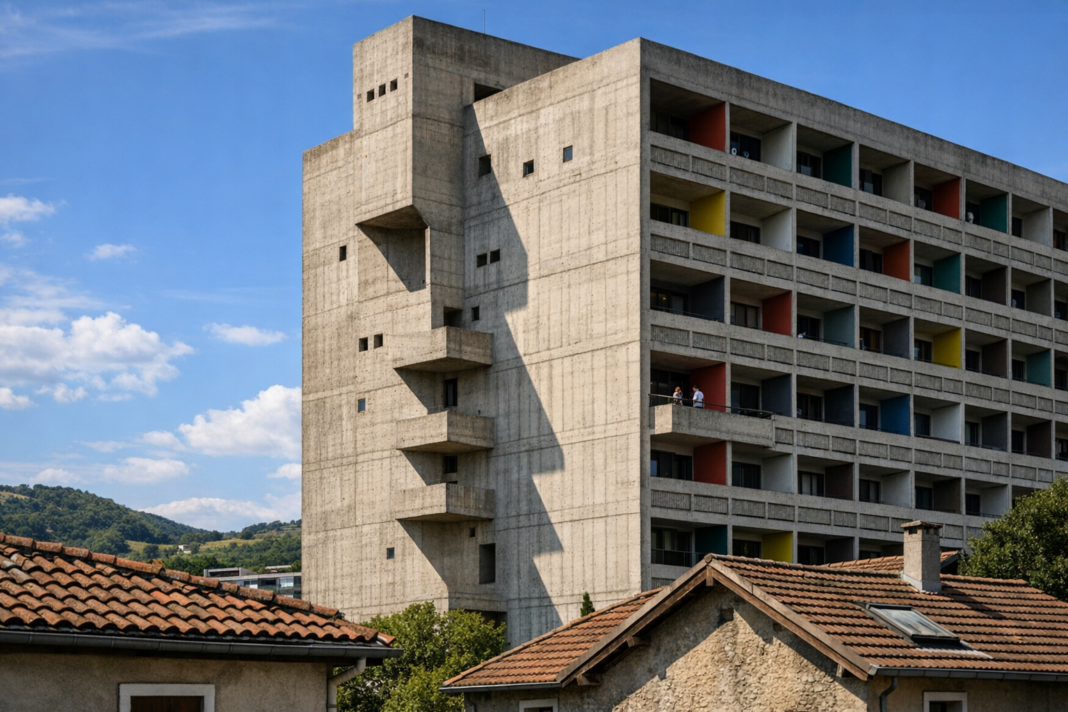
Le Corbusier’s Unité d’Habitation in Firminy has become the focus of an acute housing problem: tenants report internal temperatures reaching 40°C while restrictions derived from its listed status and prevailing regulations limit external interventions such as shutters. The tower, designed as a two-thirds social housing block for HLM, carries both architectural significance and everyday obligations to those who live there.

The building is the architect’s final major project and its facade and roof were registered as monuments historiques in 1993. That designation protects key elements of the design but also narrows the scope for alterations. Local accounts and inspection reports point to a broader context of economic change in the area — factory closures and population decline — that has left residents with limited housing options beyond the Unité.

Current technical and regulatory frameworks, including specific constraints in French building regulations, restrict visible external changes such as shutters and some types of external shading. The result is a tension between conservation objectives and the practical needs of occupants facing increasingly frequent extreme heat events. The issue is not limited to aesthetics: overheating has measurable health and comfort implications for vulnerable residents, particularly in older, concrete-constructed housing blocks.

Responses under discussion range from reversible interventions and sympathetic shading solutions to targeted mechanical cooling and improved ventilation, alongside insulation and glazing upgrades that respect protected fabric. Implementing such measures involves technical assessments, permissions from heritage authorities, and funding mechanisms that typically require coordination among local government, social housing providers and national conservation bodies.

The situation in Firminy highlights a wider policy challenge: how to reconcile the conservation of twentieth-century modernist architecture with the imperative to adapt housing to a changing climate. Preserving architectural heritage and ensuring habitability are not mutually exclusive, but achieving both will depend on timely, evidence-based decisions by the responsible institutions and clear pathways for authorised, reversible adaptations that prioritize residents’ welfare.


Hot this week

Existing Osteoporosis Drug Prevents Spinal Mineralisation in Zebrafish Model, Study Finds

A new study shows genetic changes cause disc mineralisation and spinal fusion in zebrafish. Researchers reduced damage using an existing osteoporosis drug and by targeting fat metabolism, suggesting potential avenues for back pain treatments.

Trump proposes Monday talks with Iran as Tehran remains silent

Donald Trump said new talks with Iran could begin Monday; Tehran has not responded. Previous announcements that negotiations were near were followed by renewed strikes.

Existing Osteoporosis Drug Prevents Spine Damage in Zebrafish Model, Study Shows

A study found that genetic disruption of a collagen-related gene in zebrafish led to mineral buildup and spinal fusion; damage was reduced by an existing osteoporosis drug and by targeting fat metabolism.

Ex neo‑Nazi activist withdraws as Conservative election candidate, to advise party on extremism

Joshua Bonehill‑Paine withdraws as Conservative election candidate. Kemi Badenoch says he will advise the Conservatives on tackling extremism; details of the role were not provided.

Repeating the Mistakes of Afghanistan: The Risks of an Open‑Ended Campaign in Iran

Five years after the chaotic Kabul withdrawal, lessons from Afghanistan and Iraq are resurfacing as the US campaign against Iran enters a prolonged, escalating phase with unclear goals and mounting regional risk.

Morocco–Europe After the Ceuta Crisis: Is Trust Permanently Damaged?

By Isaac HammouchThe new migratory crisis in Ceuta has...

Jahmyr Gibbs signs three-year, $75.7m deal to become NFL’s highest-paid running back

Jahmyr Gibbs agreed to a three-year contract worth up to $75.7 million with the Detroit Lions, establishing a new compensation benchmark for NFL running backs.

Dominic Sessa embodies young Anthony Bourdain in 1970s-set biopic Tony

Dominic Sessa, fresh from The Holdovers, portrays a 19-year-old Anthony Bourdain in Tony, a film set in Provincetown in the summer of 1975 that explores the chef's formative experiences.

Existing Osteoporosis Drug Prevents Spine Damage in Zebrafish Model, Study Shows

A study found that genetic disruption of a collagen-related gene in zebrafish led to mineral buildup and spinal fusion; damage was reduced by an existing osteoporosis drug and by targeting fat metabolism.

Ultra-detailed images from world’s largest solar telescope reveal thousands of tiny whirlpools on the Sun

New observations from the Daniel K. Inouye Solar Telescope provide first direct evidence of Kelvin-Helmholtz vortices on the Sun, offering insight into coronal heating and space weather.

Scientists create 16 viruses designed by artificial intelligence, study finds

A research team reports creating 16 functional viruses whose genomes were designed by artificial intelligence, prompting attention to biosafety and governance.

Africa CDC to Deploy Existing Ebola Vaccine in DRC Outbreak After Promising Test Results

Africa CDC pledges to use a vaccine developed for a previous Ebola strain in the current Democratic Republic of Congo outbreak after test cases suggested potential protection.
Advertisementspot_img

Related Articles

Advertisementspot_imgspot_img
