
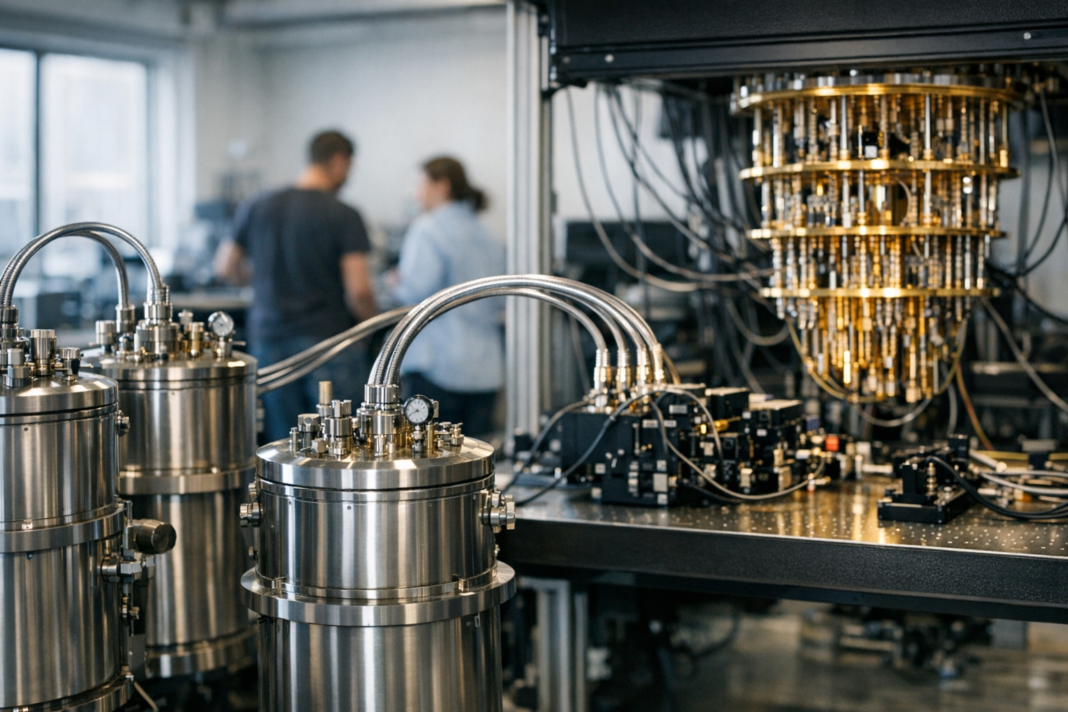

IBM has unveiled a modular ultracold cryogenic system intended to network multiple quantum processor chips and address a major infrastructure constraint in quantum computing. The company says the design will enable staged expansion of capacity while maintaining the extreme temperatures required for superconducting processors. IBM framed the development as a step toward fault‑tolerant quantum machines.
The individual cryogenic modules measure roughly 8 feet by 8 feet with an internal volume near 9 cubic feet and can cool components to about 10 millikelvin — temperatures close to absolute zero and more than 180 times colder than deep space. Those conditions are necessary for superconducting qubits and quantum processing units to preserve coherence and limit thermal and electromagnetic disturbance. Cooling is achieved with helium compressors paired to dilution refrigeration and multilayer thermal shielding; bringing a module to operating temperatures requires several days.
A core technical advance is the ability to link separate cold modules using superconducting cables known as “L‑couplers,” roughly one metre long, that carry quantum signals between processors. Oliver Dial, IBM’s vice president of quantum operations, explained that these links make two‑qubit operations possible across modules rather than being confined to a single chip. IBM has demonstrated simultaneous cooling and basic gate operations between two interconnected modules using the Flamingo processor, though multi‑module, error‑corrected computations have not yet been reported. The company plans to outfit subsequent systems with its Nighthawk processors as tests continue.
IBM plans initial deployments in 2027 with two‑ to three‑cell systems that could support around 1,000 physical qubits, and it has set a goal of performing 100 million quantum operations in a single session by 2029 with the proposed “Starling” computer. That machine is described as using 10,000 physical qubits organized into 200 logical qubits to enable error‑corrected workflows. Jerry Chow, IBM’s chief technology officer for quantum‑centric supercomputing, stressed that reaching fault tolerance will depend on many incremental engineering advances across processors, software, controls and infrastructure.
The modular cryogenics route complements alternative approaches that aim to reduce or avoid deep cryogenics, including photon‑based, room‑temperature systems and diamond‑based qubits. Progress on quantum error correction and reliable inter‑module operations will determine whether IBM and other groups can translate these engineering milestones into sustained, fault‑tolerant quantum computation at scale.






