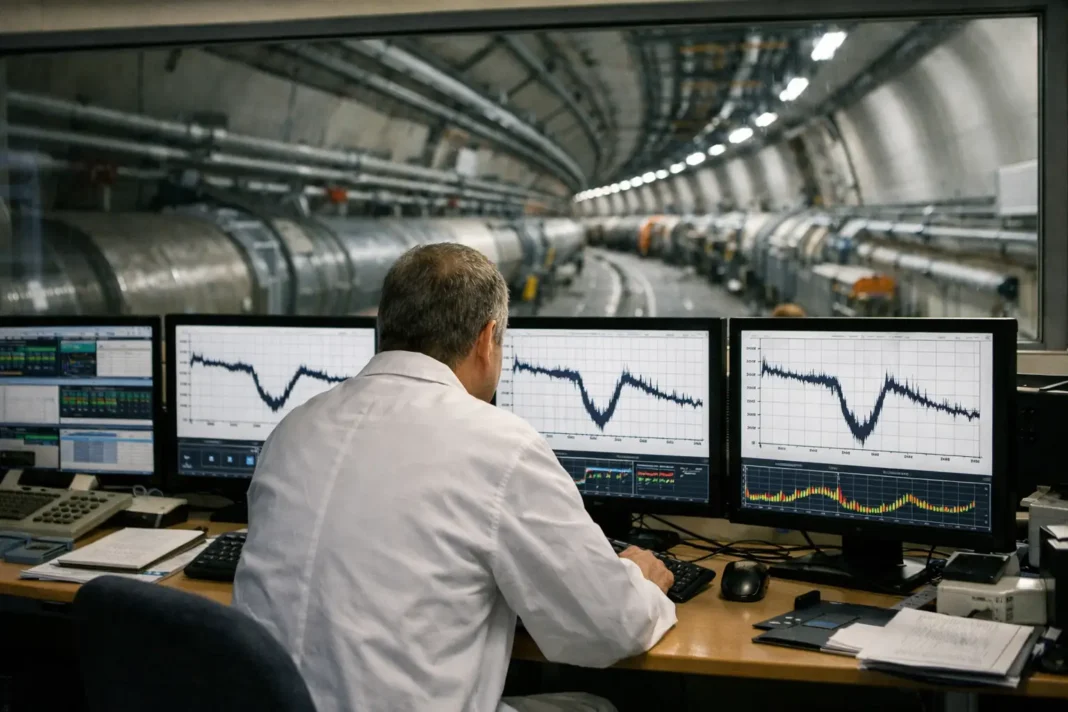

Collision data reveal a surprising pattern from tests recreating the universe’s earliest conditions. Researchers working with the STAR detector at the RHIC collider, hosted by Brookhaven National Laboratory, analysed roughly one billion gold‑nucleus collisions at beam energies between 3 and 7.7 GeV. Their study, published on Sept. 22 in Physical Review Letters, reports a pronounced dip in fluctuations of transverse momentum that departs from the smooth trend expected across collision energies.
The team measured how often pairs of charged particles produced in each collision were both pushed harder or more gently sideways than average. Those correlations encode how the fireball’s temperature and collective expansion fluctuate from event to event. Near a theorised QCD “critical point,” the heat capacity of nuclear matter should rise dramatically, damping temperature fluctuations and thus weakening those momentum correlations. In the most head‑on collisions the observed dip deviates from a smooth extrapolation with a statistical significance of 5 sigma, a level commonly treated in particle physics as unlikely to arise from random scatter.
While the signal is statistically strong, the collaboration emphasises that it is an intriguing hint rather than definitive proof of a critical point. The feature was not reproduced by a widely used simulation that does not include a critical point, but other noncritical mechanisms could also influence the measured fluctuations. Study co‑author Rutik Manikandhan and colleagues plan targeted follow‑up analyses: extracting the specific heat of the created matter, confronting the result with first‑principles supercomputer calculations, and combining this observable with independent measurements such as proton‑number fluctuations to build a consistent picture.
The potential discovery has broad implications. The hot, short‑lived quark‑gluon plasma produced at RHIC resembles matter thought to have filled the universe microseconds after the Big Bang, and the equation of state that governs its transitions is also central to understanding the interior of neutron stars. Further experimental runs, refined theoretical modelling and cross‑checks across observables will be required before the community can conclude whether this dip marks the long‑sought QCD critical point or another change in the behaviour of extreme nuclear matter.