
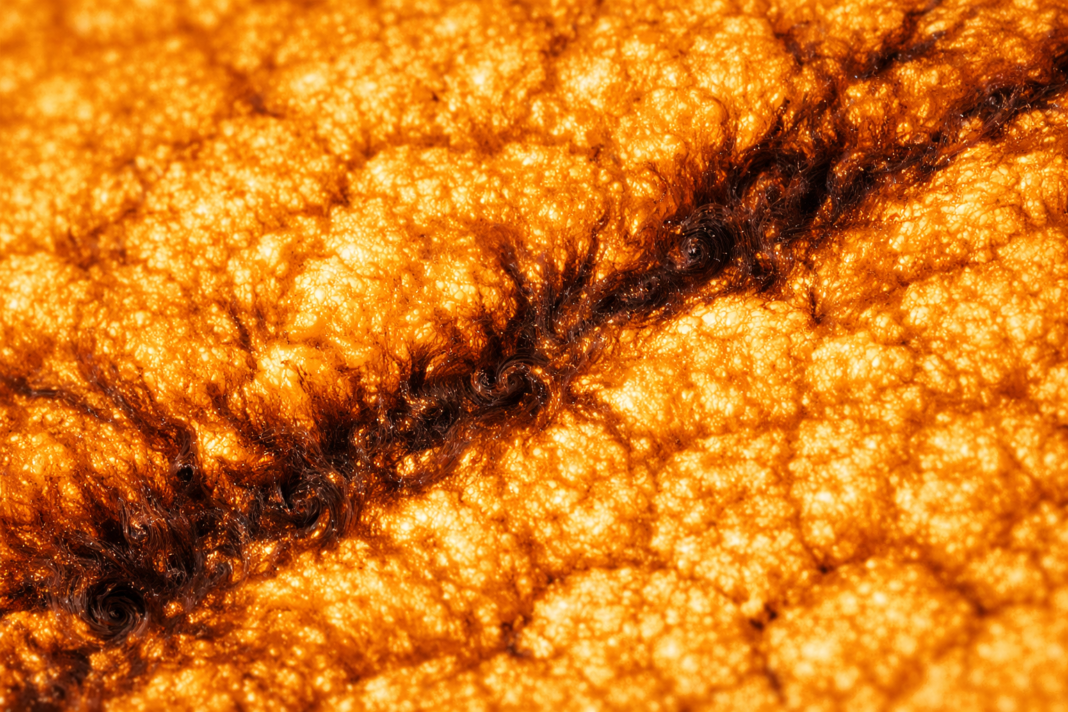

New high-resolution images from the world’s most powerful solar telescope show thousands of previously unseen tiny vortices sweeping across the Sun’s visible surface. The observations, obtained with the Daniel K. Inouye Solar Telescope in Hawaii and released alongside a paper in Nature, reveal small-scale spiral structures clustering at the edges of magnetic regions in the photosphere.
The time-lapse sequences provide the first direct observational evidence of the Kelvin-Helmholtz instability acting in solar plasma, a fluid-dynamics effect predicted when adjacent flows move at different speeds. The telescope’s resolution — sufficient to resolve features only tens of miles across — made it possible to distinguish the vortices and associated dark striations that had gone undetected in previous observations.
Scientists compared the new imagery with advanced numerical simulations of the solar photosphere and found a close match in the spacing and behavior of the vortices, strengthening the identification of the instability in action. The work was supported by the National Science Foundation and led by teams operating the observatory; the findings were reported in a study published Aug. 5 in Nature.
Researchers propose that the persistent twisting and mixing of magnetic-field lines by these small-scale vortex motions could contribute to the build-up and release of magnetic energy responsible for solar flares and coronal mass ejections. Thomas Rimmele, chief technologist at the National Solar Observatory, noted that the process may also be relevant to the long-standing problem of how the solar corona attains temperatures far higher than the visible surface.
Going forward, the team plans to deploy automated tracking algorithms to follow the vortices across extended observations, quantify their energy transport, and assess their role in coronal heating and the generation of space weather. Those measurements aim to clarify how small-scale dynamics on the photosphere couple to larger-scale magnetic events that can affect satellites, communication systems and power infrastructure on Earth.






