HomeScienceAI's Thirst and the Path to Less Water-Intensive Data Centers

AI’s Thirst and the Path to Less Water-Intensive Data Centers

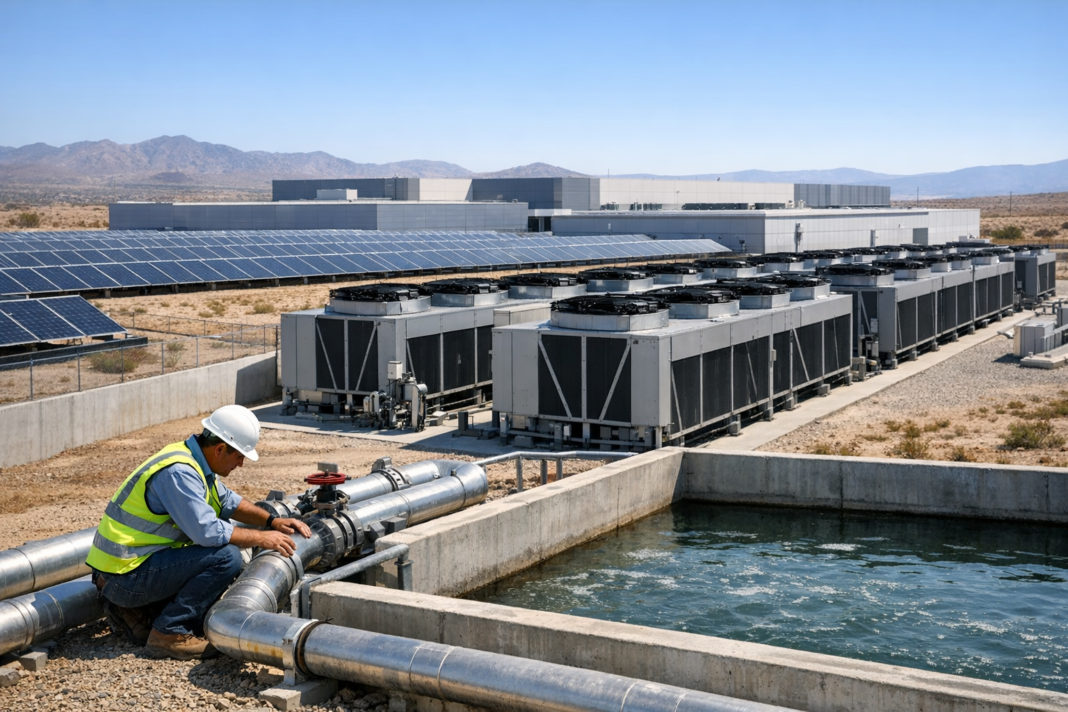
AI-driven data centers are drawing growing opposition from communities across the United States as residents raise alarms over water withdrawals, energy consumption and pollution. Protests have appeared from Texas to New Mexico and Arizona, where locals say new server campuses could deepen stress on limited supplies. The criticism focuses on evaporative cooling systems and power generation tied to fossil fuels, both of which can increase local water demands.

Cooling modern processors is energy- and sometimes water-intensive: server components can run very hot and some facilities still use evaporative towers that lose water to the atmosphere. Estimates vary widely. Researchers have calculated that data center cooling used about 66 billion liters of water in 2023, under 1 percent of national consumption, yet forecasts by Fengqi You and colleagues project between 731 billion and 1,125 billion liters annually in the United States by 2030 under high-demand scenarios. Earlier per-query water figures—such as a 2024 estimate of roughly 500 ml for a short AI response—have been revised downward as models and systems become more efficient; for example, one large cloud provider later estimated only a few drops per typical query.

Engineers and researchers point to several levers that could sharply reduce AI’s water footprint. Shifting electricity supply from steam-cooled fossil generation to wind and solar cuts the indirect water used to cool turbines. Strategic siting of facilities in water-abundant regions — names often cited include Montana, Nebraska, parts of Texas and South Dakota — can avoid adding stress in drought-prone states such as Arizona, New Mexico and California. Technological shifts also matter: many firms now deploy liquid cooling and are testing immersion systems to limit evaporative losses. Major providers such as Amazon, Microsoft and Google are rolling out such approaches, while university researchers and companies explore immersion and other advanced options.

Corporations have announced water stewardship targets: OpenAI describes plans to limit onsite water use, Google aims to replenish 120 percent of freshwater its centers use, and Amazon reports progress toward being water positive by 2030. Reusing waste heat for district heating in Europe offers another way to boost sustainability. As Eric Masanet and other experts note, the trajectory of AI’s water demand will depend on choices about siting, energy sources and cooling design — decisions that can either magnify local stress or dramatically curb future consumption.


Advertisementspot_imgspot_img

Hot this week

Planet-sized detector: Earth’s field tightens dark matter constraints and flags strange signals

Researchers used Earth's magnetic field and atmosphere as a detector, setting new limits on ultralight axions and finding unexplained dark photon signals.

Far-right AfD Takes Large Lead in Saxony-Anhalt Vote, Falls Short of Majority

AfD projected at 44% in Saxony-Anhalt, conservatives at 17%, leaving the far-right short of an outright majority and reshaping regional politics.

Updated ‘super flu’ vaccine begins rollout as NHS recovers from busiest summer

An updated influenza vaccine targeting the Super-K strain is being rolled out as the NHS reorganises after a very busy summer.

From Factory Floor to Political Faultline: How Luton’s Former Car Workers Are Rewriting Trust

Former car workers in Luton, abandoned by employers and institutions, are shifting their political allegiance, with wider implications for parties and unions.

Triple meeting lights up Friday as Ascot joins Bangor-on-Dee and Worcester on Sky Racing

Three race meetings — Ascot, Bangor-on-Dee and Worcester — feature on Friday's card, broadcast live on Sky Sports Racing.

BBC presenter Maryam Moshiri reveals blood cancer diagnosis to raise awareness

BBC presenter Maryam Moshiri has revealed a blood cancer diagnosis, aiming to raise awareness and encourage public conversation.

Healey to frame UK recovery while addressing debt and regional disparities

Chancellor John Healey will present plans to spread growth across the UK ahead of his first Budget, while addressing debt concerns.

Far-right AfD Takes Large Lead in Saxony-Anhalt Vote, Falls Short of Majority

AfD projected at 44% in Saxony-Anhalt, conservatives at 17%, leaving the far-right short of an outright majority and reshaping regional politics.

Geese at End of the Road: a generation’s uneasy soundtrack

At End of the Road, Geese delivered a taut, charged set that captured contemporary disquiet and renewed attention to guitar-driven rock.

Ndiaye Affirms Manchester City Was Always the Destination

Ndiaye says his next move was always destined for Manchester City, highlighting the club's appeal and implications for player development.

How a Dutch Cameraman Unveiled the North Sea’s Hidden Life

A Dutch cinematographer’s 20-year effort captures unexpected marine diversity beneath the North Sea’s murky surface.

Higher Blood Tyrosine Linked to Shorter Male Lifespan, Large Study Finds

A study of over 270,000 people associates elevated blood tyrosine with nearly one year shorter life expectancy in men, with no clear effect in women.

Five 60-sided dice solve a 15-year quest for perfectly fair turn order

A team of mathematicians produced five 60-sided dice numbered 1–300 that give every player equal odds of any turn order; giant wooden models are on display at Auburn.
Advertisementspot_img

Related Articles
