
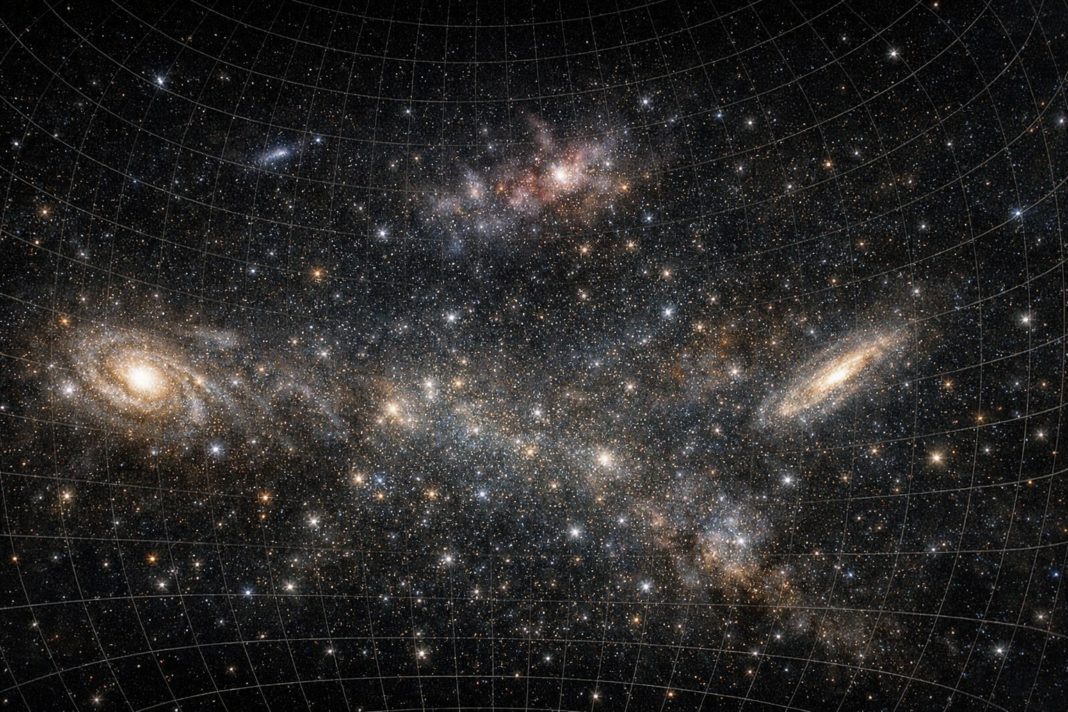

New measurements of the ancient microwave glow that permeates space have reinforced a central result of modern cosmology: the cosmos we can observe is extremely close to spatially flat. Observations of the Planck satellite and other experiments have mapped tiny temperature and polarization variations in the cosmic microwave background, producing tight constraints on curvature within the region of the universe we can see.
That empirical flatness, however, does not automatically imply that space is infinite. Geometry and global extent are distinct properties. It is possible for the observable patch to be a small, nearly flat portion of a much larger space that bends or curves on scales beyond our horizon. Conversely, space can be globally finite while exhibiting locally flat geometry if its overall topology wraps back on itself in nontrivial ways.
Topology offers concrete examples of how a flat metric can coexist with finiteness. A three-dimensional analogue of a torus, for instance, can be locally Euclidean yet compact: a straight line continued far enough returns to its starting point. Such multiply connected shapes would leave subtle imprints on radiation and matter distributions, but those signatures can be washed out if the fundamental cell is larger than the observable volume. As a result, current data strongly constrain curvature within the horizon without delivering a definitive verdict on the universe’s total size or global shape.
The distinction matters for theoretical models and for how cosmologists interpret future observations. Constraints on curvature inform scenarios for the early universe, including mechanisms such as cosmic inflation, but they stop short of establishing whether space extends without bound. Researchers continue to search for telltale patterns in the cosmic microwave background and the large-scale distribution of galaxies that could reveal nontrivial topology or residual curvature beyond the observable limit. Until such evidence appears, the question of whether the universe is infinite remains open, with empirical flatness a key but incomplete piece of the puzzle.







