
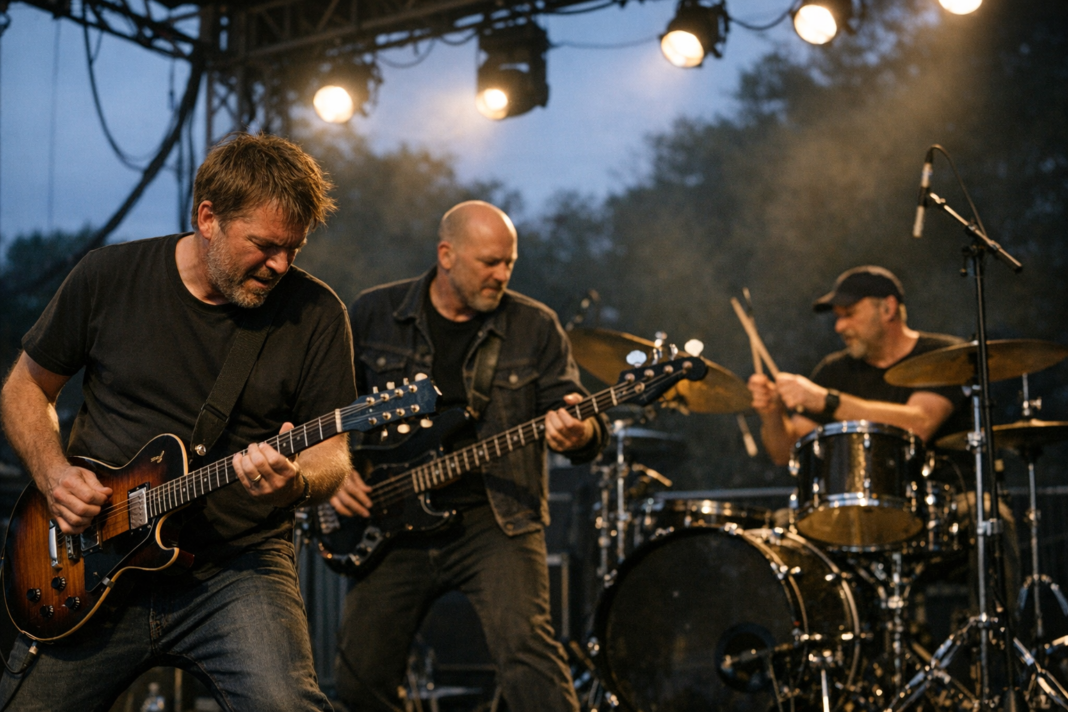

In a Dorset field last Thursday night, Geese closed the opening day of the End of the Road festival with a set that cut through the chill air and a palpable restlessness among the crowd. The New York band’s frontman, Cameron Winter, delivered lines that juxtaposed civic life and religious imagery, prompting thousands of festivalgoers to respond in unison. The performance showcased material from their most recent album, Getting Killed, and underlined why the group has become one of the more talked-about acts on the current festival circuit.
The set leaned on taut arrangements and a blend of urgent guitar work and rhythmic propulsion, a sound that steers a course between punk immediacy and more measured, art-rock ambitions. Winter, who is in his early twenties, often frames his lyrics through elliptical or oblique phrasing; onstage those fragments acquired an immediacy that invited both chant and interpretation. For many in the audience, the band’s music struck a balance between directness and ambiguity, turning brief lyrical provocations into communal moments.
Geese’s appearance at the Dorset festival also speaks to a broader moment for rock-oriented bands attempting to find footing in a crowded musical landscape. The crowd’s scale and intensity suggested that, despite frequent declarations of the genre’s decline, there remains a sizable appetite for live, guitar-led ensembles that pair muscular playing with contemporary lyrical concerns. The band’s control of dynamics and willingness to leave key phrases unresolved kept attention fixed on the stage, even as the songs oscillated between immediacy and a cooler, more considered approach.
While it is too early to map the long-term impact of a single festival performance, the reaction to Geese’s set underlines the role live gatherings still play in shaping reputations and amplifying work that channels current anxieties. Their presentation at End of the Road made clear that, for a segment of young listeners, the band’s combination of intensity, lyrical shade and compositional ambition offers a salient reflection of the present moment rather than a retro revival.





