
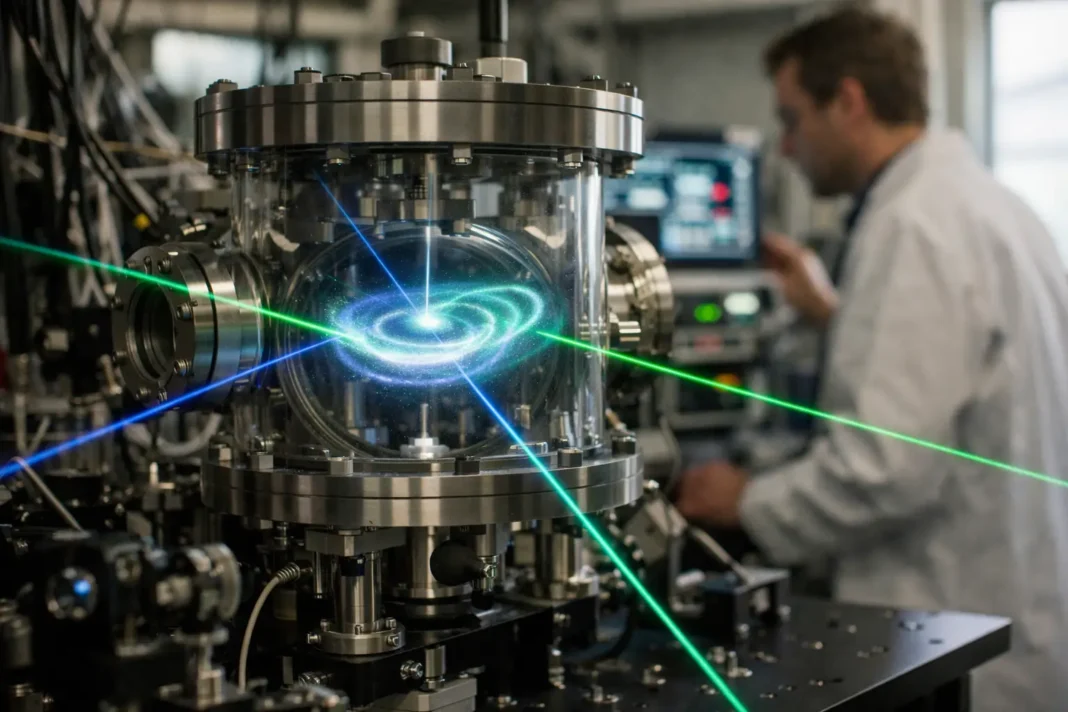

Physicists have discovered a previously unobserved phase of quantum matter: a so‑called “fractional Fermi sea.” In laboratory experiments, ensembles of ultracold atoms settled into a highly excited yet unexpectedly ordered arrangement that does not conform to the familiar organization expected for fermionic systems. The finding highlights gaps in prevailing theoretical frameworks and introduces a new class of many‑body behaviour that researchers are racing to understand.
The experimental platform employed clouds of ultracold atoms cooled and manipulated to probe interactions among fermion-like constituents. Rather than forming the standard Fermi sea—where particles fill available quantum states up to a characteristic energy—the system produced a pattern described as fractional, indicating a novel redistribution of occupation among energy levels. Observers have also reported signatures consistent with emergent quasiparticles that some have provisionally labeled “super‑Fermions.”
This discovery has immediate implications for the study of quantum matter and many‑body physics. The fractional Fermi sea sits outside conventional classifications such as Fermi liquid theory, prompting theorists to revisit assumptions about excitation, stability and collective behaviour in interacting fermionic systems. The state’s coexistence of high excitation and internal order provides a fresh testing ground for mathematical models and numerical simulations aimed at capturing correlated quantum dynamics.
Further experimental and theoretical work is needed to map the boundaries of this new phase, identify the precise nature of the emergent quasiparticles, and determine how robust the phenomenon is to changes in interaction strength, dimensionality and external control. While practical applications remain speculative at this stage, the result expands the catalogue of accessible quantum states and offers a new route for controlled exploration of exotic excitations in engineered atomic systems. The fractional Fermi sea thus represents both a challenge and an opportunity for ongoing research into the foundations of quantum many‑body physics.





