
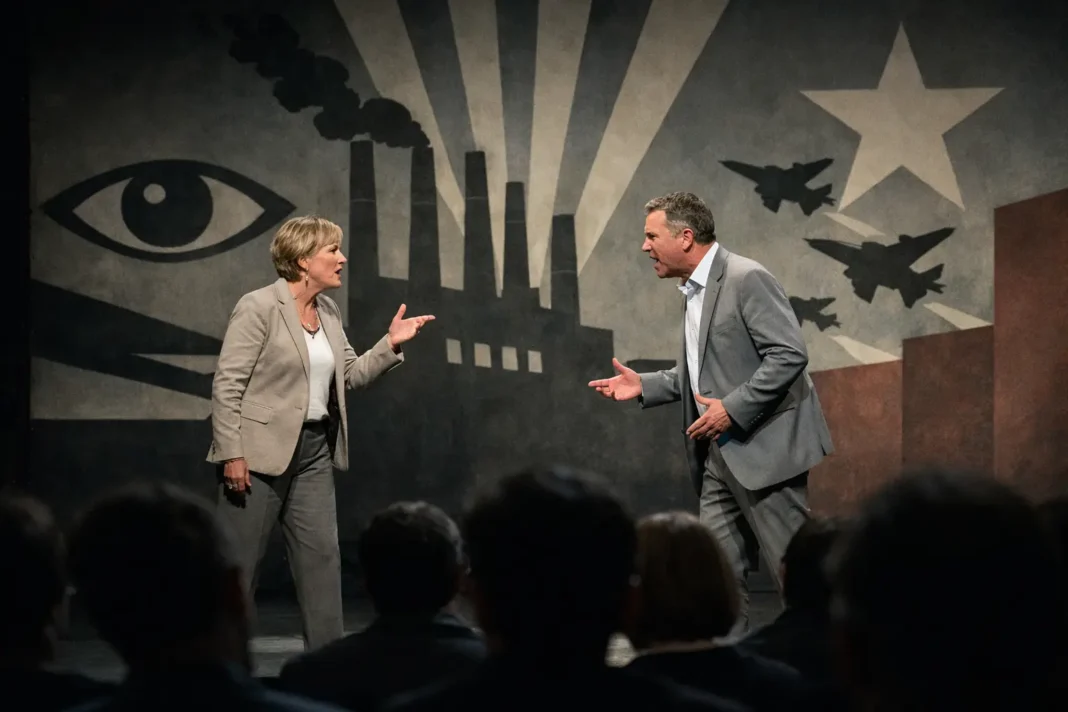

Caryl Churchill’s Triumph has opened at Almeida theatre in London as a compact, pointed response to contemporary politics. Running for roughly 20 minutes, the piece deploys a deliberately spare structure to examine how language and performance sustain harsh, centralized rule. At its narrative core is an uneasy intimacy between a male journalist and a female press officer who adopts a blond wig for her public appearances and speaks as a vigorous defender of an unnamed, vindictive ruler. The production has been presented under the direction of James Macdonald, who has noted Churchill’s persistent anticipation of social shifts.
The play avoids explicit identification of modern leaders, choosing instead to operate through historical analogy and concentrated scenes. That compression strips away contextual clutter and focuses attention on the mechanics of persuasion: scripted responses, staged appearances and the personal compromises that enable them. The decision to leave the strongman unnamed extends the play’s reach beyond any single regime, inviting audiences to consider recurring patterns rather than discrete events. This economy of detail is consistent with recent experiments in dramatic form that favor elliptical, high-intensity moments over extended exposition.
Beyond its formal choices, the work raises questions about the relationship between journalists and the sources they cover, and about the role of image-making in contemporary power. The blond wig functions as a theatrical device that highlights performance as a political tool, while the relationship at the centre of the piece sketches how professional and personal loyalties can intertwine under pressure. By compressing these dynamics into a brief encounter, the play concentrates ethical and practical tensions that often play out more diffusely in public life.
Presented in a prominent London venue, the new work is likely to prompt renewed discussion about how theatre responds to political crises and the limits of representation on stage. Its compact form makes it easy to pair with other short pieces or to include in programmed evenings, and its themes connect to broader debates about media responsibility and the aesthetics of authority. For readers interested in contemporary dramatic practice, the production provides a clear example of how short, focused plays can address large, urgent questions within the space of a single scene. See more on the evolution of modern theatre and political drama in today’s repertoire.





