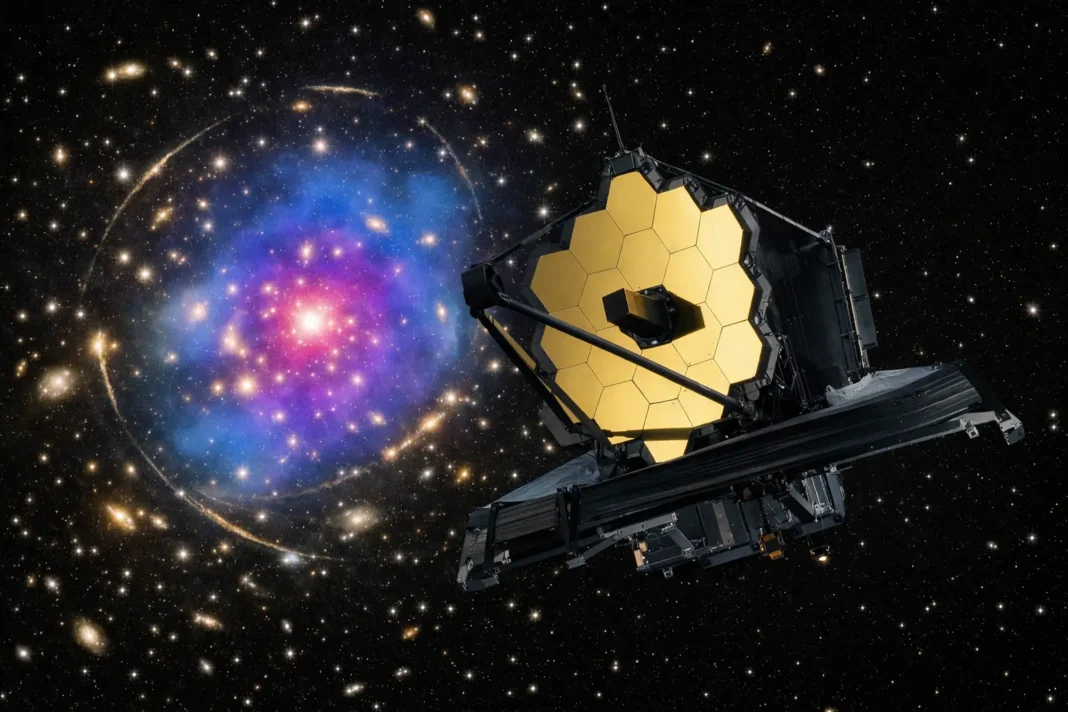

James Webb reveals fresh observations from the NASA James Webb Space Telescope that identify an ancient galaxy cluster with an unusually dense concentration of dark matter. The new data show a strong spatial association between diffuse starlight and the invisible mass that dominates the cluster, offering a different tracer for mass distribution than previously used methods.
The finding highlights an unexpected link between scattered light from old stellar populations and the cluster’s gravitational backbone. Researchers report that areas of faint starlight align closely with regions inferred to contain large amounts of unseen mass, challenging the assumption that dark structures can only be mapped with techniques such as gravitational lensing. This emergent correspondence provides astronomers with a complementary observational handle on where mass resides in the early Universe.
Because standard models of cosmic structure formation predict how and when dark matter should concentrate to form galaxy clusters, the detection of such a compact dark-matter concentration in an ancient system raises questions about the timing and mechanisms of halo assembly. The result does not invalidate existing theory, but it does indicate that current models may require refinement to account for the pace and topology of mass growth in the young cosmos. Follow-up observations and theoretical analysis will be necessary to place the new measurement into the broader cosmological framework.
The discovery also suggests new avenues for studying the dark matter distribution across cosmic time: by combining Webb’s infrared sensitivity to faint starlight with other probes, teams can test whether the observed association holds across different environments and epochs. As analysts mine the telescope’s datasets, the astrophysics community will evaluate how these results affect estimates of mass assembly and the reconstruction of the Universe’s early history without drawing premature conclusions.