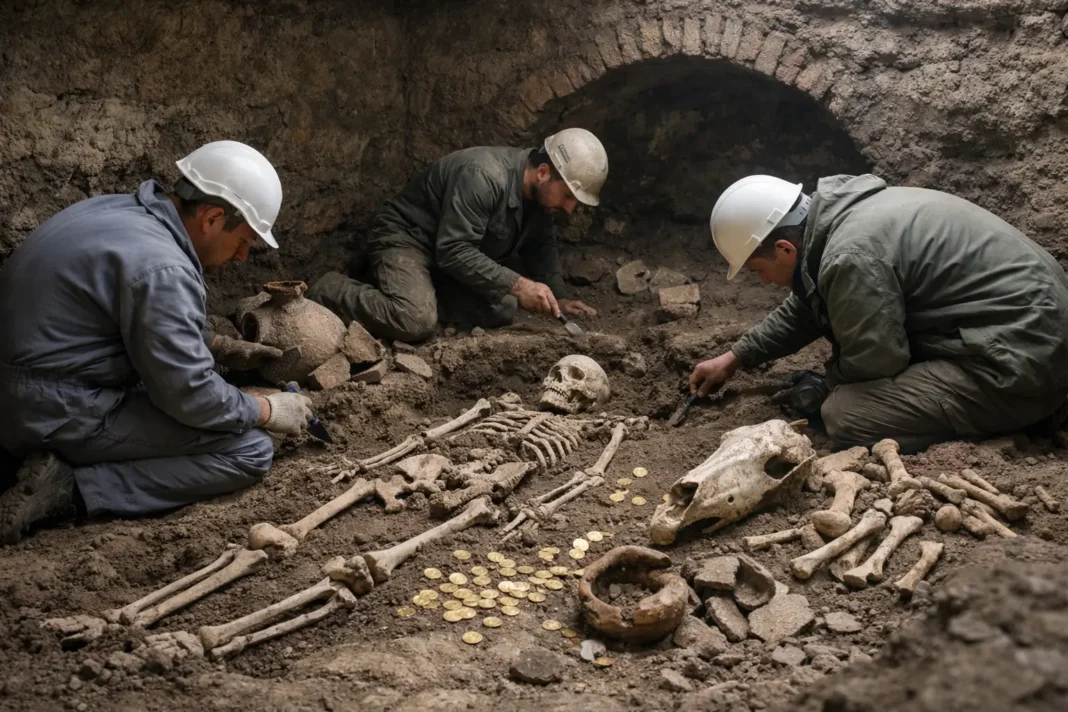

Elite warrior’s 2,000-year-old tomb has been excavated in the Kuban region, east of the Crimea, revealing a centrally placed burial within a necropolis of more than 150 graves. The interment contained a sacrificed horse, iron spearheads and an arrowhead, riding equipment and luxury objects, while two gold staters showing Alexander-style portraits were recovered nearby—one placed beneath the skeleton’s jaw in the manner of Charon’s obol.
The ensemble dates to the early first century BC and has been published in the journal Russian Archaeology. Study authors identify the interred as a noble of the Maeotian people and note that one of the coins bears features associated with Mithridates Eupator (reigned 135–63 BC). Lead author Mikhail Abramzon and collaborators from the Institute of Archaeology at Russia’s Academy of Sciences interpret the gold pieces as prestige items rather than routine currency.
Adjacent to the elite tomb, excavators uncovered a separate burial complex containing the remains of three horses, two cattle, a pig, a dog and a fragment of a human pelvis, which the team regards as evidence of a human sacrifice accompanying animal offerings. Grave assemblages also include a two-handled clay cup, a kantharos, engraved with a pentagram interpreted as a solar protective symbol, and an imported glass alabastron likely from Cyprus or the Levant, indicating long-distance exchange connections across the Black Sea region.
The finds illustrate a blend of local customs and Hellenistic practices linked to the Bosporan and Mithridatic spheres: Greek-style coin portraits and rites such as Charon’s obol sit alongside large-scale animal offerings and equine burials intended to furnish the afterlife. By documenting elite display, ritual deposition and foreign goods in a Maeotian context, the excavation adds nuance to understanding social hierarchy, cross-cultural contact and funerary behaviour on the northern shores of the Black Sea during the late Hellenistic period.