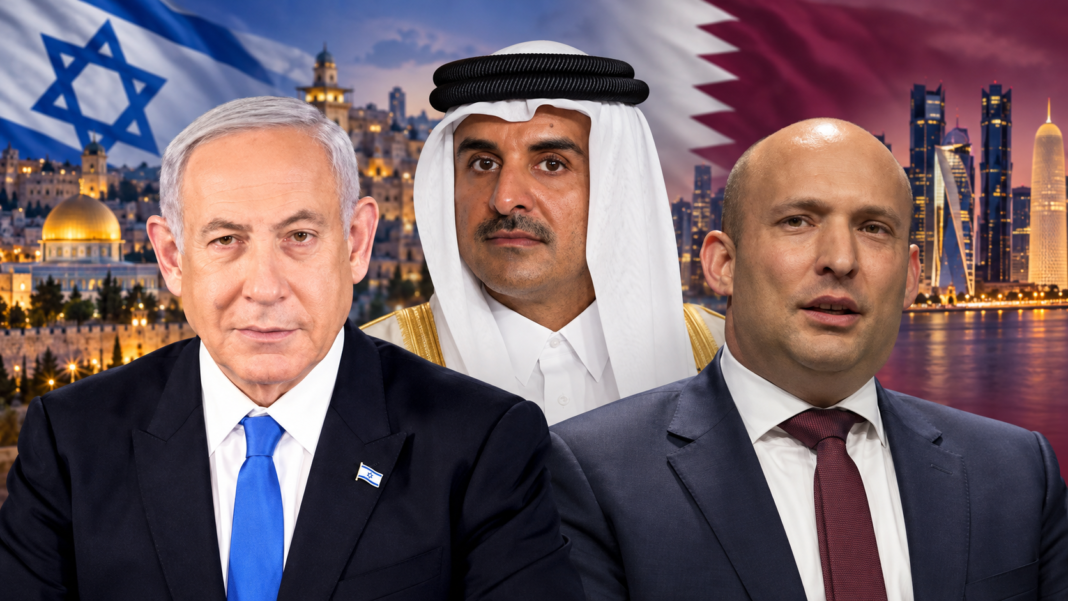

As Israel’s legislative elections, scheduled for October 27, 2026, approach, one player whose name will not appear on any ballot is occupying a striking place in the campaign: Qatar. The Gulf emirate has no candidate, party or voters in Israel. Yet its name, its presumed influence and even the image of its emir have become prominent in Israeli public debate.
When the Emir’s Image Enters the Heart of Israel’s Election Campaign
This does not mean that Qatar controls the campaign or directs Israeli public opinion. Rather, it reveals how Doha has become a reference point through which candidates seek to demonstrate their strength and leadership. In this unusual campaign with three faces, Netanyahu defends his record while hardening his rhetoric against Qatar, Bennett proposes a more radical break, and Sheikh Tamim remains at the centre of the discussion without being a candidate or directly intervening in the elections.
How Did Qatar Become Central to Israeli Political Debate?
Doha’s prominence in Israeli political life marks a significant development. The campaign might ordinarily be expected to focus on the failures surrounding the October 7, 2023 attack, Gaza’s future, Iran, the conscription of ultra-Orthodox Jews and Israel’s institutional divisions. Yet Qatar has become a point at which almost all these issues converge.
For years, the emirate funded aid programmes in Gaza with the approval of Israeli authorities, hosted Hamas’s political office, participated in hostage and ceasefire negotiations, and developed a broad international media presence through Al Jazeera. Today, each of these activities is being reassessed in Israel through the lens of October 7.
Bennett Is Not Defending Qatar — He Proposes a Tougher Break
On July 27, 2026, speaking at a conference organised by the Institute for National Security Studies, Bennett pledged to declare Qatar an “enemy state” immediately if he returned as prime minister.
He accused Doha of being a major supporter of Hamas, financing an extensive international influence network, and seeking to weaken Israel through the media, universities and political networks. Bennett also said that, during his time as prime minister, he had seen intelligence indicating Qatari funding for Iran’s Islamic Revolutionary Guard Corps. Doha rejected this serious allegation.
Netanyahu: From Pragmatic Cooperation to Confrontation With Doha
Benjamin Netanyahu’s policy towards Qatar contains a clear contradiction. For years, his governments allowed Qatari money into Gaza, with the stated purpose of funding salaries, fuel and aid. Netanyahu’s critics, however, argue that this strategy helped consolidate Hamas’s rule.
Since the October 7 attack, Netanyahu has hardened his rhetoric, accusing Doha of hosting Hamas leaders and financing the movement.
“Qatargate” and the Questions Surrounding the Prime Minister’s Office
The Qatar issue became more sensitive with the emergence of the affair known as “Qatargate”, concerning suspected financial and media ties between people close to Netanyahu’s office and entities linked to Qatar.
Several of the prime minister’s aides have been named in the investigations. These allegations remain subject to investigation and judicial assessment; they therefore do not establish Netanyahu’s personal responsibility.
The Doha Strike and Questions About Qatar’s Intelligence Capabilities
Another factor has intensified interest in Qatar’s role: the survival of the senior Hamas leaders targeted by the Israeli strike on September 9, 2025.
The operation killed several people, including Hamas members and a member of Qatar’s internal security forces, but did not kill the principal leaders it targeted. That outcome raised a series of questions: had the targets received advance warning? Had Qatari intelligence anticipated an attack on its territory? Had special measures been taken to protect the officials based in Doha?
A Quiet Power Able to Protect Itself and Negotiate With Everyone
These developments have reinforced Qatar’s image as a small state whose capabilities extend far beyond what its geographical size might suggest. It draws on its energy wealth, international partnerships, strategic relationship with Washington, diplomatic networks and extensive knowledge of regional actors.
Competing to Take the Toughest Position on Qatar
The real electoral question is not a choice between a candidate who supports Qatar and one who opposes it. It is which leader will appear more credible, consistent and effective in dealing with Doha.
Netanyahu can point to his experience, operations against Hamas and the dramatic hardening of his position towards the movement’s leaders based in Qatar. Bennett, meanwhile, seeks to show that the problem can no longer be managed through tactical arrangements and instead requires a complete strategic break.
This political competition, however, carries significant risks. Formally designating Qatar an enemy state could affect indirect economic ties, diplomatic channels, hostage negotiations and coordination with Washington, which maintains an important strategic partnership with Doha.
Does Qatar Really Determine the Future of Israeli Politics?
It would be an exaggeration to say that Qatar “decides” the outcome of Israel’s elections without evidence of direct interference capable of determining voters’ choices.
Electoral sovereignty belongs to Israeli citizens. The result will depend primarily on domestic issues, party alliances, the government’s record and each camp’s ability to secure a Knesset majority.
Yet it would also be mistaken to dismiss Doha as a peripheral issue. Through its role in Gaza, contacts with Hamas, mediation efforts, financial power, diplomatic capabilities, media influence and the controversy surrounding some of Netanyahu’s aides, Qatar has indirectly helped shape the campaign’s themes.
Its significance lies not in acting as an arbiter who chooses Israel’s next prime minister, but in serving as a political and strategic test that forces each candidate to define their approach to security, diplomacy and government responsibility.
Qatar will not cast a ballot, but its presence is pushing candidates to reveal their regional outlook to voters.
A Third Candidate Whose Name Will Never Appear on a Ballot
Whatever the outcome of the October 27 elections, relations between Israel and Qatar will not end with the campaign.
Israel will retain its right and duty to protect its security, demand full transparency concerning foreign influence and rigorously investigate allegations affecting state institutions. Qatar, for its part, will probably continue to defend its mediation diplomacy and reject accusations it considers politically motivated.
Despite their deep differences, both sides retain an interest in preventing an uncontrolled escalation and preserving mechanisms capable of delivering tangible results.