
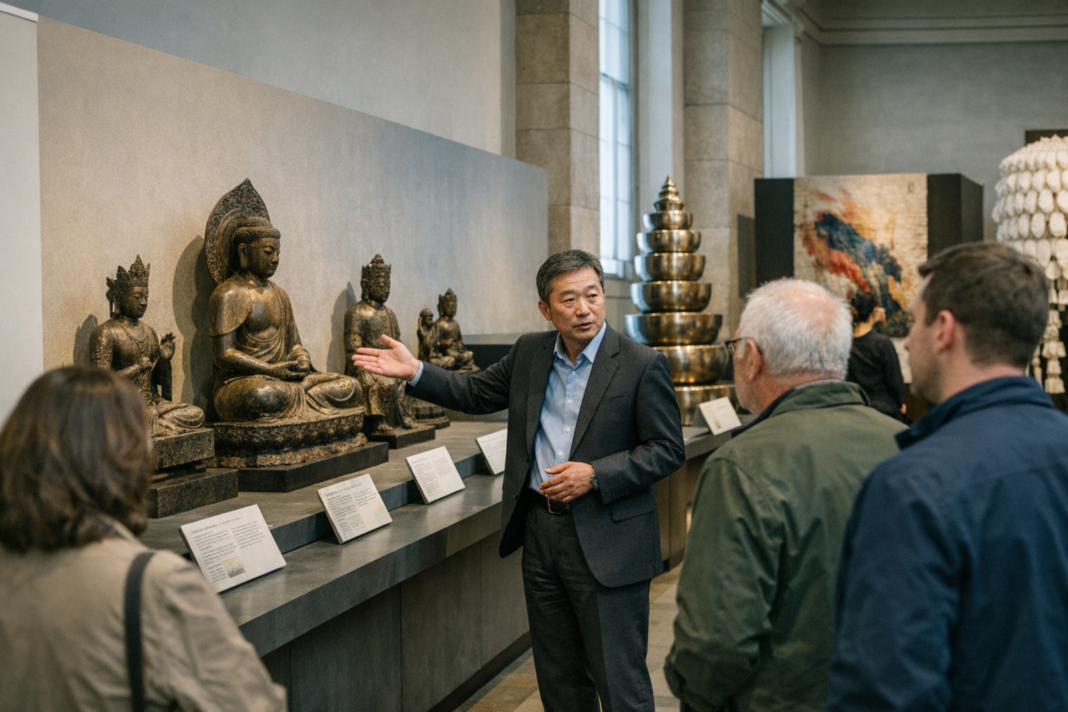

A journey through Korea at the British Museum presents an extensive panorama of material culture spanning two millennia. The exhibition assembles ceramics, metalwork, religious objects and manuscripts to trace long artistic currents that shaped the peninsula before the upheavals of the last century. Visitors encounter craftsmanship that combines technical innovation with refined aesthetics, and a curatorial narrative that aims to move from early ritual and devotional production toward later secular and modern responses. This survey follows the museum’s recent high-profile shows and arrives with heightened public attention.
The early galleries are dominated by contemplative objects: earthenware vessels with subtle glazes, a cast bronze bell from the eighth century adorned with dragons and floral motifs, hand-copied sutras and delicate bodhisattva figures that reflect Buddhist influence. Sound elements and carefully lit displays amplify the spiritual tone. Together they illustrate dialogues with neighbouring cultures and the steady development of local techniques. The show frames these centuries as a period of sustained artisan creativity, inviting reflection on craft, ritual and the visual languages that informed daily and spiritual life in Korea.
That continuity is interrupted by the exhibition’s account of the modern era, where twentieth-century turmoil reshapes the story. Objects from the recent past and works that reference rupture appear alongside centuries-old pieces, creating stark contrasts that underline loss, displacement and new artistic directions without softening their impact. The transition forces visitors to confront how political and social upheaval altered production, preservation and memory. Curatorial decisions about sequence and display thus become part of the narrative, emphasising both what survived and the gaps left by conflict and rapid change.
The show contributes to ongoing conversations about how major institutions present national histories: it both celebrates enduring skills and acknowledges a fractured passage into modernity. For the British Museum the exhibition is a test of balancing spectacle and scholarship, joining other headline displays that shape public perceptions. By gathering objects across centuries the display offers scholars and the public a concentrated encounter with Korea’s artistic legacy, while prompting questions about narrative framing and the role of museums in presenting contested pasts.





