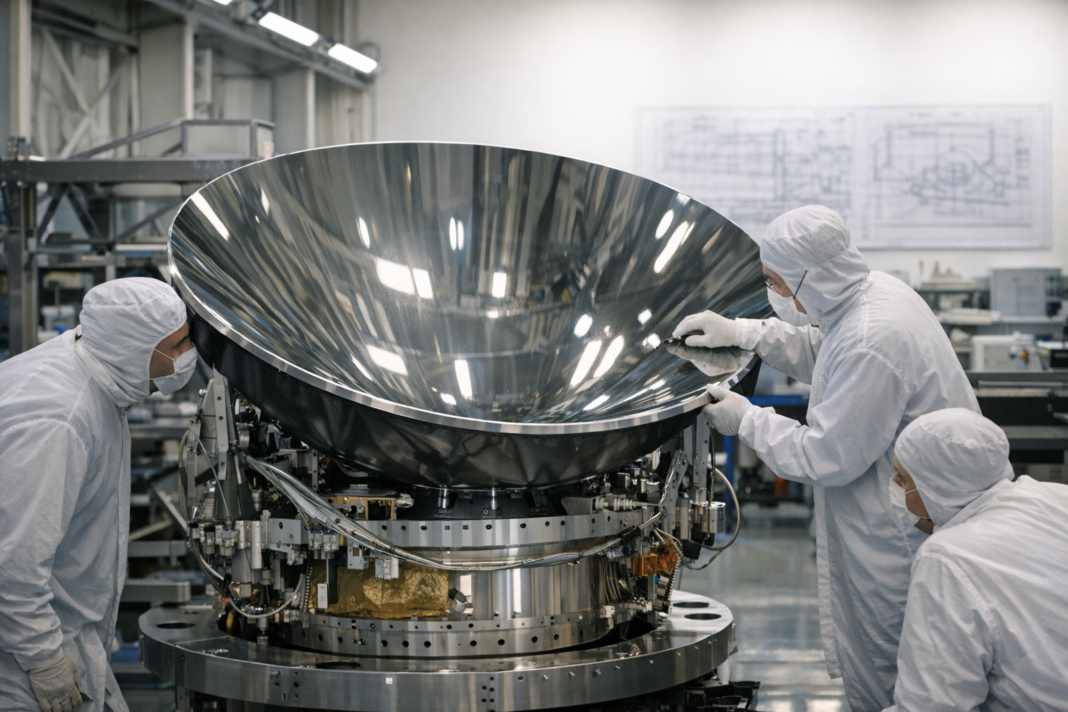

NASA selects PRIMA for further development, advancing the Probe far‑Infrared Mission for Astrophysics into the preliminary design and technology phase. NASA managers will review progress through Phase B before a final approval to proceed toward construction and launch; if the schedule holds, the mission could fly for five years starting no earlier than 2033. The effort has a project cost cap of $1.2 billion, excluding launch and other nonproject expenses.
PRIMA centers on a 1.8‑metre telescope optimized for the far‑infrared portion of the spectrum, covering wavelengths longer than those targeted by the James Webb Space Telescope. The instrument suite is designed to probe the chemical and physical conditions in planet‑forming disks, trace the role of water and measure total gas masses and elemental abundances that reveal where and how worlds assemble. Researchers expect PRIMA measurements to complement existing facilities and to extend studies of exoplanets, galaxy assembly and the growth of black holes. Meredith MacGregor, an associate professor studying planetary system formation, has highlighted that key spectral lines needed for these questions lie only in the far‑infrared.
University of Maryland and Caltech, both partners in mission development, have flagged scientific opportunities spanning star formation, molecular outflows and the interplay between galaxies and their central black holes. Caltech co‑investigator Lee Armus emphasized the mission’s potential to map powerful molecular winds and their influence on star formation over cosmic time, while UMD co‑investigator Alberto Bolatto noted the value of a new instrument that broadens the community’s observational capabilities. For context, PRIMA’s budget cap is modest compared with the roughly $10 billion launch cost of JWST.
PRIMA is the first selection in NASA’s new Probe Explorers class, an intermediate scale of missions endorsed by the 2020 Decadal Survey. Two probe concepts received seed funding in 2024 and were evaluated before PRIMA was chosen over the Advanced X‑ray Imaging Satellite. If the project continues to meet technical and programmatic milestones, the mission will be managed by JPL with contributions from multiple centers and international partners, subject to remaining reviews and approvals.