
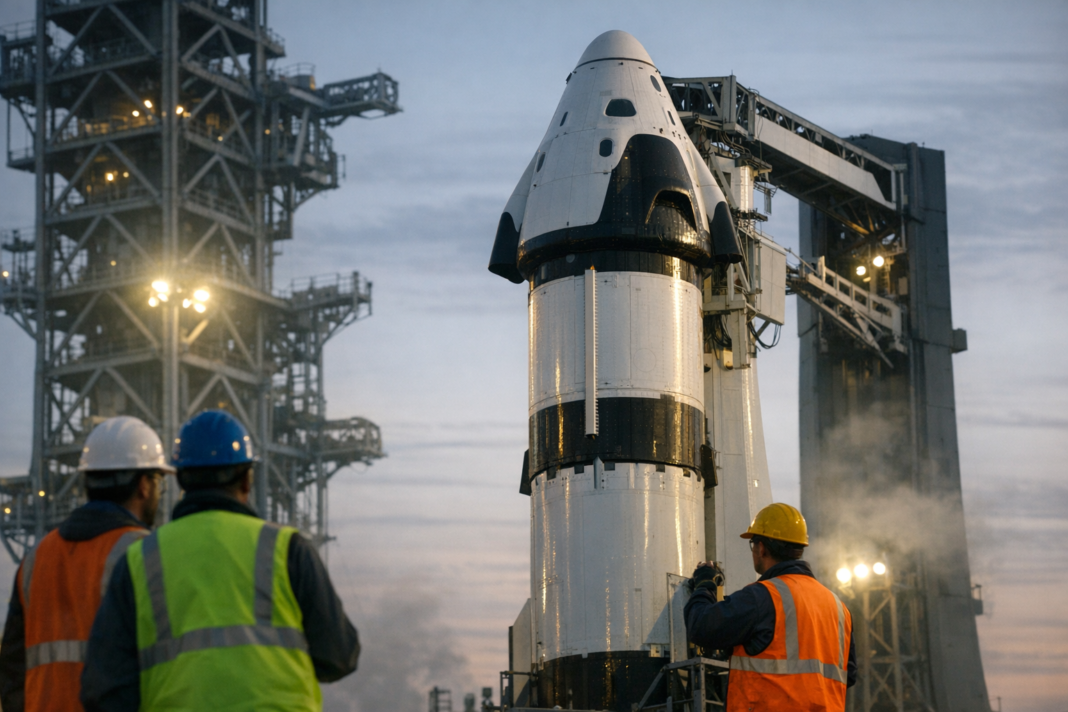

NASA’s Crew-13 launch is scheduled to lift four astronauts toward the orbital laboratory on October 1. SpaceX‘s Dragon spacecraft is targeting a rendezvous of approximately 7 hours and 50 minutes after liftoff, a transit time that would mark the fastest U.S. crewed journey to the ISS in history if achieved.
The accelerated approach relies on carefully timed orbital phasing and automated rendezvous procedures that compress the interval between launch and docking. Mission teams coordinate launch windows and orbital mechanics to allow Dragon to climb directly into the station’s orbital plane and close the gap rapidly, reducing the interval between astronauts leaving Earth and beginning work aboard the station.
A shorter transit can have practical advantages for crewed missions. Arriving sooner enables astronauts to commence scheduled scientific activities and station maintenance without a prolonged in-orbit acclimation period, and it may simplify planning for payloads and time-sensitive experiments. The mission continues the operational partnership between NASA and SpaceX to provide regular crew rotation and cargo support to the International Space Station.
Officials have outlined the launch schedule and mission milestones on agency platforms; those seeking real-time updates and official briefings can consult the agencies’ websites. If the planned timing holds, the Crew-13 flight will set a new U.S. benchmark for rapid transfer to low Earth orbit and underscore the evolving cadence and capabilities of crew transportation services to the ISS.





