HomeOpinionEstonia’s Memory Frames Europe’s Unease Over Trump and Putin

Estonia’s Memory Frames Europe’s Unease Over Trump and Putin

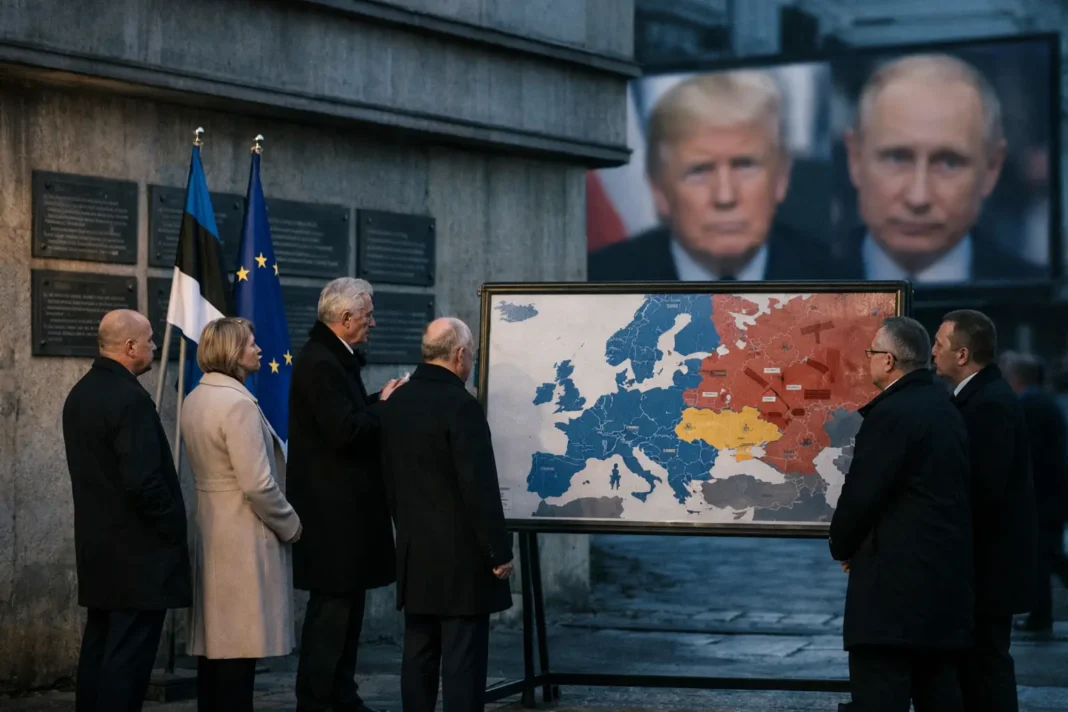
Europe’s security debate is increasingly shaped by two linked pressures: the war on Ukraine’s frontline and the political choices being made inside Western democracies. The prospect of closer alignment between Donald Trump and Vladimir Putin has sharpened concern across the continent, particularly in countries that have direct historical experience of Russian domination. For them, European security is not an abstract policy field but a question tied to borders, sovereignty and national survival.

In Tallinn, the headquarters of the Estonian Government carries that history in stone. On the facade of Stenbock House, the prime minister’s office, a plaque commemorates ten Estonian heads of government killed by Soviet forces after the USSR invaded Estonia in 1940. The country then spent 51 years under Soviet occupation before restoring independence in 1991. Today, with a population of about 1.4 million, Estonia remains acutely aware of the strategic imbalance with its much larger neighbour.

That memory explains why the Baltic states view the outcome of Russia’s war against Ukraine as central to their own security. Estonia is a member of the NATO alliance and the European Union, but its political culture is marked by the belief that deterrence depends on clarity, unity and sustained support for Kyiv. Any weakening of Western resolve is seen not only as a setback for Ukraine, but as a signal that could affect the calculations of Moscow.

The political risk for Europe is that security policy is also being contested at the ballot box. Parties and movements sympathetic to strongman leadership, sceptical of military aid to Ukraine or hostile to European integration have gained ground in several countries. Their rise does not automatically translate into a single foreign policy line, but it complicates consensus at a time when long-term decisions on defence spending, sanctions and alliance commitments are required.

Estonia’s commemorative plaque gives a concrete form to a broader European anxiety: the continent’s future may be shaped simultaneously by military developments in Ukraine and by electoral shifts inside democratic states. For governments on Europe’s eastern flank, the lesson of the twentieth century remains immediate. Sovereignty can be lost when external force meets internal division, and the cost is measured over generations.


Advertisementspot_imgspot_img

Hot this week

Hera’s New View of Didymos Sharpens the Case for Planetary Defence

Europe’s Hera spacecraft has revealed a cratered face of Didymos as it studies the legacy of NASA’s 2022 asteroid impact.

Palestinian Memory Takes Form in Stone, Poetry and Ruins at IMMA

A Dublin exhibition brings Palestinian and Levantine artists into dialogue with memory, displacement and historical violence.

Milburn Review Calls for System Reset to Tackle Youth Worklessness

Alan Milburn’s review calls for sweeping changes to education, work and welfare to help 440,000 young people into jobs.

New Hunger Games Cast Steps Into a Franchise Built on High Expectations

The new Hunger Games prequel arrives today, with its cast acknowledging the pressure of entering a major dystopian franchise.

Van Gerwen raises the bar before Wade test at the Grand Slam

Michael van Gerwen says he must produce his best game to beat James Wade in their Grand Slam of Darts second-round meeting.

Bond’s Next Leading Lady Faces a Role Under Scrutiny

Speculation around Robert Pattinson and the next Bond film renews debate over how the franchise should shape its female lead.

Verstappen and Antonelli Take Centre Stage as Ferrari Tension Rises in Las Vegas

Max Verstappen and Kimi Antonelli battled for the Las Vegas GP lead as Ferrari faced a costly intra-team collision.

Why the Long Novel Still Belongs to Winter

A new literary feature highlights why expansive novels suit the colder months, from Don DeLillo to Eleanor Catton.

New Clock Test Could Probe Whether Time Has a Quantum Split

Scientists propose using ultra-sensitive atomic clocks to test whether time can follow multiple flows at once.

PTSD Leaves Distinct Epigenetic Signatures in the Brain, Study Finds

A postmortem brain study identifies DNA methylation patterns tied to PTSD, distinct from depression and strongest in the prefrontal cortex.

Next Stops Sales of Baby Sleeping Bag After Mother Flags Safety Risk

Next has stopped selling a baby sleeping bag after a mother warned its large neck opening could cover an infant’s face.

Burnham Sees UK-EU Deal as a Platform for Deeper Cooperation

Andy Burnham says the UK should pursue closer EU ties after a new deal on food exports, emissions trading and youth mobility.

Tech Sell-Off Pulls Wall Street Deeper as AI Pressure Hits Sentiment

US markets fell as technology stocks weakened, pushing the S&P 500 and Dow into correction territory amid pressure on Anthropic shares.
Advertisementspot_img

Related Articles
