
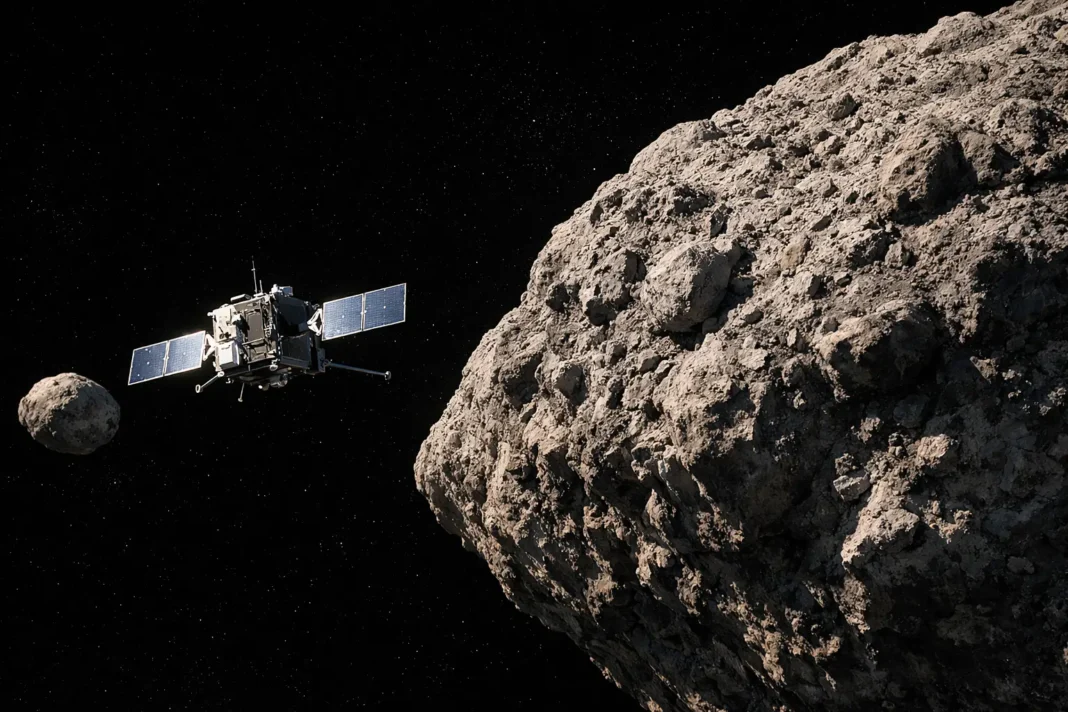

A European spacecraft has opened a fresh window onto Didymos, revealing a crater-marked face of the asteroid system that became central to humanity’s first full-scale test of asteroid deflection. The images add a new layer to the scientific story that began when NASA deliberately struck the smaller body in the system in 2022, an experiment designed to test whether a hazardous object in space could be nudged off course.
The mission now in focus is ESA’s Hera, Europe’s follow-up investigation into the Didymos system. Its target is not only the larger asteroid, Didymos, but also the consequences of the impact delivered by NASA’s Double Asteroid Redirection Test, known as DART. That collision hit Dimorphos, the small moonlet orbiting Didymos, and changed its motion, turning a theoretical approach to planetary defense into a measured space experiment.
The newly revealed terrain on Didymos matters because the structure, surface and composition of asteroids influence how they respond to force. Craters, boulders and surface texture can help scientists reconstruct an object’s history and understand whether it is a solid body, a loose aggregate of rubble, or something in between. For a deflection strategy, those details are not academic: the same impact can produce different results depending on the target’s density, cohesion and shape.
Hera is designed to examine the aftermath of DART with a level of detail that was not possible during the original impact mission. By studying the altered asteroid system, scientists aim to refine measurements of the collision and improve models used to predict how future deflection attempts might work. The effort links observation, engineering and risk planning in a field where precision is essential and where assumptions must be tested against real objects in space.
The Didymos investigation has broader significance because asteroid deflection is one of the few natural-hazard scenarios in which early detection and intervention could, in principle, change the outcome. No single mission can provide a complete defence system, but the combined work of NASA and ESA is helping define the practical steps needed to assess a threat, choose a response and measure its effect. Hera’s view of this cratered world is therefore more than a scientific portrait: it is part of the evidence base for protecting Earth from future impacts.






