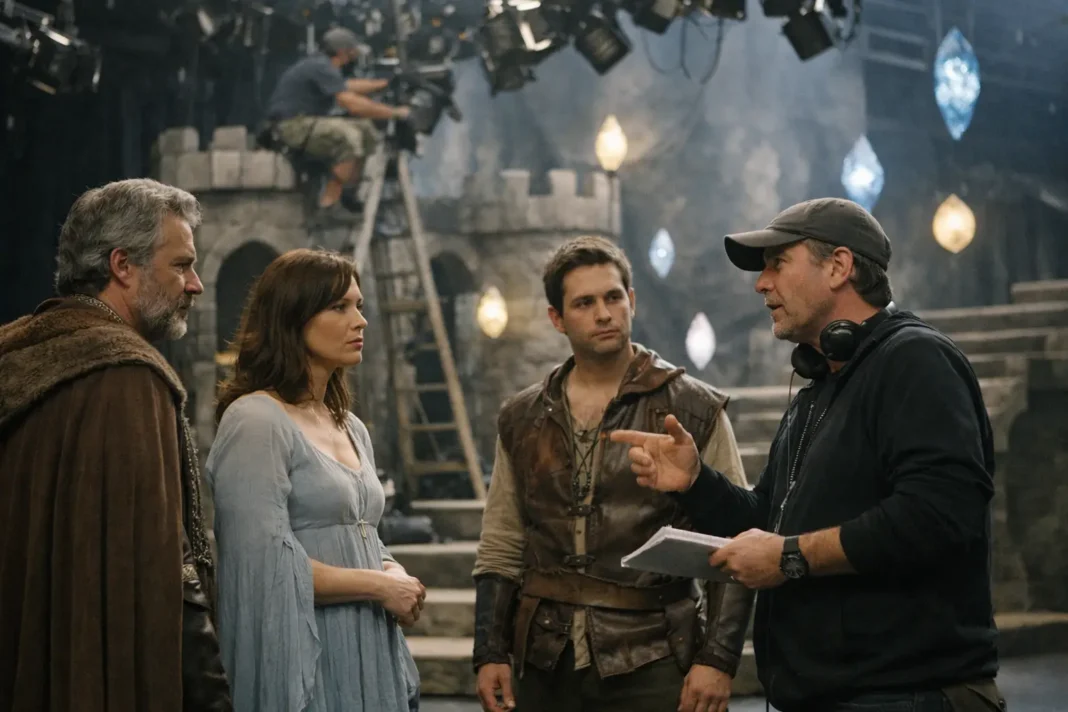

After a decade-long international run, the two‑part stage production of Harry Potter and the Cursed Child is undergoing a major rework that reduces the story into a single evening. The change has set the creative team and company to work rethinking transitions, scene order and the logistics that supported a show conceived in two parts. In a rehearsal room that still bears the marks of long touring life, movement exercises, prop checks and rapid costume adjustments underline how much must be reorganised when a sprawling theatrical event is tightened.
Inside that rehearsal space, movement director Nuno Silva rehearses a summoning gesture while cloak and luggage choreography is practised in sequence, and associate director Nicola Samer takes notes with cast members between runs. Technicians adjust sound cues and costume fittings continue apace: practical, hands‑on work that points to the complexity of compressing a layered narrative that relied on shifts of time, place and spectacle. The company’s immediate task is to preserve the story’s key beats while making movement and technical transitions seamless.
Condensing two parts into one imposes creative limits that affect staging, pacing and actor doubling. Scenes that once had room to breathe will need tighter economy; technical set pieces and illusions must be reoriented to new entrances and call times; and the rhythm of dramatic reveals will have to be recalibrated for a single continuous performance. These are structural challenges as much as artistic ones, and the rehearsal process is serving as a laboratory where timing, clarity and effect are tested together.
The revision will also change how audiences experience the narrative in a single sitting rather than across two sessions, with implications for accessibility and scheduling. As rehearsals continue, the creative team appears focused on preserving the production’s theatrical identity while adapting its mechanics to the streamlined format. Observing the company at work reveals the meticulous craft behind large‑scale theatre and the practical trade‑offs that come with reimagining a spectacle for a different mode of presentation. For now, the final form will be judged on how successfully it balances narrative compression with the technical ambitions that defined the original staging.