HomePoliticsUAE and Jordan Foreign Ministers Abdullah bin Zayed and Ayman Safadi Lead...

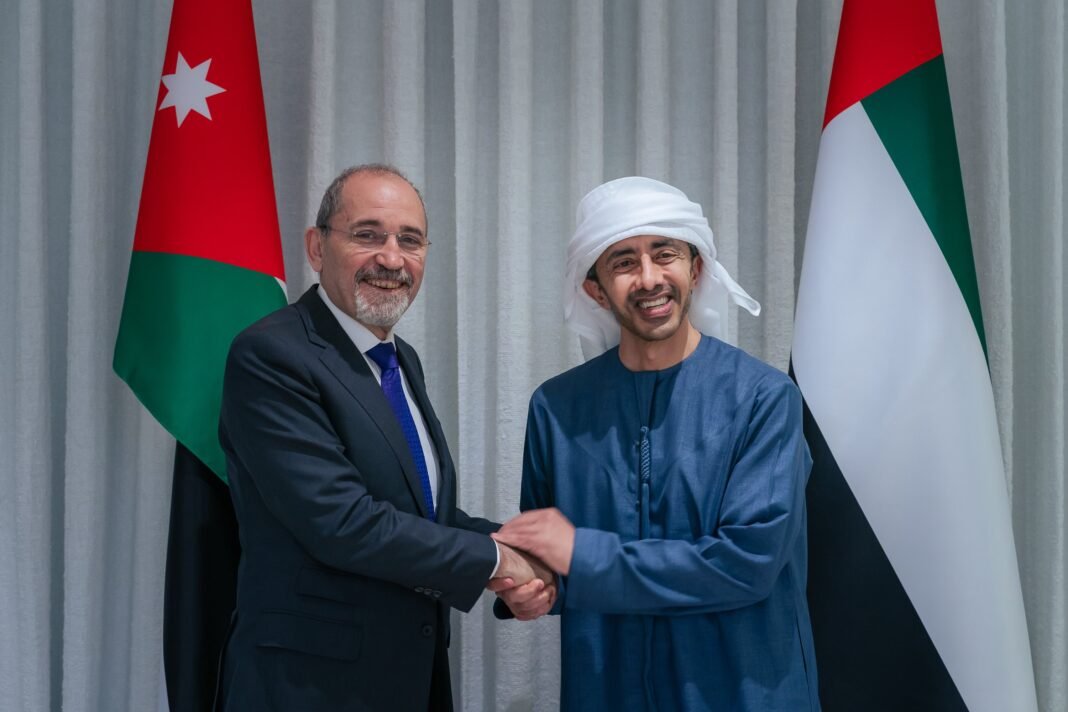
UAE and Jordan Foreign Ministers Abdullah bin Zayed and Ayman Safadi Lead High-Level Diplomatic Coordination Amid Rising Regional Tensions

At a time of mounting regional instability and shifting geopolitical dynamics, the meeting between , Minister of Foreign Affairs of the United Arab Emirates, and , Deputy Prime Minister and Minister of Foreign Affairs of Jordan, stands out as a strong signal of strategic coordination between two key Arab diplomatic actors.

Far from being a routine diplomatic engagement, the discussions reflect a shared determination by Abu Dhabi and Amman to deepen their cooperation in response to increasingly complex regional challenges, where security, energy, and economic concerns are closely intertwined. Both ministers, central figures in shaping their countries’ foreign policy, conducted a comprehensive assessment of ongoing developments across the Middle East.

Regional security featured prominently in the talks. The two leaders emphasized the importance of safeguarding international maritime routes, which are vital to global trade, as well as ensuring the stability of energy supplies in a context of heightened tensions that could disrupt global economic balances.

In this regard, Abdullah bin Zayed and Ayman Safadi underscored the urgent need to prioritize diplomatic channels and multilateral initiatives to contain escalation risks. They advocated for strengthened regional and international dialogue, promoting an approach centered on de-escalation, cooperation, and sustainable political solutions rather than confrontation.

The meeting also addressed broader international efforts aimed at stabilizing the region. Both ministers stressed the importance of coordinated global action to effectively respond to the multifaceted challenges facing the Middle East, highlighting diplomacy as a critical tool for crisis prevention.

The Palestinian issue was another key focus of the discussions. The two sides reviewed the latest developments in Gaza, the West Bank, and Jerusalem, calling for increased humanitarian support for civilians and renewed efforts toward a credible political process leading to a just and lasting solution.

Beyond immediate crises, the meeting reflects the positioning of the United Arab Emirates and Jordan as moderate and pragmatic diplomatic actors committed to regional stability. Their coordinated approach underscores a shared ambition to play an influential role in shaping regional dynamics through dialogue and balanced diplomacy.

Ultimately, this high-level exchange confirms that cooperation between Abu Dhabi and Amman extends beyond bilateral relations, forming part of a broader vision aimed at regional stabilization. Through the leadership of their foreign ministers, both countries seek to actively contribute to diplomatic solutions to the Middle East’s ongoing challenges, at a time when political pathways remain essential to preventing further escalation.


Advertisementspot_imgspot_img

Hot this week

Far-right AfD Takes Large Lead in Saxony-Anhalt Vote, Falls Short of Majority

AfD projected at 44% in Saxony-Anhalt, conservatives at 17%, leaving the far-right short of an outright majority and reshaping regional politics.

Emergency department failings behind rising clinical negligence claims, families say

A BBC analysis links cases like Oli's to a wider rise in clinical negligence claims in England and highlights pressure on services and families.

Rattlesnake blood reveals potent proteins that neutralize multiple venoms

Toxin-blocking proteins in rattlesnake blood neutralize multiple venoms and showed about 10x potency versus a commercial antivenom in lab tests.

How Colin From Accounts Found a Quiet, Satisfying Finale

The modest rom-com concluded with a measured finale that rewarded character work and restraint, confirming its place in contemporary TV.

Study finds removing AI ‘consciousness’ guardrails reshapes beliefs and empathy

A preprint shows disabling consciousness-suppression in AI raises supernatural beliefs and affects attributions of mindedness to animals.

How a Warming Planet Is Rewiring Infection Risk and Drug Resistance

Rising temperatures and extreme weather are expanding vector ranges, increasing outbreaks and driving antibiotic resistance, experts warn.

Patients’ cancers progress as waits lengthen despite government pledge on timeliness

Analysis finds cancer services in England have deteriorated since a government pledge to cut waiting times, with consequences for patient outcomes.

Couple Rebalance Retirement Plans After Becoming Parents: Why He Began Paying Into Her Pension

A couple restructured their savings after having a child, with the husband contributing to his partner's pension to protect long-term security.

Houthi Capture of Mokha Raises Stakes for Red Sea Shipping

Houthi forces have taken Mokha port, heightening risks to traffic through the Bab al-Mandab and Red Sea shipping lanes.

Parliament faces a decisive vote on assisted dying law

A pivotal Commons vote on the assisted dying bill will decide whether terminally ill adults can request medical assistance to end their lives.

Rybakina Upsets Gauff, Sets Final with Sabalenka

Elena Rybakina beat Coco Gauff to reach the US Open final, where Aryna Sabalenka awaits after defeating Jessica Pegula.

A Joyful Look Back: Pulp’s Legacy, New Film and the Stories Behind the Songs

A new film revisits 's history with Jarvis Cocker and Garth Jennings, exploring songs, fans and the possibility of new music.

Two Decades of Change: How 9/11 Reshaped Security, Health and Memory

The 9/11 attacks transformed security, health responses and public memory, with lasting effects on policy, first responders and global politics.
Advertisementspot_img

Related Articles
