

In the 2026 legislative session, Georgia passed two laws that represent one of the most serious state-level responses to antisemitism and foreign government influence in education in the country.
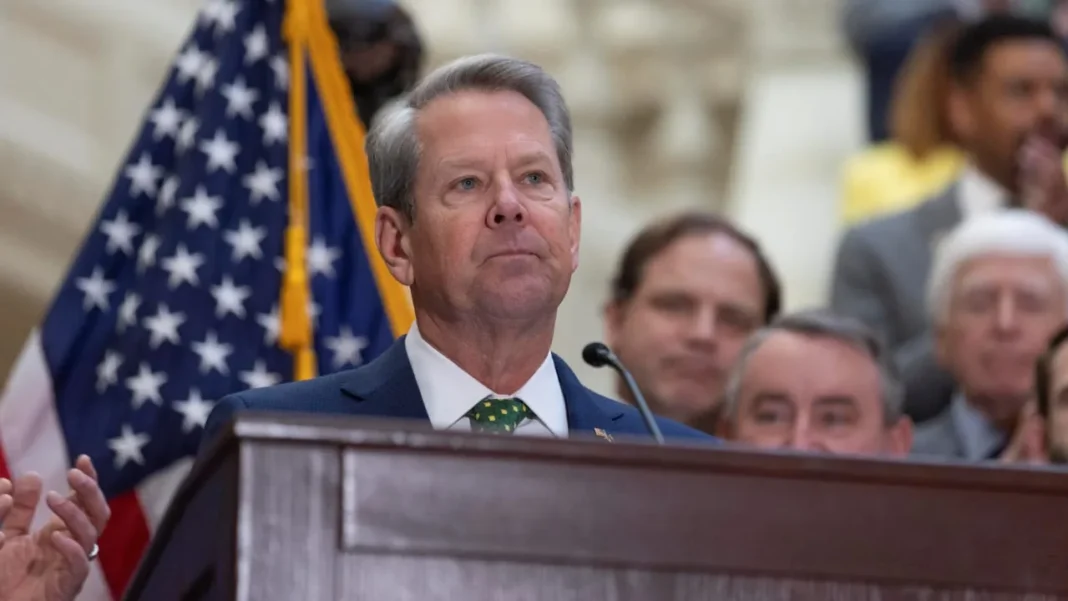
The bills are on Governor Brian Kemp’s desk awaiting signature. They deserve to be replicated everywhere.
Giving civil rights law
Federal civil rights law already prohibits discrimination against Jewish students. The problem has never been the standard – it has been the enforcement. When complaints are filed, institutions delay and cases drift. Nothing happens. For decades, the federal government has treated this as inevitable.
Georgia’s SB 523 fixes it at the state level. The law designates a statewide Title VI Coordinator for K–12 schools, requires the University System of Georgia and the Technical College System to implement civil rights enforcement procedures and, most importantly, authorizes withholding state funding from any institution that fails to correct a violation within 30 days.
Other states have passed aspirational language on this. Georgia attached real consequences. That is the difference between a law that works and one that gets filed and forgotten. SB 523 also explicitly adds religion as a protected category under Georgia state law, closing a gap that has left Jewish students exposed for years.
Going where Congress would not
The second law may be even more consequential.
HB 1379 is the first state law in the country to require disclosure of funding from Qatar and Saudi Arabia, the two largest foreign funders of American universities, who have never appeared on any federal accountability framework.
Qatar has funneled an estimated $7.7 billion into American universities since 1986, and Saudi Arabia has been designated a Country of Particular Concern for religious freedom violations by the US State Department since 2004. Georgia went further than Congress was willing to go.
HB 1379 requires every Georgia public school and university to disclose foreign funding above $10,000. The federal threshold is $250,000, and federal law doesn’t cover K–12 schools at all.
By multiple estimates, those federal rules have failed to capture hundreds of millions of dollars flowing into American institutions from Qatar and Saudi Arabia alone. Institutions that fail to disclose face a penalty of three times the undisclosed amount.
The question every state should be asking is how the scale of foreign funding is influencing curriculum, academic priorities, institutional incentives, and campus culture. Georgia answered that question before anyone else was willing to ask it.
A roadmap, not just a victory
We set out to build a model, not score a local win.
The two laws work as a unified framework: one makes civil rights protections enforceable, the other makes foreign funding visible. Together, they address the two channels through which antisemitism takes hold in academic institutions – the failure to act on discrimination, and the foreign money that funds it.
This is not about restricting speech or academic exchange. It is about transparency and enforcement. Every state can do the same. The blueprint now exists in Georgia.
Why it matters
The hostility directed at Jewish students on many campuses has been amplified by institutional failures and funding networks that deserve far greater scrutiny. Georgia’s legislation addresses both, as well as real law, with real enforcement, real deadlines, and real consequences.
This is another reason Georgia is a great place to live, work, and play. Georgia is one of America’s most pro-business states and one of Israel’s most committed partners.
Georgia companies invest in Israeli technology. Israeli innovation creates jobs and capital in Georgia. Delta will launch nonstop service between Atlanta and Tel Aviv this fall.
Georgia and Israel share values, not just interests. The legislators who passed these bills understand that.
The writer is chairman of the Georgia Solidarity Network and founder of the Georgia-Israel Business Alliance. He is the founder and former CEO of GreenSky, acquired by Goldman Sachs.
Source:
www.jpost.com




