
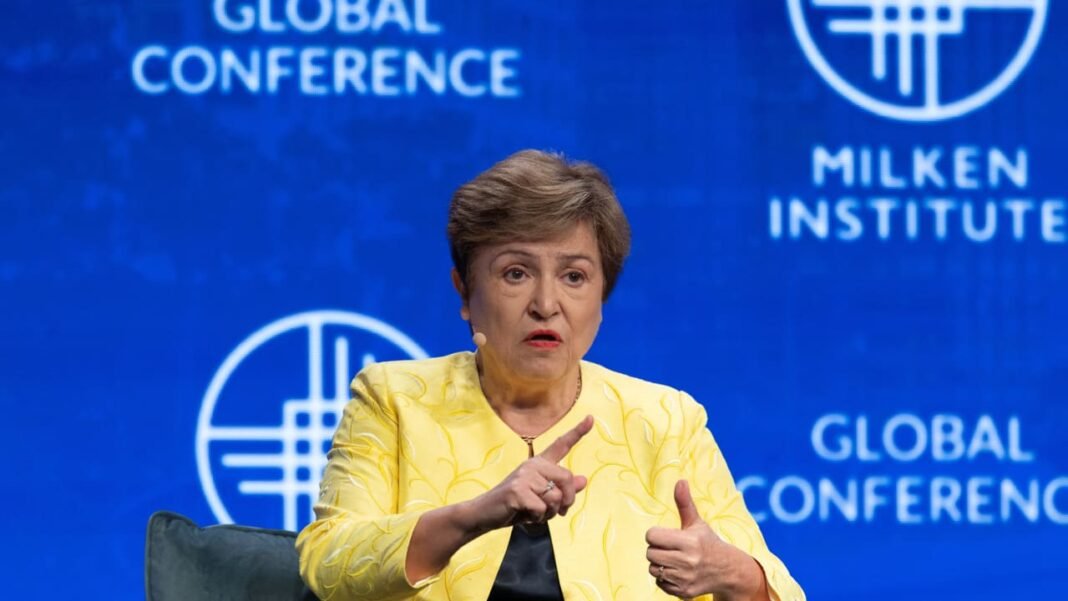

The head of the International Monetary Fund on Monday warned that inflation was already picking up and the global economy could face a “much worse outcome” if the war in the Middle East drags on into 2027 and oil prices hit around $125 per barrel.
IMF Managing Director Kristalina Georgieva said the continuation of the war meant that the global lender’s “reference scenario,” assuming a short-lived conflict, which forecast a minor growth slowdown to 3.1% and a minor increase in prices to 4.4%, was no longer possible.
“This scenario, with every day that passes, is further and further behind in the rear-view mirror,” Georgieva said.
The continuation of the war, a forecast of oil prices at or above $100 per barrel, and rising inflationary pressures meant the IMF’s “adverse scenario” was already in effect, she said.
Long-term inflation expectations remained anchored, and financial conditions were not tightening, but that could change if the war continued, she told a conference hosted by the Milken Institute.
“Now, if this continues into 2027 and we have oil prices of $125 more or less, then we have to expect a much worse outcome,” she said. “Then we are going to see inflation climbing up, and then inevitably, inflation expectations would start de-anchoring.”
Three possible scenarios for global GDP growth path
The IMF last month issued three scenarios for the global GDP growth path in 2026 and 2027 amid massive uncertainty over the war in the Middle East: the main “reference forecast,” a middle “adverse scenario,” and the much worse “severe scenario.”
The adverse scenario forecasts global growth slowing to 2.5% in 2026 and headline inflation of 5.4%. The severe scenario forecast growth of just 2% and headline inflation of 5.8%.
Chevron Chairman and CEO Mike Wirth, speaking on the same panel, said that physical shortages in oil supply would begin appearing around the world because of the closure of the Strait of Hormuz, through which 20% of global crude supply passed before the war.
Economies will begin shrinking, first in Asia, as demand adjusts to meet supply while the strait remains closed because of the US-Israeli war with Iran, Wirth said.
Georgieva said the IMF was carefully tracking the slow-moving impact of the conflict on supply chains, with fertilizer already 30% to 40% more expensive, which would drive food prices up between 3% and 6%. Other industries could also be affected.
‘It is really serious’
“What I want to stress is that it is really serious,” she said, expressing concern that many policymakers were still acting as if the crisis would end in a couple of months and were putting in place measures to cut the impact on consumers and business, which was keeping demand for oil high.
“Don’t throw gasoline on fire,” she said. “Everybody in this room knows that if your supply shrinks, your demand has to follow.”
Source:
www.jpost.com




