
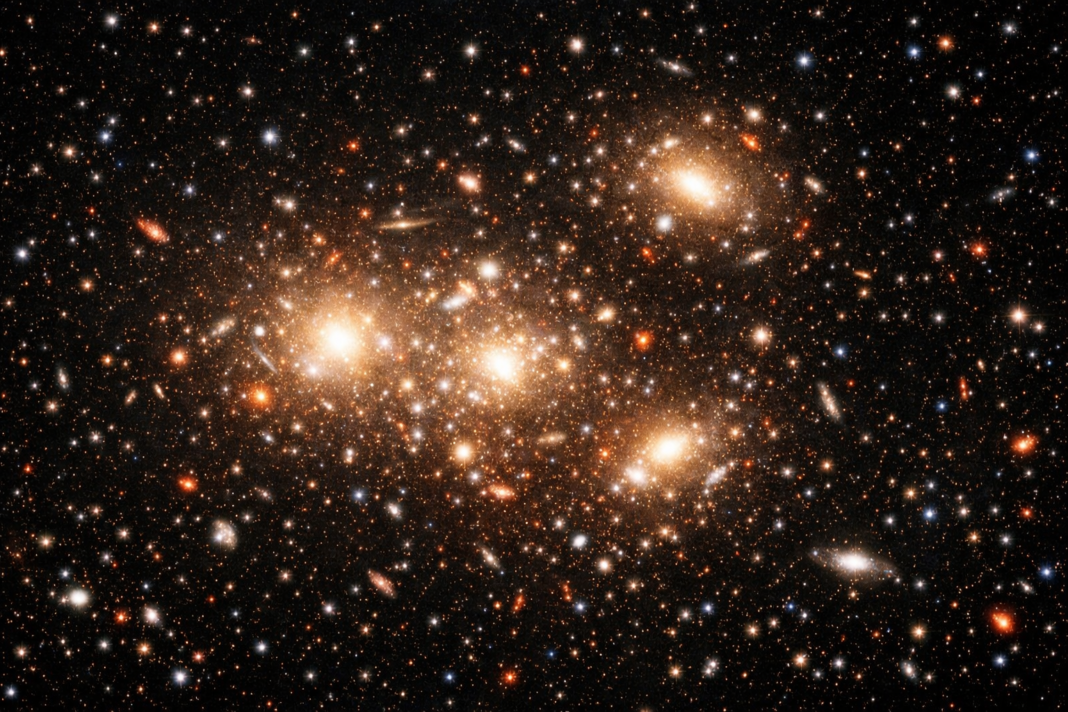

New JWST findings show that observations by the James Webb Space Telescope reveal a substantial population of faint, low-mass stars embedded in massive galaxies that formed within the first billion years after the Big Bang. Accounting for this dim component increases stellar mass estimates for some systems by roughly three to four times compared with earlier calculations based mainly on brighter, short-lived stars. The revision deepens the challenge of explaining how such large, apparently evolved galaxies existed so early in cosmic history.
The apparent discrepancy stems from sensitivity: the telescope’s infrared capabilities can detect redder light and aggregate emission from numerous faint sources that previous instruments missed. When these low-mass stars are included, the integrated light and inferred stellar-mass functions of early galaxies change substantially. Past surveys that relied on the most luminous stars likely undercounted the total stellar content, biasing mass and star-formation estimates toward lower values.
The consequence extends beyond bookkeeping. If many early galaxies are significantly more massive than thought, theoretical models of galaxy assembly, star-formation efficiency and dark-matter halo growth may need adjustment to account for faster or more efficient accumulation of stellar mass. The discovery also carries implications for planet formation: a larger population of low-mass stars in the young universe would increase the number of stellar systems around which planets could have formed, altering estimates of early planetary abundance.
Researchers note that confirming the new picture requires expanded surveys and spectroscopic follow-up to characterize the stellar populations and ages more precisely. Ongoing and planned JWST programs will target larger samples and provide the spectral data needed to refine mass measurements. The finding will prompt both observational campaigns and theoretical work in astronomy to reconcile models of early galaxy growth with the updated census of faint stars.






