
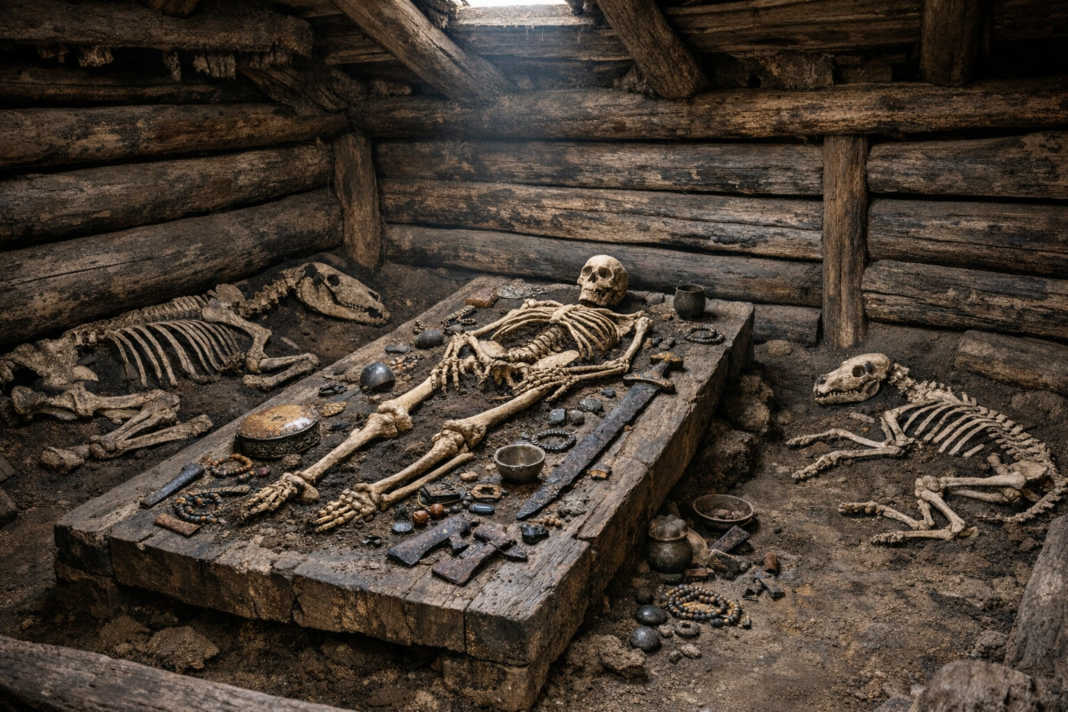

Rare 10th-century chamber tomb unearthed this summer in the Gnezdilovo cemetery near Suzdal contained the skeleton of an adult man interred with the remains of a horse and a dog. The burial, found about one metre below the surface, was built as a wooden chamber and dates to the 10th century, offering an unusually complete example of an elite tomb from the early medieval period of eastern Europe.
A translated statement by the Institute of Archaeology of the Russian Academy of Sciences describes the chamber as measuring roughly 3.1 by 2.7 metres with a collapsed wooden roof. Excavators recovered the skeleton of a man aged about 25–35, alongside horse and dog bones and a set of grave goods that included an iron knife, stirrups, riding equipment, a bone comb and a battle axe. A silver, horseshoe-shaped brooch lay near the neck of the deceased, signalling the occupant’s high status within his community.
Chamber burials of this construction are rare in the region: the Institute notes only about 80 comparable graves are known across western Russia. The find sits within the wider historical context of the Kievan Rus’ polity, where burial customs and material culture show interactions among Baltic, eastern Slavic and Norse groups. Evidence that chamber interment styles were adopted from Scandinavia helps explain parallels between burials in urban centres and this newly revealed site in the northeastern territories of the Rus’. The discovery therefore adds a data point to studies of elite identity and cultural exchange in the 10th century.
The summer field campaign at Gnezdilovo produced 15 burials in total. Most were simpler inhumations dug into the ground, some covered with barrows; female graves yielded silver rings and necklaces with rock-crystal beads, while male graves frequently contained weapons and riding gear. The presence of a wooden chamber among otherwise modest graves highlights a social and spatial complexity at the cemetery that had not been fully recognised before.
Beyond enriching the catalogue of medieval burials in the region, the chamber tomb at Gnezdilovo contributes material evidence for the geographic reach of elite funerary practices. By situating a richly furnished tomb outside previously known urban centres, the discovery prompts a reassessment of the political and military networks of the early Rus’ era and provides new targets for future archaeological research.






