
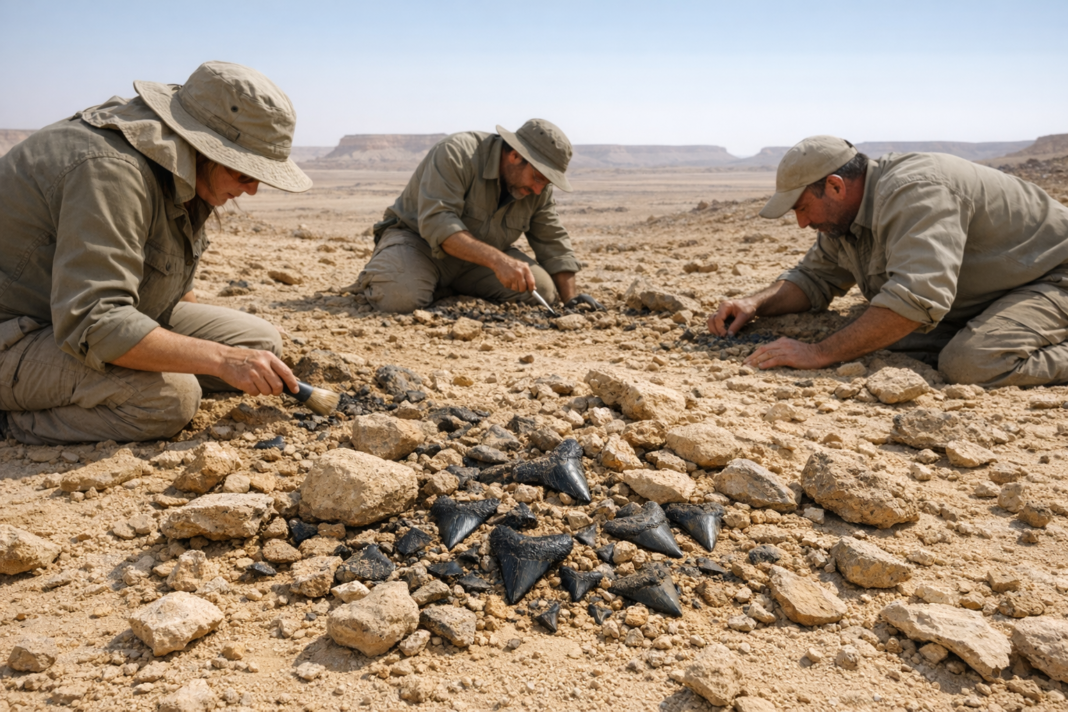

Ancient shark graveyard unearthed in the central Egypt desert has supplied scientists with fossilized teeth from seven distinct shark species, deepening understanding of the region’s marine past. Field teams working on the Abu-Tartur Plateau recovered the remains during expeditions between 2020 and 2022; those finds included 14 teeth collected on recent trips in addition to earlier discoveries. The study identifying the assemblage lists Tarek Yassin, a paleontologist at Cairo University, among the lead researchers.
The fossils come from rock layers of the Duwi Formation, a Late Cretaceous period unit that extends beneath Egypt’s Eastern and Western deserts and is known for phosphate-rich deposits. Previous work in the formation has yielded remains of fish, sea turtles and marine reptiles, and the sedimentary context is consistent with deposition in shallow marine environments. Global reconstructions for the Cretaceous indicate warmer climates and substantially higher sea levels; the Natural History Museum in London notes sea levels could have been many tens of metres above present-day levels, allowing shallow seas to cover areas that are now arid.
The tooth assemblage includes representatives of taxa not previously documented in the region. Among them is Scapanorhynchus raphiodon, an ancient relative of modern goblin sharks not formerly reported from Africa, while fossils attributable to Serratolamna serrata and Squalicorax bassanii mark first records for Egypt. Researchers interpret the mix of species as evidence of a productive, nutrient-rich ecosystem capable of supporting multiple predatory sharks, though they caution the remains may represent a time-averaged accumulation rather than a single contemporaneous community. The full research account was published on Aug. 18 in Cretaceous Research.
Investigators say the discovery expands the known paleogeographic range of several shark lineages and underscores significant environmental change since the Late Cretaceous. Ongoing and planned fieldwork on the plateau and adjacent areas aims to map the distribution of fossils within the phosphate-bearing strata and to place the shark remains in a broader ecological and stratigraphic framework, with the team expecting further material to emerge as excavations continue.






