
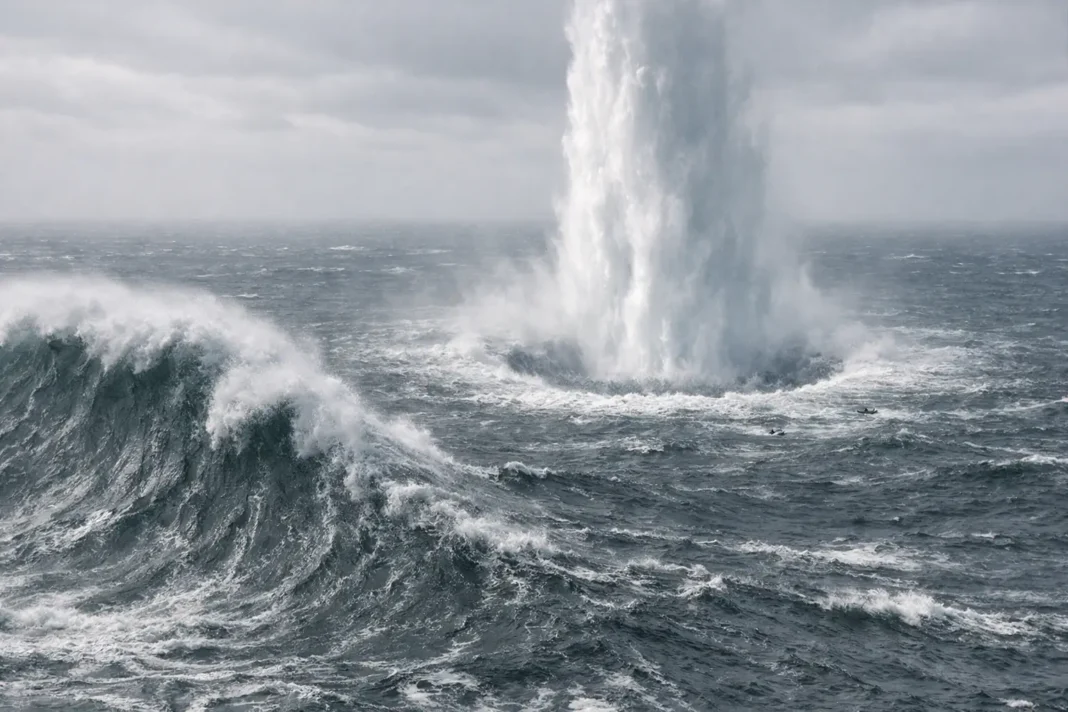

New research confirms that the Silverpit Crater, buried some 700 metres beneath the seabed of the North Sea, was created by an asteroid impact roughly 43 to 46 million years ago. The study reconstructs a violent collision by a body about 160 metres across that produced an extraordinary plume of rock and seawater rising about 1.5 kilometres and set off a tsunami that exceeded 100 metres in height.
The finding resolves a decades-long question about the origin of the circular feature, which was not obvious from surface observations because it lies beneath thick sediment. The reconstructed scenario places the event in the mid-Eocene and shows that a relatively modest-sized impactor — far smaller than the bodies linked to mass extinctions — can still produce extreme local effects, including massive water ejection and very large tsunami waves in the immediate vicinity of the strike.
Beyond solving a regional geological mystery, the result carries implications for how scientists read the ancient record preserved beneath continental shelves. Identifying an impact origin for this buried structure helps to explain anomalous sedimentary signatures and provides a calibrated example of how impact-generated tsunamis and ejecta are recorded in deep-sea deposits. That information can refine models used to interpret other enigmatic features in marine basins and to reconstruct past environments after sudden catastrophic events.
Because the crater is concealed under hundreds of metres of sediment, its discovery and reinterpretation underline the value of subsurface geophysical data and targeted sampling in revealing Earth’s hidden history. The confirmation of this impact adds a precisely dated event to the catalogue of terrestrial collisions, improving the picture of how impacts of different sizes have shaped the planet’s geological and coastal environments over millions of years.






