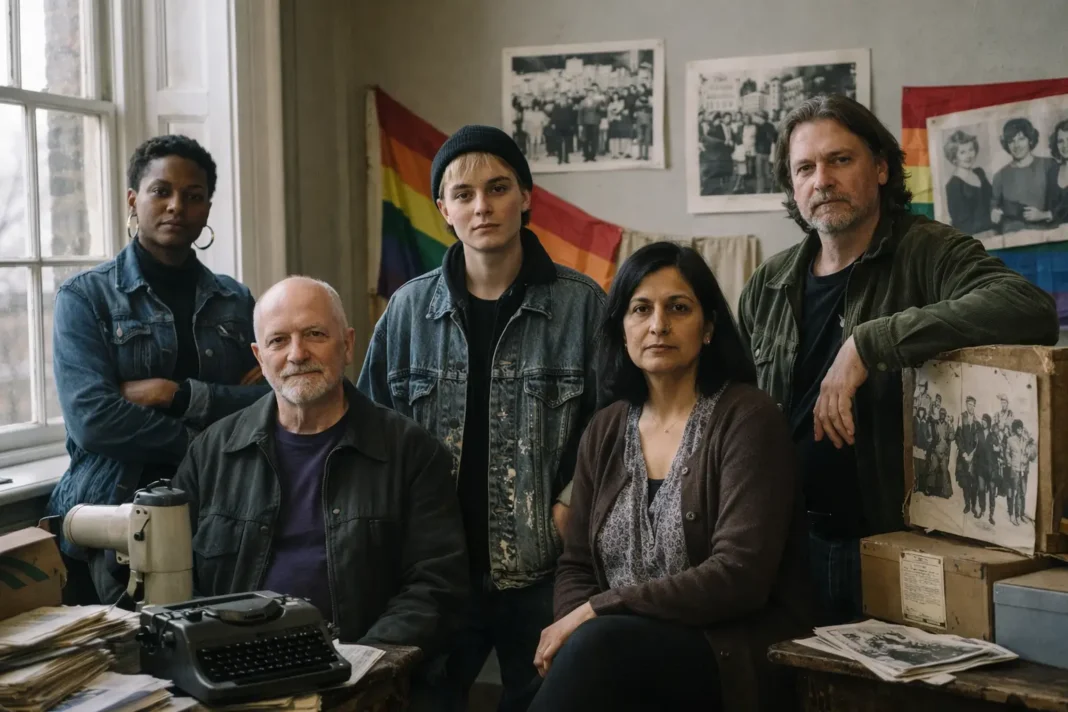

Fashion photographer Tim Walker has spent decades shaping visual culture through images of global stars, and his latest work turns that gaze toward a different cast of subjects. Best known for shoots with Madonna, Rihanna, Kate Moss and Frank Ocean, he now concentrates on activists, artists, writers, models and ordinary people who have sustained queer life. The series is framed as a kind of photographic tapestry that seeks to make visible connections between public figures and the quieter networks that have carried community memory.
The project began with an encounter in north London. While walking near Highbury Fields, Walker noticed a plaque marking the site where, in 1970, Louis Eakes was arrested for importuning. The plaque also records that the local demonstration organised that year by the Gay Liberation Front is widely regarded as one of the earliest public protests for gay rights in Britain. The arrest and the subsequent march fell on 27 November 1970 — a date that resonated with Walker personally because it is his birthday — and prompted his question about who had taken to the streets that day and where they are now.
From that starting point, Walker assembled portraits and scenes that emphasise continuity rather than spectacle: photographs of campaigners who organised in the margins, of creative figures whose work shaped culture, and of people whose daily lives kept communities alive. The series intentionally foregrounds personal histories alongside public moments, suggesting how activism and art have intertwined in the slow work of social change. By documenting a range of subjects, Walker aims to trace a living line between past demonstrations and present visibility across Britain.
Presented through richly composed images rather than historical argument, the work offers a visual archive that invites further research and recognition. It highlights the role of ordinary individuals in sustaining movements that later achieved legal and cultural shifts, and points to the importance of remembering protest as part of cultural history. For readers and viewers, the series functions as both a corrective to selective histories and a prompt for renewed attention to the people whose efforts underpin contemporary queer life in photography and public memory.