
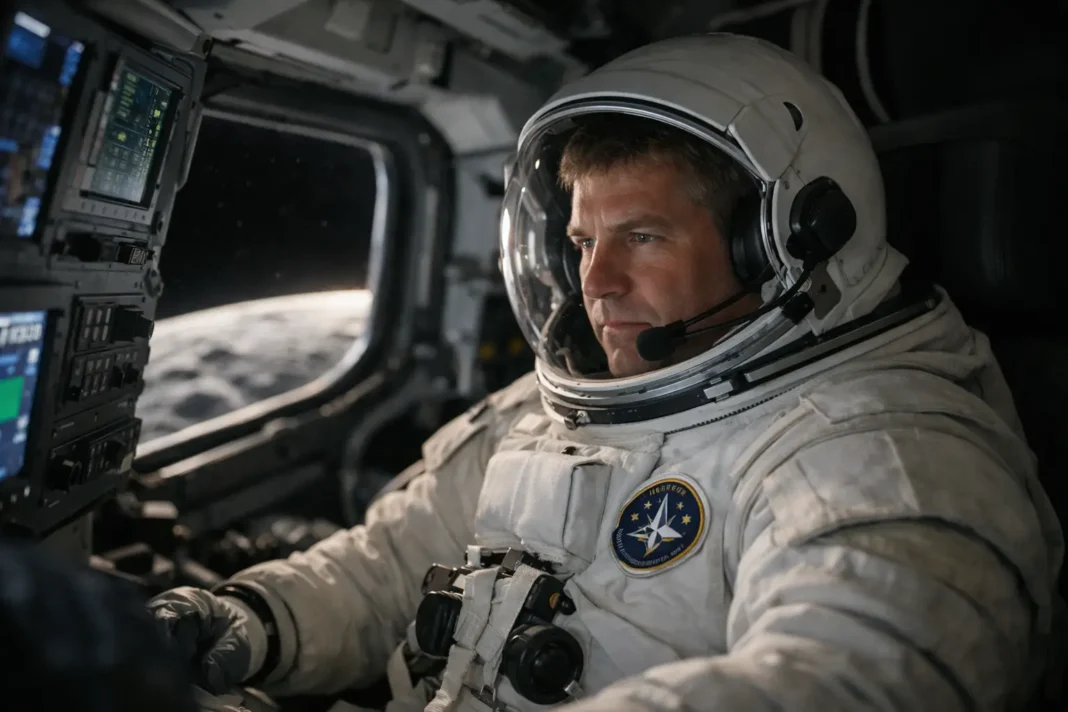

A terrifying moment unfolded for Reid Wiseman during the crewed flyby of the Artemis II mission when an onboard odometer continued to register increasing distance after the planned turn‑back point. Speaking at the Starmus VIII festival in Tenerife, the mission commander described the instant he believed the spacecraft had passed the maximum safe distance — a realization that briefly convinced him the crew might not return to Earth.
The spacecraft reached and then exceeded the mission control limit of 219,667 nautical miles from Earth, a figure that marked the planned furthest separation on day six of the nearly ten‑day voyage around the moon. Wiseman watched the readout climb past the expected peak — to 219,668 and then 219,669 — and said that when the counter kept rising he experienced genuine fear that the capsule had gone too far to reverse course.
During that interval, fellow crewmembers Victor Glover and Christina Koch were carrying out observational science at the windows of the Orion capsule while Jeremy Hansen relayed routine reports to flight controllers. After a tense few minutes the distance began to fall and the odometer rolled back, prompting a wave of relief aboard the vehicle. The crew later celebrated the return trajectory and the mission’s successful conclusion.
Wiseman credited the success to the expertise and procedures of the Earth‑based teams, praising NASA flight controllers and engineers for the engineering and operational work that guided the first crewed Orion flight. Launched from the Kennedy Space Center on April 1, the mission marked the first human trip to the lunar vicinity since Apollo 17 in 1972 and was widely livestreamed, drawing significant public attention. At Starmus the crewmembers received the Stephen Hawking Medal for Science Communication in recognition of the mission’s outreach and the visibility of their activities.






