
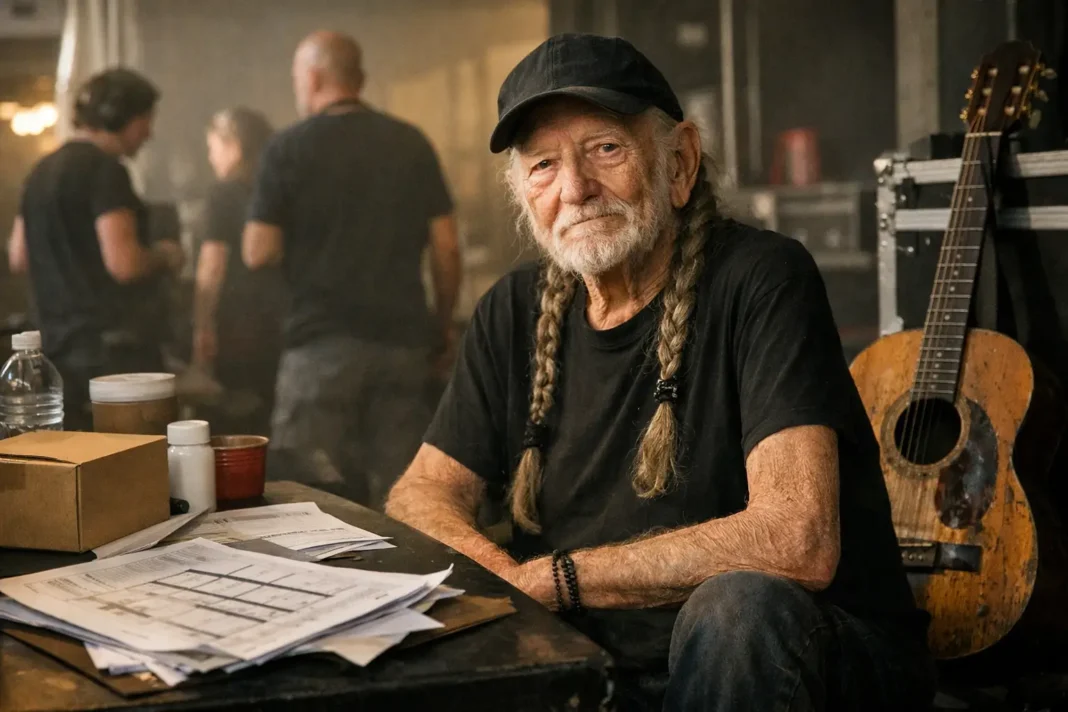

Willie Nelson’s public story now carries an unusual tension: the episodes that built his legend are precisely the ones he prefers not to revisit. At 93, the country musician is still presented less as a monument than as a working artist, with attention directed toward concerts and his cannabis brand, Willie’s Reserve. That forward-looking stance is striking for a performer whose name is inseparable from decades of country music history.
The scale of Willie Nelson’s career makes that refusal to dwell on yesterday difficult to maintain. He has recorded more than 150 albums, helped form the Highwaymen with Kris Kristofferson, Johnny Cash and Waylon Jennings, and wrote “On the Road Again” on an airplane sick bag. Such details are not decorative footnotes: they explain why Nelson occupies a rare position in American music, at once a prolific songwriter, a touring figure and a symbol of artistic independence.
His biography also includes episodes that have become part of a broader cultural mythology. Nelson paid off a $32 million tax bill through the double album “The IRS Tapes,” co-founded Farm Aid with Neil Young and John Mellencamp, and has been linked to stories involving poker, police and parking-lot disorder. The temptation is to treat those anecdotes as the whole man. His present-day emphasis suggests the opposite: the work remains central.
That distinction matters because longevity in popular music is often measured by nostalgia. Nelson’s case is different. His representatives have made clear that the conversation around him is meant to focus on what comes next: live performance and his business interests. The approach aligns with a career built on motion, travel and reinvention, rather than on the preservation of a fixed image. For an artist who has openly acknowledged excess in drink, smoking and pills, continued productivity has become one of the most significant facts of all.
Nelson’s endurance also reflects the lasting reach of the music he helped shape. His audience now spans listeners who first encountered him through classic recordings and others who know him through collaborations, activism or the cultural shorthand of the road. At 93, Willie Nelson remains a rare figure: not merely a subject for retrospectives, but an active participant in the continuing story of American music.





