
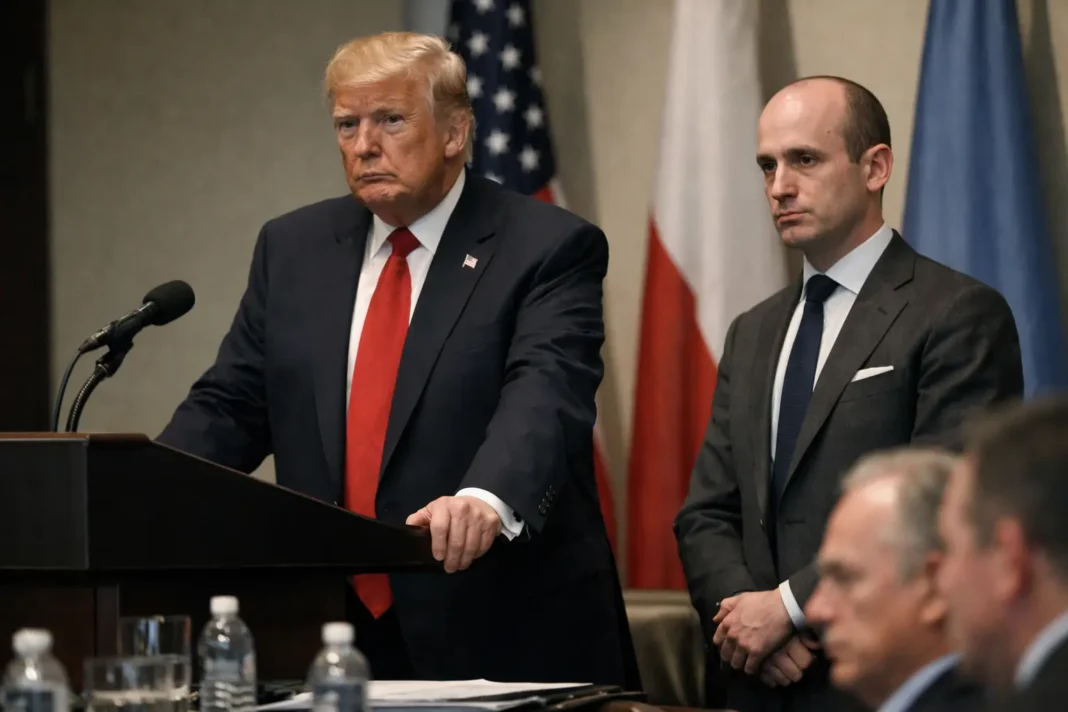

Donald Trump’s decision to appoint Stephen Miller as chief of staff places one of the most polarizing figures of his political movement at the center of power inside the White House. Coming after severe midterm losses, the move indicates that the president is not seeking a softer course or a broader governing tone, but is instead elevating an aide closely associated with the administration’s most confrontational instincts.
The chief of staff is not a symbolic post. The role shapes access to the president, controls the flow of decisions and often determines which priorities receive immediate attention. By choosing Miller, Trump gives operational authority to an adviser whose influence has long been tied to restrictive immigration policies and combative messaging. The appointment therefore carries weight beyond personnel management: it suggests the political response to defeat will be discipline around a hardline identity rather than recalibration.
The timing is central to the significance of the decision. Midterm elections are commonly read in Washington as a referendum on the party in power, and major losses often prompt administrations to make visible adjustments. Some presidents use such moments to widen their coalition or bring in figures seen as bridge-builders. Trump has chosen a different signal. His selection reinforces continuity with the faction of his team that views confrontation as a governing method and political loyalty as an essential qualification.
For Republicans, the decision may sharpen an internal debate already exposed by the midterm result: whether the party’s future lies in intensifying its alignment with Trump or in limiting the political costs of his most divisive positions. For Democrats, the elevation of Miller offers a clear target in future fights over United States policy, particularly on immigration, executive authority and the tone of federal governance. The appointment is likely to make compromise more difficult in areas where language and enforcement priorities already carry high political voltage.
The move also clarifies the president’s priorities at a moment when governing strategy and electoral strategy are closely linked. Rather than distancing himself from the figures most identified with his administration’s controversial record, Trump has brought one of them closer. In practical terms, the appointment consolidates decision-making around a trusted loyalist. Politically, it signals that the response to defeat will be defiance, not moderation, as the administration prepares for the next phase of its confrontation with Congress and public opinion.






