
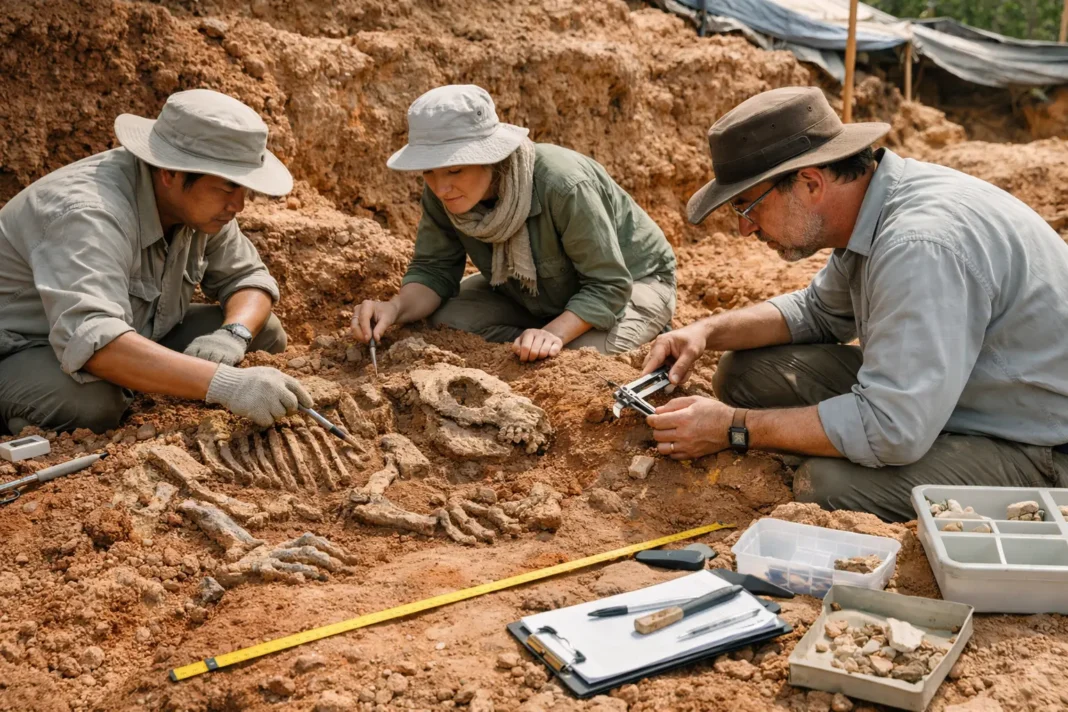

Fossils found in Thailand have revealed a giant ancient rodent that lived around 34 million years ago, offering scientists new evidence about how early some mammals reached remarkable body sizes. The species, named Yakamys sirindhornae, is estimated to have weighed about 66 pounds, making it far heavier than other known rodents from the same period. The discovery places large-bodied rodents deeper in the fossil record than researchers had previously recognized.
The animal lived in what is now Thailand, a region whose fossil deposits continue to add important details to the history of Asian mammals. While the available evidence does not provide a complete picture of its appearance or behavior, the estimated weight alone makes Yakamys sirindhornae a notable addition to paleontology. At roughly twice the size of other rodents known from its time, it challenges assumptions about when gigantism emerged within the wider rodent lineage.
Body size is a key clue in the study of extinct animals because it can reflect broader evolutionary pressures, including access to food, competition and ecological opportunity. In this case, the fossils indicate that rodents were already experimenting with much larger forms 34 million years ago. That timing matters because it pushes back the appearance of very large rodents, suggesting that diversification within the group was more advanced than previously thought at that stage of mammalian evolution.
The naming of Yakamys sirindhornae also underscores the importance of fossil discoveries outside the best-known research regions. Finds from Southeast Asia can help rebalance the global record of ancient mammals, which is often shaped by where fossil-bearing rocks have been studied most intensively. Each well-described species adds a point of comparison for scientists reconstructing how mammals spread, adapted and changed after earlier geological transitions.
For researchers, the significance of the discovery lies less in the animal’s size alone than in what that size reveals about evolutionary timing. A 66-pound rodent from 34 million years ago shows that extreme body mass was not a late development confined to more recent members of the group. Instead, the fossil record now indicates that the path toward giant rodents began earlier, adding a new chapter to the history of fossils and mammal evolution in Asia.






