
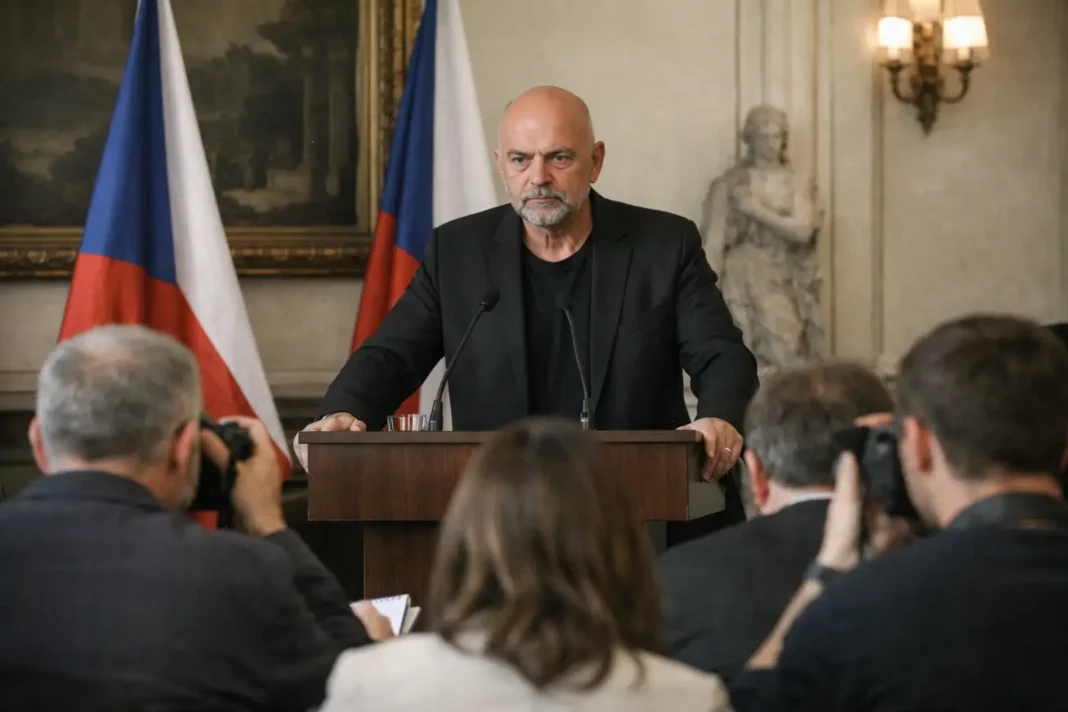

The Czech government is facing renewed scrutiny over press freedom after the rise of Oto Klempíř, a former frontman of the Czech funk-rock band JAR, to the post of culture minister. His move from the stage into national politics has become a symbol of a wider dispute over cultural policy, public debate and the space allowed for critical media in Czechia.
Klempíř was removed from JAR after he declared his intention to run for parliament with Motorists for Themselves, a populist, nationalist and climate-sceptic party. He now holds a senior role in the Czech government led by Andrej Babiš. The appointment has given political weight to a cultural programme that places media, artistic institutions and public broadcasters at the centre of a broader confrontation over national identity and dissent.
The controversy matters beyond one ministerial career. Culture ministries in European democracies often oversee funding channels, public institutions and policy frameworks that influence artistic independence and the resilience of journalism. In this case, concerns are focused on whether government pressure could narrow the space for critical voices. The debate also reflects a wider pattern in Central Europe, where political battles over broadcasters, cultural bodies and independent outlets have repeatedly become tests of democratic safeguards.
Andrej Babiš has returned to power with a coalition that has placed cultural conflict high on the political agenda. The presence of Motorists for Themselves in that landscape has sharpened attention on the language and priorities entering government. For journalists and civil society groups, the key issue is whether new policies will preserve institutional autonomy or create mechanisms that reward political alignment and punish criticism.
The case of Oto Klempíř illustrates how quickly cultural disputes can become questions of governance. A musician’s political break with his band has led to a ministerial role with consequences for public life. The test for the Czech administration will be whether its cultural agenda remains compatible with media pluralism, artistic freedom and accountable democratic institutions.






