HomeCultureRoman Scotland Unearthed Through Altars, Bathhouses and Everyday Objects

Roman Scotland Unearthed Through Altars, Bathhouses and Everyday Objects

A buried pair of sandstone altars has become one of the most striking clues to the Roman presence in Scotland. Found in 2010 during work to rebuild a cricket pavilion in Inveresk, near Edinburgh, the objects had been laid on their sides and deliberately concealed in antiquity. Their survival offers a rare view of a community where military power, imported beliefs and local materials met on the northern edge of the Roman world.

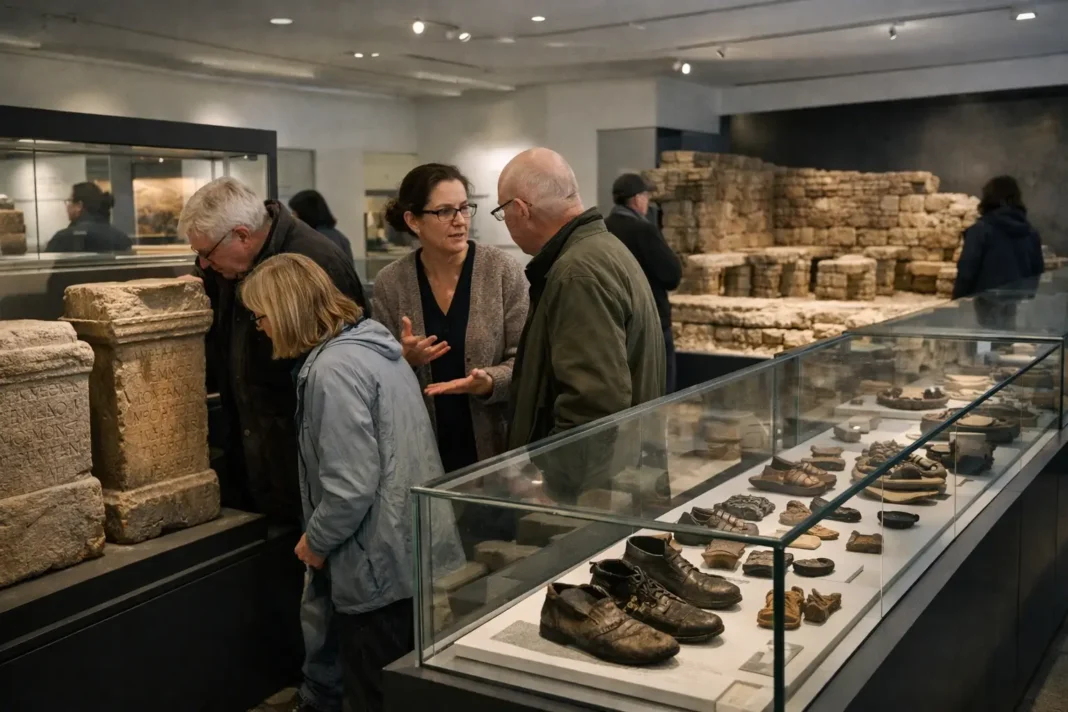
The altars were carved from sandstone quarried nearby and date to the 140s CE. They were dedicated to Mithras and Sol, the sun god, and formed part of a mithraeum, a sanctuary associated with a cult especially popular among Roman soldiers. Mithraic worship involved secrecy and initiation, making physical evidence particularly important for understanding how these religious practices travelled with the army. Although fragile, the Inveresk altars are notable for their scale and quality of workmanship.

A new exhibition on Roman Scotland uses such finds to broaden the familiar story of forts and frontiers. It brings together objects linked to daily life and military occupation, from the technology of heated floors and steam-filled bathhouses to leather footwear that has survived across the centuries. Even large quantities of nails, modest as they may seem, help reconstruct the infrastructure of occupation: barracks, workshops, roads and temporary installations required materials in vast numbers.

The setting of the Inveresk discovery adds to its significance. Today the village is known for elegant 18th-century houses, a kirk dated 1805 and its position above the river Esk close to the Firth of Forth. Nothing in its appearance immediately suggests a Roman religious site. The buried altars therefore underline how much of archaeology depends on chance encounters between modern construction and ancient deposits, especially in places where later settlement has obscured earlier activity.

The exhibition presents Roman Scotland not as a distant appendix to imperial history, but as a landscape shaped by contact, movement and adaptation. Imported gods were honoured in local stone; military customs left traces in civilian-looking places; practical objects now carry historical weight. Together, these remains show how the Roman presence in Scotland was both material and cultural, leaving evidence that can still alter the understanding of a seemingly familiar village.


Advertisementspot_imgspot_img

Hot this week

Oligarchic Power Moves From the Margins to the Center of Global Politics

An estimate says 64 national leaders are oligarchs, governing countries that represent about 60% of global GDP.

Bernie Taupin Steps Out From Behind the Songbook

Bernie Taupin discusses anonymity, his Elton John partnership, a new solo album and a life that now includes rodeo culture.

Arteta’s Arsenal Turns to Science as Injury Questions Return

Arsenal’s reported use of NASA expertise puts Mikel Arteta’s injury management under renewed scrutiny amid a demanding football calendar.

Multi-Cancer Blood Tests Set to Reach Selected GP Surgeries

Selected GP surgeries will soon use multi-cancer blood tests to help detect abdominal cancers earlier, including liver, ovarian and pancreatic cancer.

Annie Andrews Breaks a Long Democratic Drought in South Carolina Senate Race

Annie Andrews is projected to defeat Darline Graham, ending an almost three-decade Democratic drought in South Carolina.

NASA’s Swift Observatory Ends a 22-Year Hunt for Cosmic Explosions

NASA’s Swift observatory reentered over Sumatra after 22 years studying gamma-ray bursts, black holes and supernovas.

Cocaine Deaths Signal a New Drug Harm Pattern in England and Wales

Cocaine is now the leading drug linked to deaths in England and Wales, with fatalities nearly quadrupling over a decade.

Markets Prepare for the First Interest Rate Rise in More Than Three Years

Analysts expect rates to rise from 3.75% to 4%, marking the first increase in more than three years and a key policy shift.

UK Signals Time-Limited Talks on Slavery Apology Without Setting a Date

British diplomats seek to show urgency on a slavery apology, promising time-bound talks while no formal timetable has been confirmed.

Vance’s Iran War Critique Exposes a Rare Rift Inside Trump’s Republican Party

JD Vance’s criticism after a Republican election defeat highlights tensions over the Iran war and Trump’s political leadership.

Istanbul turns against Liverpool as Fenerbahce seize the moment

Liverpool's Istanbul visit ended in defeat to Fenerbahce, with Andoni Iraola pointing to cheap, messy goals and Dirk Kuyt celebrating a miracle.

John Frieda, celebrity hairstylist turned global beauty entrepreneur, dies at 75

John Frieda, the celebrity hairstylist who built a global haircare brand after styling stars in the 1960s and 1970s, has died at 75.

Czech Culture Ministry Shift Deepens Press Freedom Concerns

Oto Klempíř’s rise to culture minister has intensified scrutiny of Czechia’s media climate and the Babiš coalition’s cultural agenda.
Advertisementspot_img

Related Articles
