
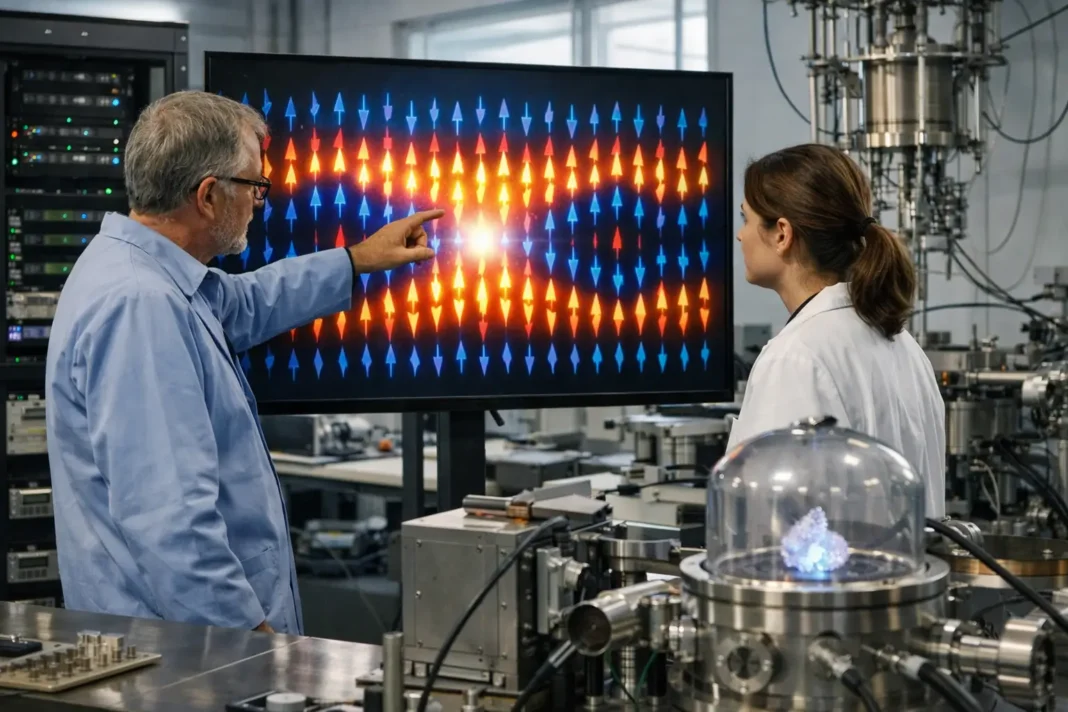

A decades-old map of magnetism has been redrawn. Researchers at SLAC National Accelerator Laboratory have confirmed the existence of altermagnetism, a third form of magnetic order that sits outside the two categories long used to classify magnetic materials. The result provides experimental proof for a phenomenon that could expand the foundations of modern magnetism and open new routes for technologies built around the movement of information at extremely small scales.
For almost 90 years, magnetic behavior was generally divided between ferromagnetism and antiferromagnetism. Ferromagnets, familiar from everyday permanent magnets, produce an external magnetic field because their internal magnetic moments align in the same direction. Antiferromagnets arrange those moments in opposing directions, cancelling the external field and offering stability that is attractive for advanced devices. Altermagnets combine features associated with both groups while displaying a distinct internal pattern, making them neither conventional ferromagnets nor standard antiferromagnets.
The SLAC team used specialized X-rays to detect a magnetic signature that identifies this separate state. That evidence is central because altermagnetism is not defined only by how a material behaves from the outside, but by the way its underlying electronic and magnetic structure is organized. The confirmation gives researchers a clearer experimental basis for studying materials that can remain stable while also carrying information efficiently, a combination that matters for next-generation electronics.
The implications extend beyond a single laboratory result. Today’s computing systems face growing pressure from energy use, heat and the limits of conventional electronic architectures, especially in large-scale data processing. Materials with altermagnetic properties could help address some of those constraints by enabling faster and more efficient ways to process or transmit information. The same physics may also be relevant for research in quantum technology, where controlling magnetic and electronic states with precision is a central challenge.
The discovery does not immediately translate into commercial devices, and further work will be needed to identify suitable materials and integrate them into usable systems. Its importance lies in establishing that altermagnetism is a real and measurable form of magnetic order. By confirming a third category after decades of a two-part framework, the SLAC finding gives scientists a new platform for investigating how matter can store, protect and move information in future computing technologies.







