
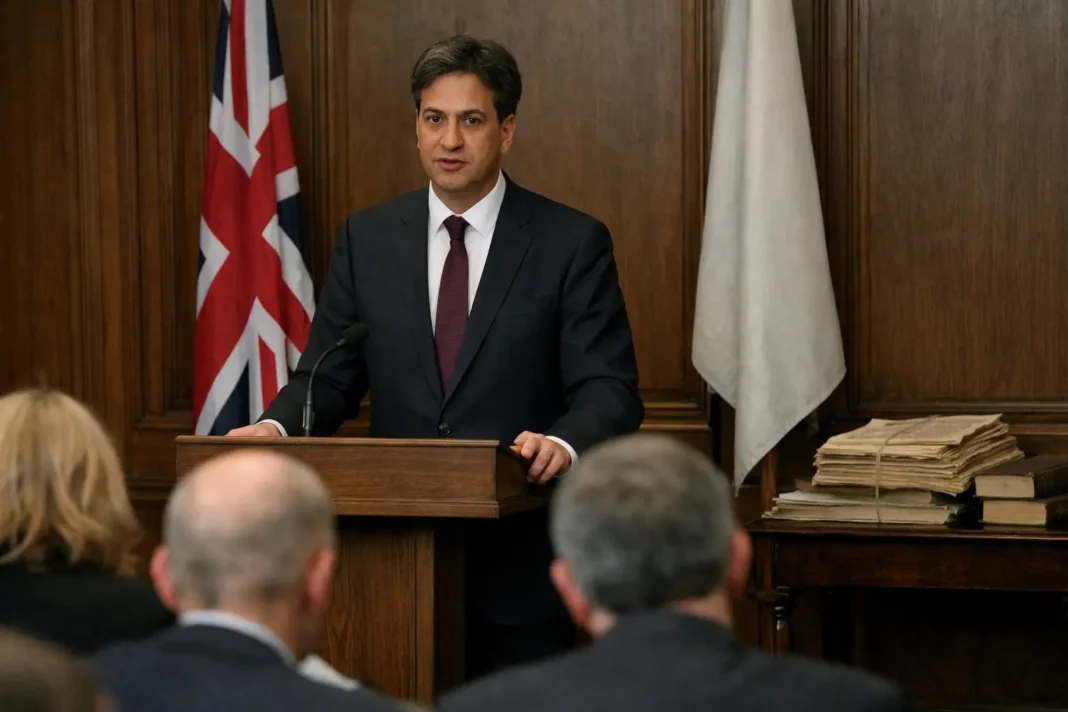

Miliband has sought to separate the question of an apology for Britain’s role in slavery from concerns over public spending, saying such a step would not create a cost for UK taxpayers. Speaking on BBC’s Newscast, the foreign secretary said the country could not treat its history as something to be hidden away, framing acknowledgement as a matter of public honesty rather than a fiscal commitment.
The remarks place Miliband at the centre of a sensitive debate in British politics, where calls for official recognition of the country’s role in slavery and the transatlantic slave trade often intersect with questions over reparations, diplomacy and national memory. His emphasis on taxpayers indicates an attempt to address one of the most politically charged objections raised whenever the subject of a formal apology is discussed.
Britain’s historical involvement in slavery remains a recurring issue in relations with countries whose societies were shaped by the trade and by colonial rule. The discussion has also become part of a wider reassessment of how public institutions, museums, universities and government bodies present the legacy of empire. By saying the past cannot be swept ‘under the carpet’, the foreign secretary signalled that avoidance is no longer a sustainable response for a government seeking credibility on historical accountability.
The Foreign, Commonwealth & Development Office is responsible for managing the UK’s diplomatic relationships, including with Commonwealth and Caribbean partners where the legacy of slavery is a prominent political concern. Any shift in language from the government is therefore watched closely beyond Westminster. The significance of Miliband’s comments lies not in the announcement of a new financial policy, but in drawing a boundary between acknowledgement and an immediate charge on the public purse.
The intervention also reflects the difficulty facing ministers who must address historic injustice while operating in a domestic environment shaped by pressure on public finances. Miliband’s message was that recognition of the past and responsibility toward taxpayers are not necessarily in conflict. For campaigners and governments seeking a broader reckoning, however, the wording of any apology, and what follows it, will remain central to the debate.






