HomeScienceReaders Choose Dogs and Cats as Science Edges Toward Animal Communication

Readers Choose Dogs and Cats as Science Edges Toward Animal Communication

The imagined conversation between humans and animals is moving from fantasy toward a serious scientific question. Recent work by Julie Elie, an ethologist at the University of California, Berkeley, used artificial intelligence and behavioral experiments to interpret vocalizations in zebra finches. The research does not mean people can hold conversations with birds, but it adds momentum to a growing field focused on animal communication and the ways other species use sound, context and behavior to transmit information.

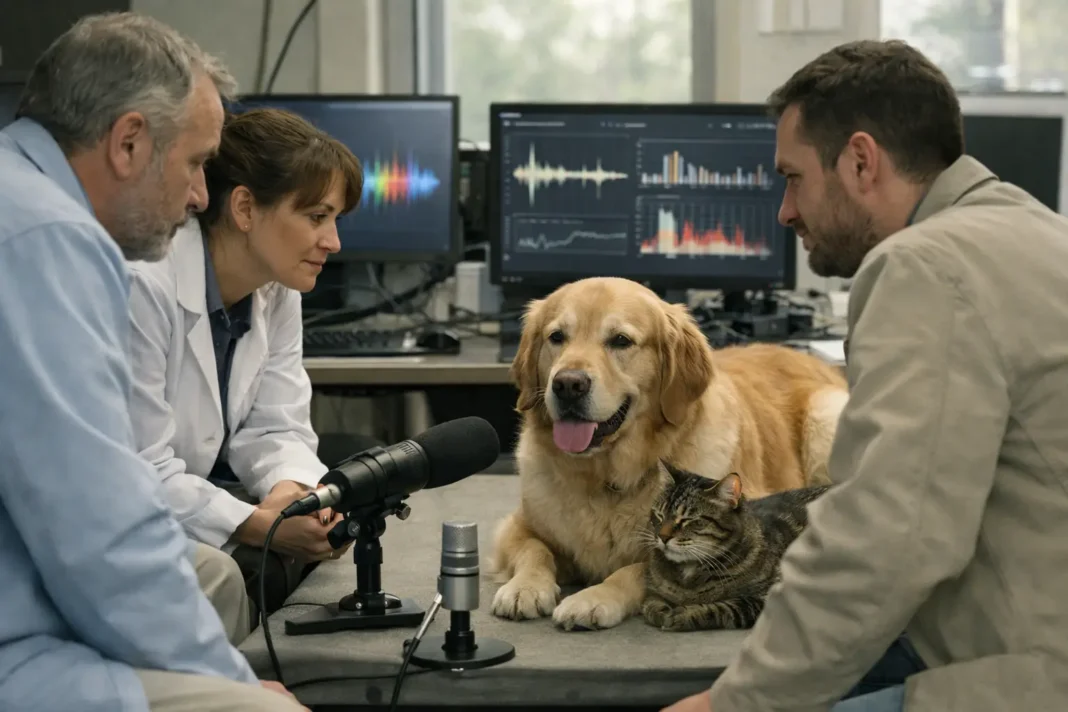
That scientific progress has also revived a familiar public question: if communication were possible, which animal would people most want to understand? In a Live Science reader poll that drew more than 550 votes, household companions dominated the results. Dogs were chosen by 54% of respondents, while cats followed with 28%. The outcome reflects less a ranking of animal intelligence than the closeness of daily life with pets, where owners often interpret gestures, sounds and habits while wondering what remains hidden behind them.

The preference for pets is especially notable because research into animal signals extends well beyond the home. Scientists are studying the clicks and calls of sperm whales and humpback whales, while other work has explored how cats alter their meows depending on whether they seek food, attention or another response from people. In that context, public curiosity and scientific inquiry overlap: both are concerned with whether vocal patterns can be linked reliably to intention, emotional state or social interaction, even when the sensory world of another species is profoundly different from ours.

Reader comments also showed the limits of the idea. Some participants questioned whether translation alone could ever create true understanding, noting that a dog’s experience is shaped heavily by smell and not only by sound. Others looked beyond cats and dogs, with mentions of horses and particular interest in octopuses, animals widely recognized for complex behavior, problem-solving and striking changes in color and pattern. These responses point to a central challenge for researchers: communication is not only a matter of decoding signals, but of interpreting them within the biology and environment of the species producing them.

The poll’s results are not a scientific measure of animal cognition, but they illustrate why this research attracts broad attention. Advances in machine learning may help identify patterns in birdsong, whale calls or pet vocalizations, yet any claim of understanding requires careful behavioral evidence. For now, the strongest conclusion is that humans remain eager to bridge the gap with animals they know best, while science is beginning to clarify how difficult, and how fascinating, that bridge may be.


Advertisementspot_imgspot_img

Hot this week

How Australian Television Turned Local Voices Into Global Hits

Australian shows from Bluey to Colin from Accounts are reaching global viewers, helped by distinctive voices, local humour and streaming habits.

Alzheimer’s Warning Signs May Appear in the Brain Years Before Memory Loss

Johns Hopkins scientists found that two brain regions may shrink years before memory loss, offering clues to Alzheimer’s risk.

Zelensky Presses Washington and Musk Over Starlink Limits as Ukraine Faces Russian Strikes

Ukraine’s president says slower Starlink service hampers efforts to counter Russian attacks, urging the US and Elon Musk to act.

Medical Regulator Faces Scrutiny After Doctor Complaint Summaries Were Sent to Newspaper

The General Medical Council mistakenly sent The Times summaries of complaints alleging antisemitism and Islamophobia against doctors.

Australia and England Meet at Adelaide Oval in Second ODI

England face Australia at Adelaide Oval in the second match of a three-game ODI series, with the scorecard central to the contest.

PTSD Leaves Distinct Epigenetic Signatures in the Brain, Study Finds

A postmortem brain study identifies DNA methylation patterns tied to PTSD, distinct from depression and strongest in the prefrontal cortex.

Next Stops Sales of Baby Sleeping Bag After Mother Flags Safety Risk

Next has stopped selling a baby sleeping bag after a mother warned its large neck opening could cover an infant’s face.

Burnham Sees UK-EU Deal as a Platform for Deeper Cooperation

Andy Burnham says the UK should pursue closer EU ties after a new deal on food exports, emissions trading and youth mobility.

Tech Sell-Off Pulls Wall Street Deeper as AI Pressure Hits Sentiment

US markets fell as technology stocks weakened, pushing the S&P 500 and Dow into correction territory amid pressure on Anthropic shares.

Lauren Price Claims Undisputed Welterweight Crown

Lauren Price defeats Michaela Kotaskova to become undisputed world welterweight champion and strengthen her place in boxing history.

New Hunger Games Cast Steps Into a Franchise Built on High Expectations

The new Hunger Games prequel arrives today, with its cast acknowledging the pressure of entering a major dystopian franchise.

Spain’s Election Puts Europe’s Far-Right Moment Under Scrutiny

Spain’s November vote opens a crowded European election cycle, testing far-right gains and the centre-left’s shrinking map across Europe.

Verstappen Inherits Las Vegas Pole After Antonelli Penalty

Kimi Antonelli topped Las Vegas qualifying, but a five-place penalty moves Max Verstappen to pole ahead of George Russell.
Advertisementspot_img

Related Articles
