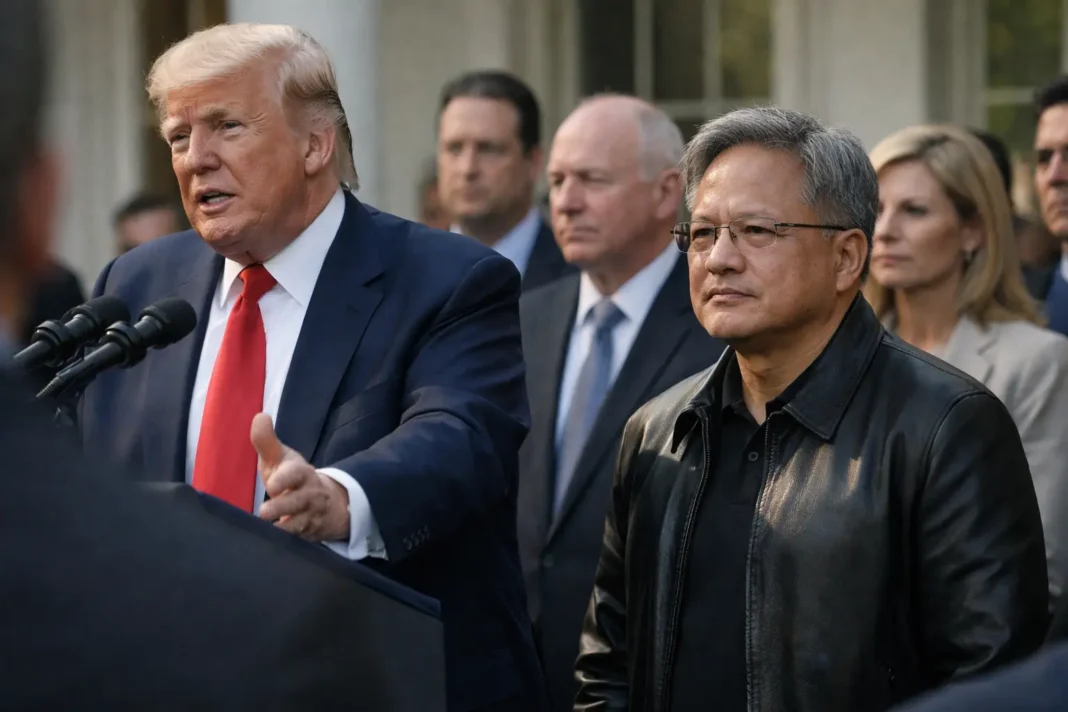

President Donald Trump’s claim that he “convinced” Nvidia to reinstate Jensen Huang has triggered backlash and renewed attention on the boundaries between political influence and corporate decision-making. The remark places one of the world’s most closely watched technology companies at the centre of a governance debate, after Huang’s comeback was linked to a rise of $1tn in the company’s stock market value.
The episode is significant because Nvidia is not an ordinary market player. Its chips have become central to the expansion of artificial intelligence, data centres and high-performance computing, giving the company strategic relevance far beyond the technology sector. Any suggestion that a sitting president pressed a boardroom decision at such a company inevitably raises questions about the independence of directors, the role of shareholders and the limits of political involvement in private enterprise.
Jensen Huang remains one of the most recognisable figures in the global semiconductor industry, and his leadership has been closely associated with Nvidia’s rise. The reported market impact of his return, adding $1tn to the company’s value, underscores how strongly investors can respond to leadership signals at major technology firms. It also highlights the degree to which executive appointments at companies tied to advanced computing can influence broader market sentiment.
The backlash to Donald Trump’s statement reflects a wider concern over corporate governance at strategically important companies. Boards are expected to make leadership decisions in the interests of the company and its shareholders, while governments often focus on industrial capacity, national competitiveness and technological leadership. When those priorities appear to overlap, the distinction between public policy and private management can become politically sensitive.
For Nvidia, the immediate attention is not only on Huang’s role but also on the precedent suggested by Trump’s comments. In a sector where regulation, export controls, public procurement and national security considerations already shape business conditions, perceptions of political pressure carry consequences. The controversy adds another layer to the scrutiny surrounding companies whose technologies now sit at the centre of economic power and state strategy.