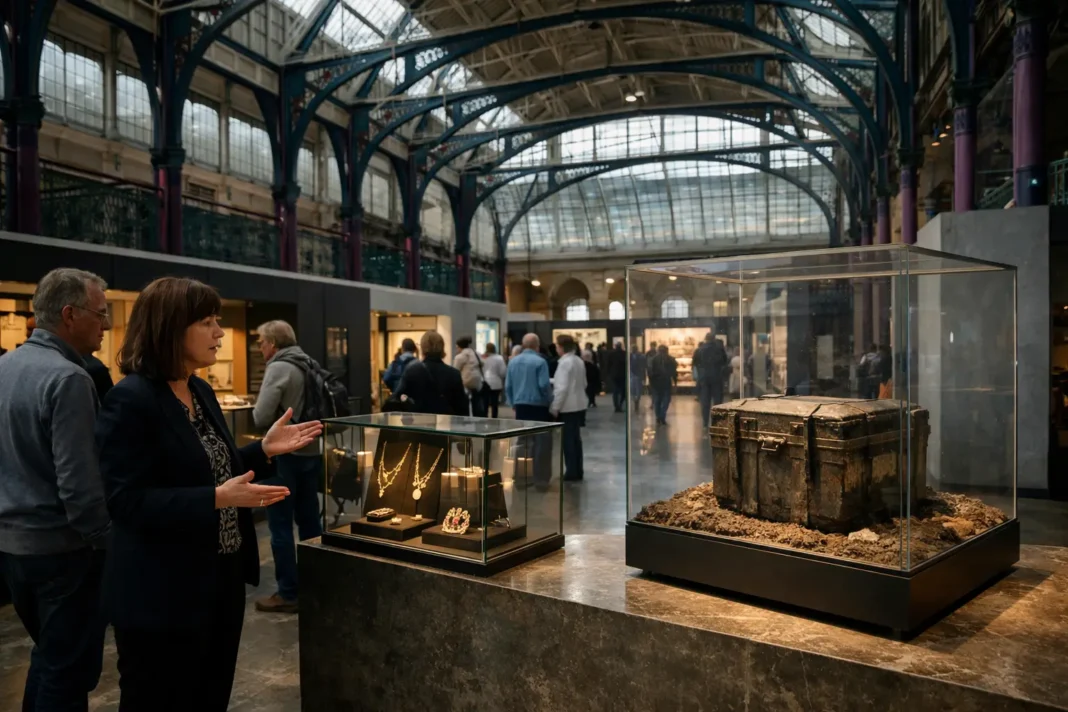

London’s newest museum address is also one of the capital’s most layered historical sites. After a decade-long transformation costing £437m, the London Museum has taken over the former Smithfield general market, turning a Victorian trading complex into a major cultural landmark. The move gives the institution a more prominent setting for telling the story of London, from courtly splendour to urban grime, in buildings long associated with the city’s working life.
The relocation is a significant shift for an institution previously based at a more constrained site in the City. At Smithfield, the museum occupies vast halls and a network of basement vaults that once formed part of London’s meat market district, an area linked to butchery for centuries. The setting is not a neutral container: its ironwork, scale and industrial memory have become part of the visitor experience, connecting the museum’s collections to the streets, trades and infrastructure that shaped the capital.
The new presentation embraces contrast. A roof sign bearing the phrase “All the grit and the glitters” captures the range of material on display, from Tudor jewels to a preserved fragment of fat, waste and rags removed from a Whitechapel sewer. The collection also reaches into everyday and popular culture, including objects connected with tools, music scenes and urban leisure. Even Syd’s, the century-old coffee stall associated with the market, helps anchor the project in lived city history rather than polished nostalgia.
For London’s museums sector, the project underlines the growing importance of adaptive reuse in cultural development. Instead of constructing a purpose-built landmark elsewhere, the museum has revived a complex already embedded in public memory. That choice brings architectural conservation, urban storytelling and visitor access into the same frame. It also places the institution beside the continuing life of Smithfield, making the surrounding district part of the narrative rather than just a backdrop.
The result is designed to broaden what a city museum can show and how it can show it. By placing precious artefacts near evidence of sewers, markets and street culture, the London Museum presents the capital as a place defined by wealth, labour, spectacle and residue. Its new home gives that approach physical weight: a former marketplace, cleaned and reworked, now serving as a public archive of the city that grew around it.